
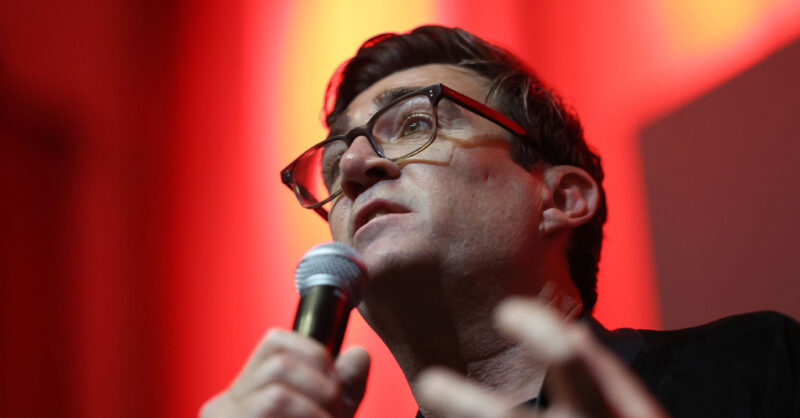
Labour’s National Executive Committee (NEC) did something unfashionable this week. It chose not to feed the drama. Its reported 8-1 decision to block Andy Burnham from standing in the Gorton and Denton by-election was not surprising. It was the NEC performing its role: protecting the collective interests of the Labour Party, not facilitating individual career moves – however senior the individual or impressive his communications.
Let’s start with the bluntest fact. Burnham’s return to Westminster would not trigger one election, but two. A parliamentary by-election followed by a mayoral by-election across Greater Manchester, one of the largest and most complex city-regions in Europe – and before the electoral system switches back to single transferable vote (STV). That means two campaigns, two administrative exercises for regional and local government in the city, two draws on public funds, two draws on political funds and bandwidth, all at a time when the government correctly states that every penny must be focused on relieving pressure on working households. And a winning candidate in the current political climate could be elected on around just 20 per cent of the vote – a dreadful turnout.
It would be hard to explain to voters why they are being asked to foot the bill of well over £4m for a wholly avoidable election caused not by scandal or crisis, but by one politician’s timing and ambition.
Not only would we likely be outspent by Reform, but the costs to the Labour Party would be significant and taken from a limited pot. The party rightly decided that they should be concentrating its money and organisers on holding Wales, winning Scotland and defending hundreds of council seats around the country – not pouring resources into an internal psychodrama.

New year, new read. Save 40% off an annual subscription this January.
But there is politics here too: Burnham has not concealed his desire to return to Westminster. Nor is his interest in the leadership exactly a state secret. Ambition is part of politics. Keir and the party do have to manage ambition – we want tall poppies, but we do not need an arsonist whose intent is to unseat the Prime Minister at the earliest opportunity.
The NEC’s role is to provide strategic direction and management for the party as a whole. That means asking a simple question: does this help us? The high-profile return of the “King of the North” would be framed as the re-entry of a potential leadership contender, mid-term, and would inevitably be interpreted as the opening shot in an internal contest. That may excite Westminster. It definitely excites journalists. It does nothing for the country.
The 2025 rule change requiring combined authority mayors to seek NEC permission before standing for Parliament recognised something: these are not ceremonial roles. They are senior executive mandates. Voters elect mayors to serve, not to treat the office as a holding pattern before re-entering national politics.
Burnham’s reaction to the decision was revealing. “I’m not sure losing a by-election does us any good either,” he wrote in response to a tweet by journalist Tom Baldwin. The subtext was obvious: his candidacy was the safest option.
But politics isn’t about indispensable individuals. Parties are supposed to be bigger than any one figure – including the Prime Minister, whilst we are at it. And even if one momentarily accepted the premise, the argument collapses under its own logic. If Burnham is uniquely placed to win Gorton and Denton, who is uniquely placed to win the Greater Manchester mayoralty he would abandon? That is the contest with far greater consequences. The mayoralty covers 2.8 million people and controls transport, housing, policing oversight and regional economic strategy. It is one of the most visible examples of English devolution working in practice. An open mayoral by-election, fought amid national volatility midterm would be precisely the kind of contest in which surprises happen.
The risk is not theoretical. Reform UK is explicitly targeting low-turnout, anti-establishment contests. Handing them a credible shot at one of England’s major executive offices in order to facilitate a Westminster return would be an extraordinary gamble. Losing a mid-term by-election is a headache. Losing Greater Manchester would be a nightmare.
None of this ends future leadership debates. It simply says: not like this, not now, and not at the cost of one of Labour’s most significant devolved power bases.
And none of this diminishes Burnham’s record. He has been an effective Mayor, and “Manchesterism” – the attempt to forge a coherent political and economic identity across historically fragmented boroughs – is no small achievement.
For those who feel this alone is enough to justify making him prime minister, a word of caution. Founding moments in new institutions, such as those created in Manchester in recent years, always carry structural advantages. Like Ken Livingstone at the birth of the London mayoralty, Burnham has governed at a point when powers, funding and visibility are expanding for the first time. When institutions are being built rather than managed, progress is more visible and political wins can more easily be framed as breakthroughs.
Some Labour MPs – the usual suspects – have complained. But voters did not put their trust into Labour at the last general election to watch internal auditions and psychodrama. With economic fragility, international instability and stretched public services, there is little public appetite for Westminster navel-gazing.
The NEC did not stifle democracy. It’s members – including trade union members on that officers’ committee – fulfilled their roles and put delivering for the country above drama for the party.
[Further reading: If not Burnham, who could defeat Starmer?]
Content from our partners