

Listen to this article
Estimated 5 minutes
The audio version of this article is generated by AI-based technology. Mispronunciations can occur. We are working with our partners to continually review and improve the results.
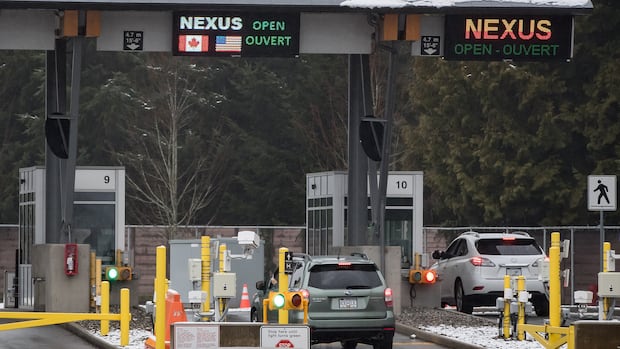
The number of Canadian applications for the Nexus trusted-traveller program has fallen off a cliff since U.S. President Donald Trump returned to the White House last year.
Applications had been steadily increasing following the onset of the COVID-19 pandemic, according to data from the Canada Border Services Agency (CBSA).
But the border agency said that it received half the number of applications — just under 350,000 — in 2025, compared to the previous year when nearly 700,000 travellers applied for a Nexus card.
Nexus is a jointly run program with the U.S. that allows travellers who have undergone extensive background checks to quickly pass through security at border crossings and airports.
The 2025 application numbers show a significant drop even compared to 2022 and 2023. During those two years, there was a massive backlog due to disagreements between the two countries that was only resolved in mid-2023.
More signs Canadians turning away from U.S.
While Americans also make use of the program, a majority of Nexus members are Canadian.
The new applicant numbers are another data point in a growing mountain of evidence that show Canadians are turning away from the U.S. during the second Trump administration.
Statistics Canada said last week that the number of Canadian vehicles that crossed the border into the U.S. and back last year fell by 30.9 per cent compared to 2024.
A U.S. Travel Association report from November forecasts a 3.2 per cent decline in international tourism spending in the country for 2025, a loss of $5.7 billion US compared to the previous year. That report attributes much of the loss to a decline in the number of Canadian visitors.
WATCH | Canadian land travel to U.S. fell more than 30% last year:
Canadian land travel to U.S. dropped 30.9% in 2025, says StatsCan
Statistics Canada says 30.9 per cent fewer Canadian automobiles visited the United States in 2025 compared to 2024. That’s a difference of roughly 7.6 million vehicles — which StatsCan considers a notable decline. CBC’s Dalson Chen reports.
It’s not just travel numbers that show a Canadians are shunning the U.S. A CBC News analysis of trade, shopping and cultural data shows Canadians are taking a big step back from their neighbours to the south.
Political tensions between Canada and the U.S. have been heightened since Trump’s re-election last fall. The U.S. president consistently mocked Canada as the 51st state last winter while slapping tariffs on a number of Canadian goods.
Tensions appeared to ease slightly over the spring and summer as Washington and Ottawa worked to negotiate some tariff relief. But talks blew up in the fall when Trump called the negotiations off, blaming an Ontario government ad that used former president Ronald Reagan’s arguments against tariffs.
In the past week, Trump has taken a more agonistic tone when referring to Prime Minister Mark Carney.
WATCH | Trump’s tone on Canada changes in Davos:
Why Trump just threatened Canada in Davos | About That
U.S. President Donald Trump shot back at Prime Minister Mark Carney’s comments at the World Economic Forum about a new way forward for countries seeking distance from U.S. influence. Andrew Chang breaks down key moments from both leaders’ speeches, highlighting shifts in both Canada’s global strategy and the deteriorating relationship between two longtime allies.
Images provided by The Canadian Press, Reuters and Getty Images
Carney gave a speech at the World Economic Forum that gained international attention and is largely being seen as a rejection of Trump’s foreign policy tactics.
Since then, Trump said Canada “lives because of the United States” and rescinded an invitation for Carney to join his “Board of Peace” initiative.
Over the weekend, Trump for the first time referred to Carney as “governor” — a moniker that he had used with former prime minister Justin Trudeau — while threatening to impose a 100 per cent tariff on all Canadian goods if Ottawa “makes a deal with China.”
Alternative to Nexus?
The drop-off in Nexus applications spurred Sen. Paula Simons to propose a domestic alternative for Canadians who want to quickly move through airport security.
But under the current system, the only way for a member of the general public to become a verified traveller is through the Nexus program. The Alberta senator said it makes sense for Canada to have its own verified traveller program that isn’t reliant on the U.S.
“It is unusual for a country to contract out its airport security fast-pass system to a different sovereign nation. We’ve just sort of been piggybacking on the Nexus process using it as a proxy,” Simons told CBC News.
 Sen. Paula Simons introduced a motion in Parliament last fall that calls for a trusted-traveller program that is separate from Nexus. (Roger Cosman/CBC)
Simons noted that the U.S. has its own verified traveller program, called TSA PreCheck, that is separate from Nexus.
Simons argued that there is also a human rights rationale behind implementing a trusted-traveller program that’s separate from the U.S.
The U.S. has also stopped accepting an “X” gender marker on Nexus applications, instead forcing Canadians to choose either “M” or “F.”
“Requiring Canadians who are trans, non-binary or two-spirit to get a Nexus card to use the good line is clearly discriminatory. It’s clearly a violation of their Charter rights,” Simons said.