
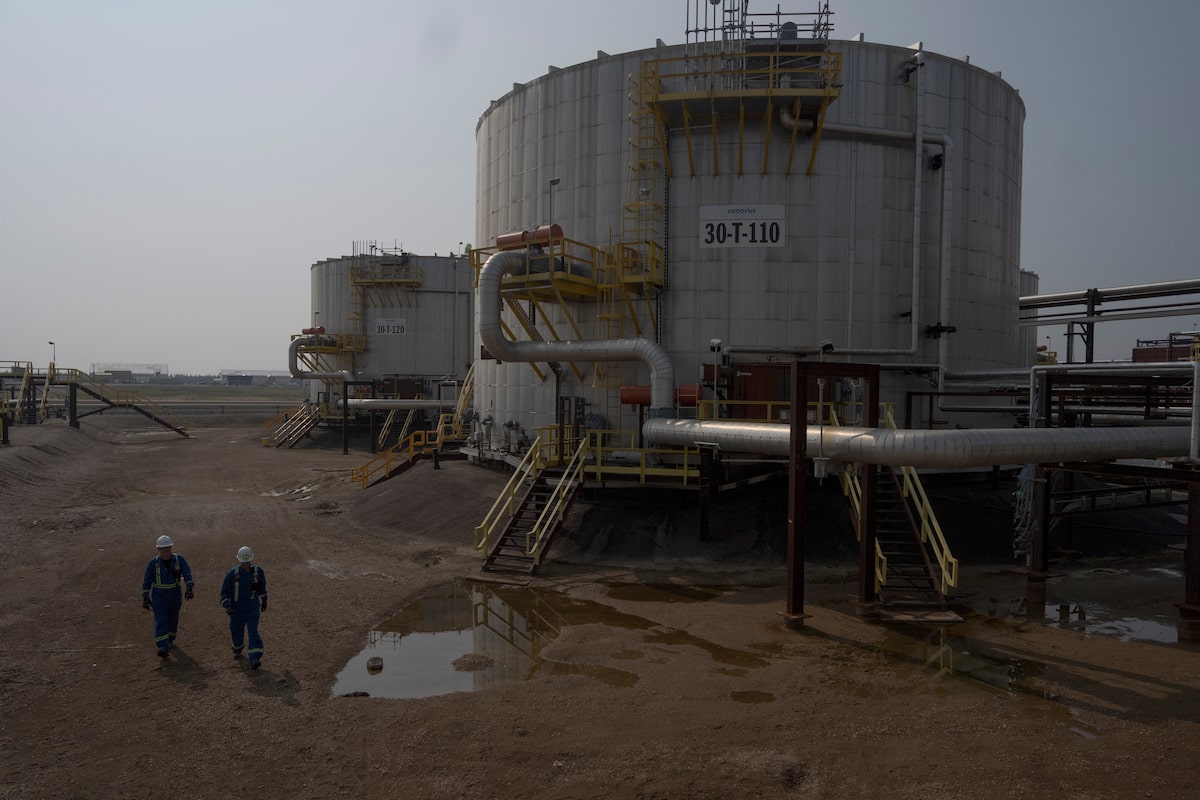
Workers walk by crude oil tanks at Cenovus’ Sunrise oil facility northeast of Fort McMurray, Alberta, in 2023.Victor R. Caivano/The Associated Press
Ottawa’s plan to increase energy exports to India makes sense given how the South Asian country’s massive population and rapid economic growth have boosted its demand for fossil fuels, analysts say.
Energy Minister Tim Hodgson told the India Energy Week conference in Goa on Tuesday that Canada is looking to boost energy exports to India to diversify its customer base and cut dependence on supply to the United States.
Exporting 98 per cent of Canadian energy to the U.S. is a “strategic blunder,” Mr. Hodgson said. “The fastest-growing demand for energy in the world will be in India,” he added.
Susan Bell, senior vice-president of commodity markets at Rystad Energy, said that exporting Canadian fossil fuels to India is “definitely worth pursuing.”
India and EU clinch ‘mother of all deals’ after nearly 20 years of negotiations
The country already has a fairly large refining sector that processes roughly six million barrels a day of crude, and it has plans to grow its petrochemical sector, Ms. Bell said.
“So it’s not just an opportunity for crude oil, it could also be an opportunity for naphtha and potentially even ethane,” she said.
Canada does sell crude to India, but at roughly 150,000 barrels a day, it’s a sliver of the country’s overall export market. The bulk of India’s heavy crude imports come from Iraq, and could reasonably be substituted with Canadian oil, Ms. Bell said.
The Canadian crude that heads to India typically does so via the U.S. Gulf Coast at the rate of about one Very Large Crude Carrier ship a month, said Rory Johnston, an oil analyst with Commodity Context.
Carney likely to visit India in March as Canada makes efforts to diversify trade
A new pipeline to a deepwater port that can handle VLCCs would open up India as a more accessible market from Canadian shores, not just from the U.S. re-export market, he added.
With oil demand from China set to plateau over the next couple of decades, “India always comes up as the next big engine for global oil demand,” Mr. Johnston said.
Daily oil demand in India grew at a much slower rate than expected in 2025, rising by roughly 100,000 barrels, rather than the 300,000 forecast by various agencies. But Mr. Johnston said demand in India is expected to accelerate in 2026.
The country is “absolutely” a strategic market to target, he said, given its growing energy demands and massive population.
Even if Canada’s energy sector wasn’t dealing with damaging American trade policies, he said, “we’ve already saturated the U.S. market.”
Ms. Bell said there is also opportunity for other products such as liquefied natural gas, for which India imports about 5 per cent of the world’s supply.
“China’s market is three times the size of India’s in terms of LNG imports, but India’s market is substantial, and there’s no reason why we can’t participate in that market,” she said.
India has averaged 5.8-per-cent annual GDP growth since 2016, according to a November analysis from Stuart Bergman, chief economist at Export Development Canada.
Opinion: Canada and China have an opportunity to build an energy partnership
Ms. Bell said that while India has gone a long way toward industrializing, “they have a lot more to do.”
“I think it’s a smart market to target.”
Federal government data list India as Canada’s seventh-largest goods and services trade partner, with mineral fuels and oils worth around $767-million, or 14.5 per cent of total merchandise exports.
Dinesh Patnaik, India’s High Commissioner to Canada, said in an interview that there is a “huge field” of opportunity for more trade co-operation between the two countries, including for energy, fertilizer, nuclear and critical minerals.
“We want to tie up with everybody possible – especially countries like Canada – to be able to work out deals together.”
With reports from Steven Chase (in Ottawa) and Reuters