
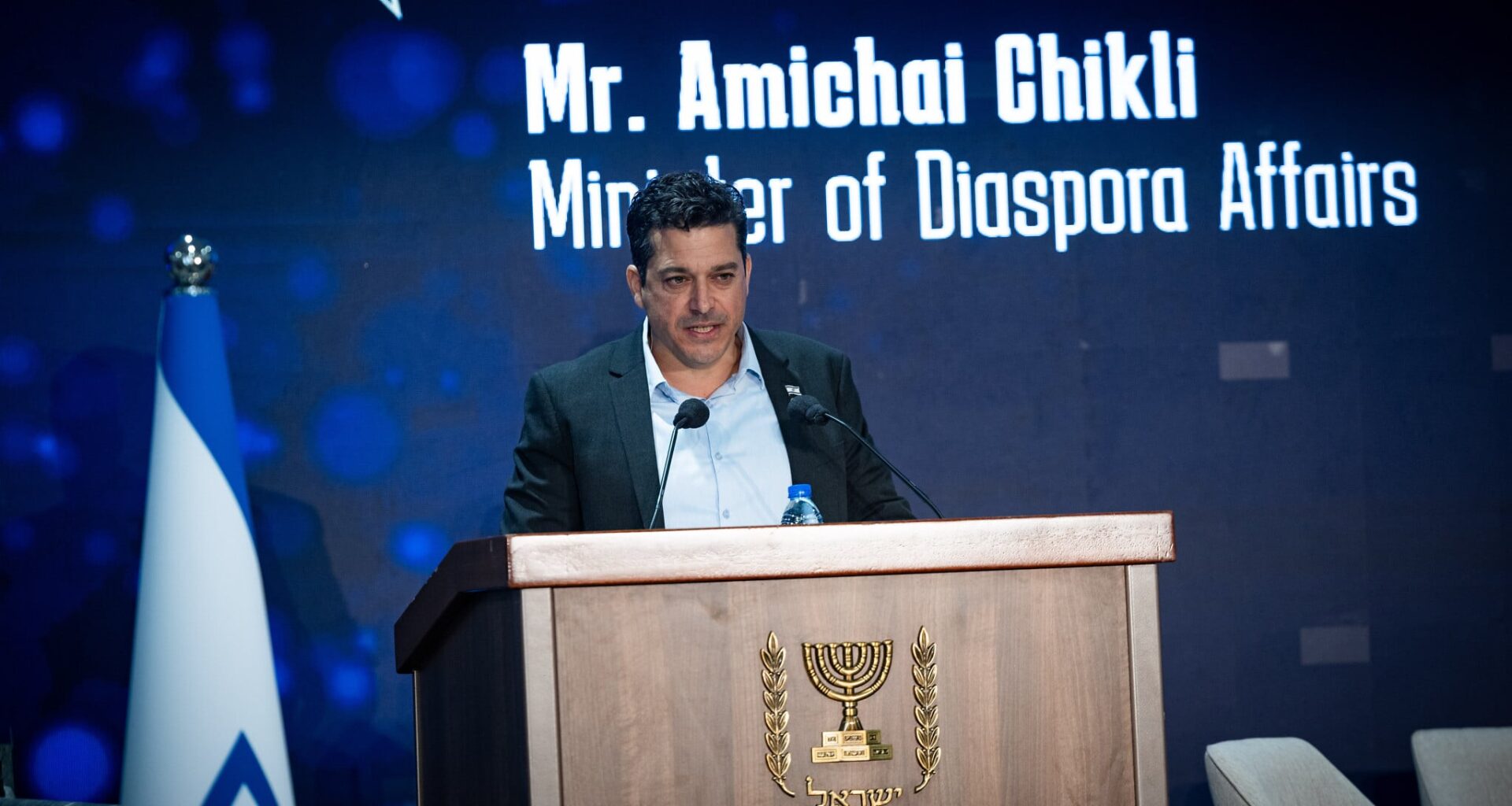
Amichai Chikli is unapologetic about fomenting discord within the Jewish world. To Israel’s controversial Minister for Diaspora Affairs and Combating Antisemitism, disagreement can be positive when it forces people to confront difficult questions and sharpen their beliefs.
But even after countless disagreements with Jewish leaders across the world, the former educator is quite confident that his bold, nationalist vision is rooted in authentic Jewish principles, even if they stand in stark opposition to many of the progressive values embraced by the global Jewish communities he is meant to advocate for in Jerusalem’s halls of power.
His confrontational style and willingness to act as a provocateur have made Chikli one of Israel’s most polarizing cabinet ministers, willing to butt heads with authorities on matters of safety and politics.
Ahead of a divisive international conference on combating antisemitism in Jerusalem this week, organized by his ministry, Chikli spoke with The Times of Israel about why he is prepared to go against the wisdom of Jewish community leaders around the world to develop a coalition with far-right-wing European politicians.
“I’m not trying to undermine the policies of those Jewish organizations,” Chikli said. “We just have a disagreement.”
Get The Times of Israel’s Daily Edition
by email and never miss our top stories
By signing up, you agree to the terms
A contentious conference
It was last March when Chikli’s first conference on fighting antisemitism attracted the international spotlight. After word got out that the confab would include members of several extremist parties associated with racist ideologies and Nazi sympathizers, numerous high-ranking Jewish community leaders, including Anti-Defamation League CEO Jonathan Greenblatt and British Chief Rabbi Ephraim Mirvis, opted to boycott the event to show their disapproval.
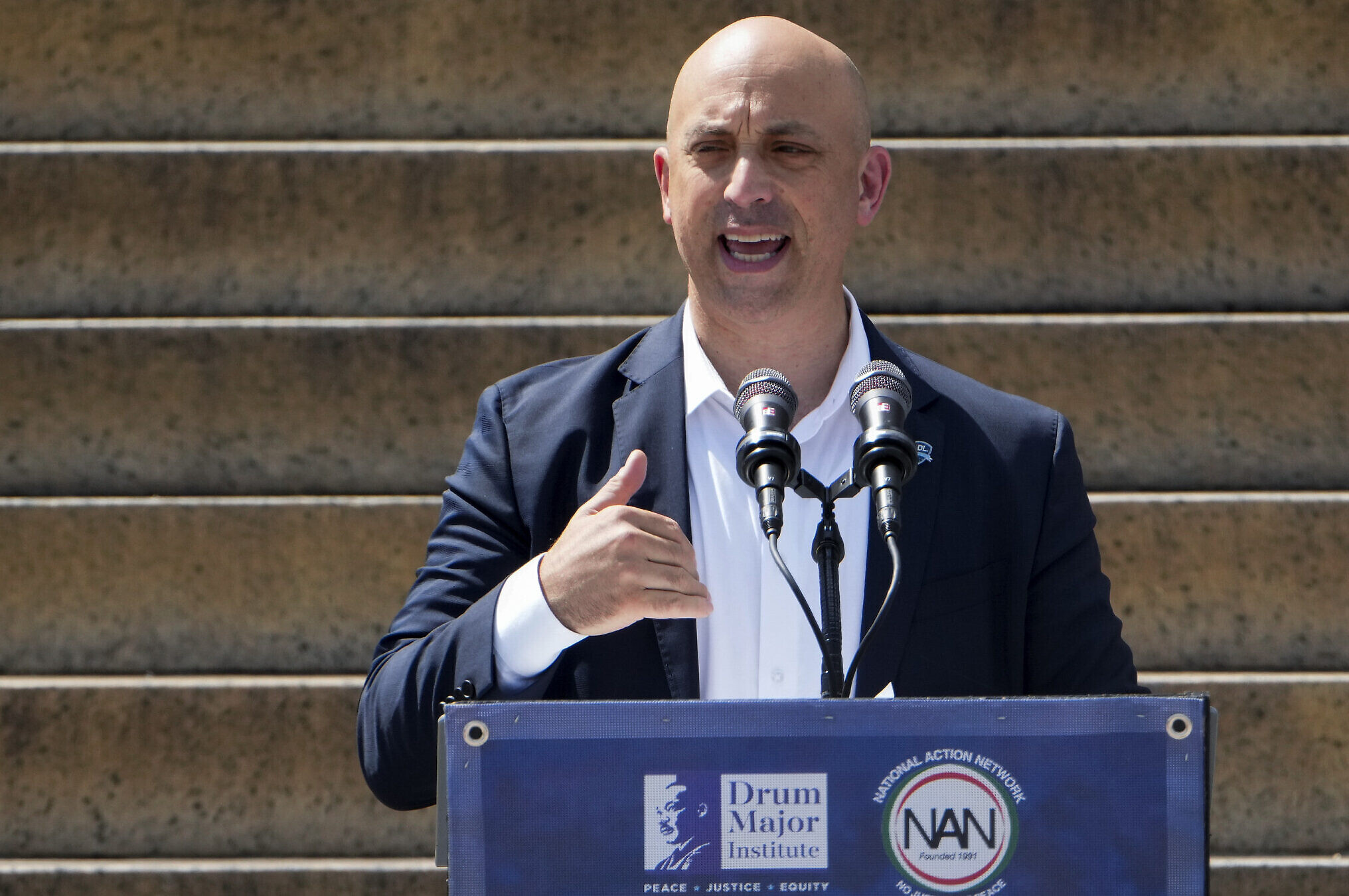
Jonathan Greenblatt, head of the Anti-Defamation League, speaks at the 60th Anniversary of the March on Washington at the Lincoln Memorial in Washington, August 26, 2023. (AP Photo/Andrew Harnik)
Jewish leaders like European Jewish Congress President Ariel Muzicant said they saw the invitation of figures such as Jordan Bardella, president of the far-right French National Rally Party, as a “stab in the back” to Diaspora Jewish communities, providing a sort of “stamp of kashrut” to parties with deep ideological roots in fascism, Nazism, and xenophobia.
To Chikli, however, the move was part of a strategic decision to fight antisemitism by working with the parties most vocal in confronting radical Islam.
“The real threat to European Jewry is radical Islam, not the political right,” Chikli said. “Our goal is form a broad camp to fight together the lethal antisemitism that is coming from within. That’s not to say we can ignore the far left or far right, but this is the most lethal form of antisemitism that we face.”
The first conference was a “success,” Chikli told The Times of Israel, and the ministry decided to make it an annual event coinciding with International Holocaust Memorial Day on January 27.
The second annual event, entitled “Generation Truth,” is taking place over two days, January 26-27, at Jerusalem’s International Convention Center (Binyanei Hauma), without most of the mainstream Jewish organizational leaders.
While for last year’s conference, several invitees publicly rescinded their participation after the guest list was revealed, the makeup of this year’s lineup was known ahead of time. Jewish Federations of North America President and CEO Eric Fingerhut will speak on a panel, but representatives from the ADL and Yad Vashem are said not to have been invited.
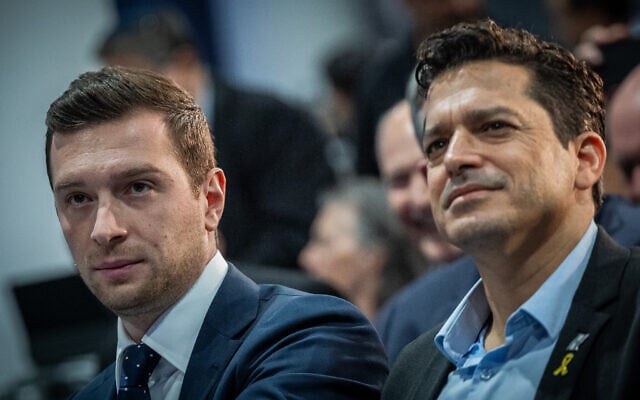
France’s National Rally leader Jordan Bardella (right) and Diaspora Minister Amichai Chikli at the international conference on combating antisemitism in Jerusalem, March 27, 2025 (Yonatan Sindel/Flash90)
Among the political figures expected to attend are current and former government officials from across the conservative spectrum, including former Australian prime minister Scott Morrison; former Austrian chancellor Sebastian Kurz; Edi Rama, prime minister of Albania; Argentina’s minister of justice Mariano Cúneo Libarona; Hungarian minister for EU Affairs János Bóka; Brazilian senator and presidential candidate Flávio Bolsonaro; and US ambassador to Israel Mike Huckabee.
Influencers and thought leaders set to appear include author and filmmaker Dinesh D’Souza, UK legal advocate Natasha Hausdorf, Babylon Bee CEO Seth Dillon, and Noa Cochva, a former Miss Israel who now does public advocacy for the Jewish State.
At a gala event ahead of the conference, an award for fighting antisemitism will be given to Leo Terrell, who heads the US Department of Justice Task Force to Combat Antisemitism. A special award in memory of slain conservative activist Charlie Kirk will be presented to his personal pastor, Rob McCoy.
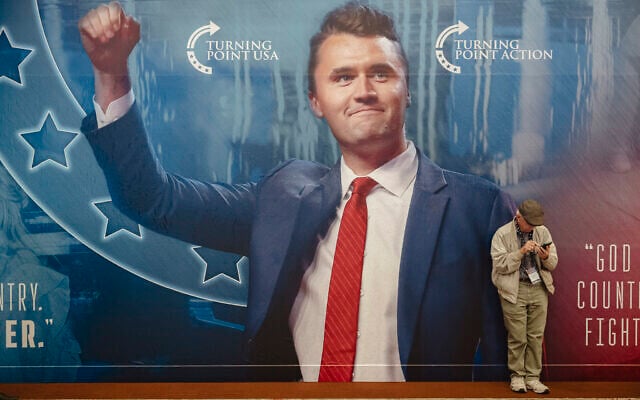
An attendee waits for the start of Turning Point’s annual AmericaFest conference, in remembrance of late right-wing political activist Charlie Kirk, in Phoenix, Arizona, on December 18, 2025. (Olivier Touron / AFP)
The lineup of the conference reflects Chikli’s view that rather than seeing European nationalist, anti-immigration parties as a threat to Jewish well-being, Israel should look to them as partners to battle radical Islamist ideology, which he sees as a more potent danger.
The minister pointed to attacks on Jews around the world in the last year, including the murder of 20 Jews in attacks in Sydney, Australia, Manchester, UK, Washington, DC, and Boulder, Colorado.
“In nearly all of these attacks, with the exception of Washington, you can see that the terrorist came from an Islamist ideology,” Chikli said. “So while we have a major challenge with antisemitism on the ‘progressive woke’ far left, and a rising problem on what we call the ‘woke right,’ the main threat is radical Islam.”
Chikli has frequently faced criticism for what is seen as a “selective outrage” against the left, with detractors saying he focuses disproportionately on left-wing and Islamist antisemitism while actively whitewashing or ignoring antisemitism on the far-right, which has also included deadly attacks.
In his conversation with The Times of Israel, however, he insisted that radical Islam is the main threat to Jewish communities.
“I’m not saying we should ignore the right or the left. Not at all,” Chikli said. “We need to focus on the most deadly and dangerous form of antisemitism we are facing, which comes from jihadist Islam.”
Chikli dismissed what he termed “woke” attempts to fight antisemitism that condemn general hatred or Islamophobia without explicitly addressing the jihadist challenge.
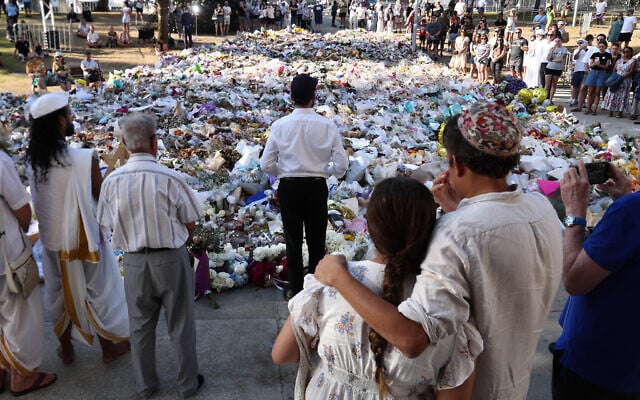
A rabbi (center) delivers a sermon as mourners gather in front of tributes laid in memory of victims of a terror attack on a Hanukkah celebration at Bondi Beach, in Sydney, on December 20, 2025. (David Gray/AFP)
“Until now, Australian Prime Minister Anthony Albanese refused to even say the words radical Islam, and indicated that the Bondi Beach massacre happened because of insufficient gun control or hate speech,” Chikli said, referring to the December 14 attack on a Hanukkah party by two shooters linked to the Islamic State jihadist group.
To fight Jew hatred properly, he said, Jews need to form a strong coalition with the political parties already challenging radical Islam abroad.
“If we are going to limit ourselves to internal Jewish discussions about these challenges without bringing together our partners who share the same threats,” he added, “we’d be making a big mistake.”
‘Flirting with fascism’
As last year, many of the figures invited to this week’s conference come with controversial political histories that have alarmed Jewish leaders in their home countries.
Fabrice Leggeri is attending as a representative of France’s National Rally party, co-founded by Jean-Marie Le Pen, who was repeatedly convicted in France for Holocaust denial and racist speech.
French Jewish institutions have traditionally expressed deep distrust toward the party, which has attempted to disassociate itself from antisemitism under Le Pen’s daughter, Marine Le Pen, who changed the name of the party from National Front.
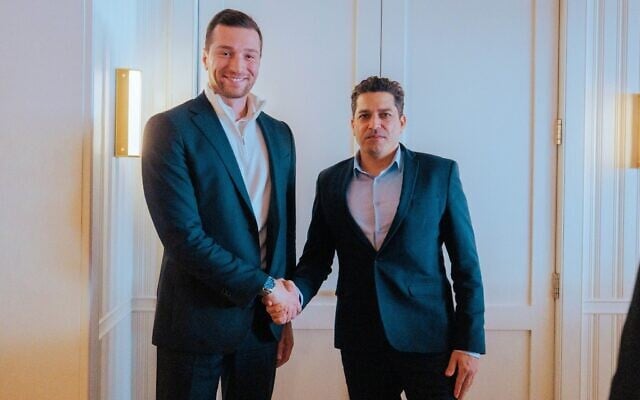
French National Rally leader Jordan Bardella (L) meets Israeli Diaspora Minister Amichai Chikli in Washington on February 21, 2025 (Bardella/X)
Yonathan Arfi, president of the Representative Council of French Jewish Institutions, or CRIF, has warned that National Rally has sought to use its relationship with Chikli as part of a “de-demonization” strategy, while its current leader, Bardella, insists the party has fundamentally changed.
Sweden Democrats leader Jimmie Åkesson will also attend. Scholars and watchdog groups have documented the party’s origins in neo-Nazi and white supremacist movements. While the party has apologized for its early history, Sweden’s Jewish Central Council has long refused to work with it, citing positions such as opposition to kosher slaughter and non-medical circumcision.
Belgium’s Vlaams Belang party, which is tied to Flemish nationalist movements with fascist origins, will be represented by Sam van Rooy. Regina Sluszny, chair of Belgium’s Forum of Jewish Organizations, has said the party’s pro-Israel stance masks an ideology that still “flirts with fascism” and promotes historical revisionism.
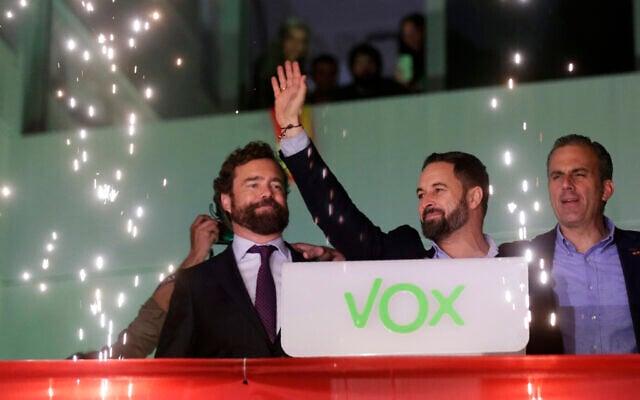
Santiago Abascal, leader of the far-right Vox Party, waves to supporters as fireworks go off outside the party headquarters after the announcement of the general election’s first results, in Madrid, November 10, 2019. (AP Photo/Andrea Comas)
Spain’s Vox party leader Santiago Abascal was initially listed as a speaker but has since been removed from the program. His party has been generally shunned by the Federation of Jewish Communities of Spain (FCJE), which maintains that the party’s anti-immigrant and anti-Muslim rhetoric creates a climate of xenophobia that ultimately endangers all minorities, including Jews.
A spokesman for the ministry said Abascal couldn’t make it for personal reasons, but he would deliver an address to the conference by video.
‘We are very careful’
Despite the criticism, Chikli insisted that each participant had been carefully vetted, noting that the Foreign Ministry lifted bans against cooperation with France’s National Rally, Sweden Democrats, and Spain’s Vox party ahead of last year’s conference.
“For parties that have origins with Nazi founders, we’ve made it clear that without a public statement rejecting those founders, there will be no collaboration,” he said. “The same applies to parties that make Jewish life difficult by opposing shchita [Jewish ritual slaughter] and brit mila [male circumcision]. These are not technicalities for us.”
He was willing to let the Sweden Democrats’ opposition to ritual slaughter and non-medical circumcision slide, though, given the fact that it appears aimed at Muslims rather than Jews and considering the party’s pro-Israel voting record.
He indicated that parties were mainly judged on their stance toward Israel, rather than any other qualms.
“Can you imagine if they would only work with [French President Emmanuel] Macron, but banned Bardella, who speaks up repeatedly against Hamas, comes out against the ICC and ICJ [court decisions against Israel], and says explicitly that he is against any form of antisemitism?” Chikli exclaimed. “To suggest that Bardella is an antisemite is completely ridiculous. So I see it as a major success.”
He pointed to Germany’s Alternative for Germany (AfD) as an example of a party that failed to meet those standards.
“I’ve heard no antisemitic statements from Alice Weidel, but there are senior figures who have expressed extreme hostility toward Israel, including Maximilian Krah and Björn Höcke, who referred to Berlin’s Holocaust memorial as a ‘monument of shame,’” Chikli said, referring to members of the ascendant German party. “That’s a red line.”
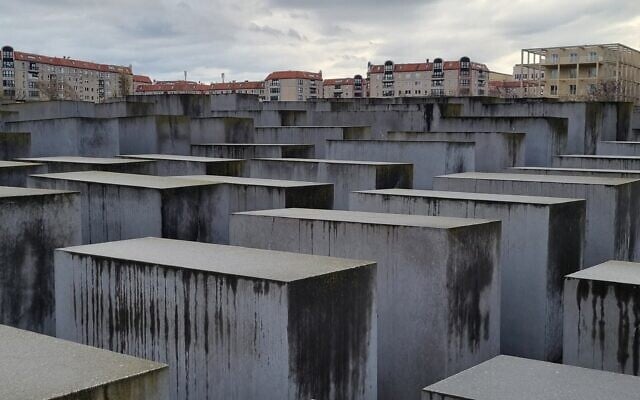
The Holocaust memorial in Berlin, December 2024. (Bart Schut)
Austria’s Freedom Party, he added, presents a more complicated case. “They are supportive of Israel and strongly opposed to Islamist extremism, but we need to hear their leaders explicitly reject their Nazi-linked founding figures. I’m not aware of any such statement.”
Chikli rejected criticism from European Jewish leaders who have described the invitations as a betrayal of European Jewry.
“We are very careful in who we invite,” Chikli said. “I’m not trying to undermine the policies of those Jewish organizations. We just have a disagreement.”
Wokeism versus Torah
The son of a Conservative rabbi, Chikli, 44, was born in Jerusalem to a family of French immigrants with deep ties to progressive Jewish movements. He served as an officer in an elite IDF unit and studied for a master’s degree in diplomacy and security at Tel Aviv University.
However, his religious Zionist education and his skepticism toward post-Oslo liberal thinking gave him a deep mistrust of liberal ideologies. His strengths as an educator led him to found the Tavor pre-army preparatory academy for Israeli teenagers in 2010.
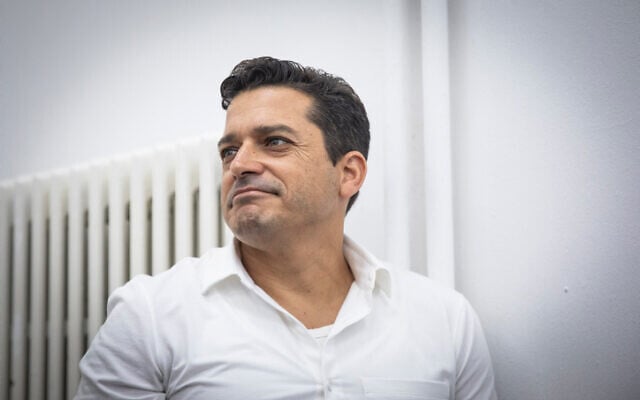
Amichai Chikli arrives at the District Court in Jerusalem, for his appeal against the declaration of Chikli as “rebel”- a procedure legislated to block MK’s from defecting in return for political appointments, July 10, 2022. (Noam Revkin Fenton/Flash90)
After a failed run for Knesset in 2019 on Naftali Bennett’s New Right slate, Chikli entered national politics in 2021 as a member of Bennett’s Yamina party. He quickly gained notoriety for breaking with the party and opposing the broad-based governing coalition led by Bennett, and eventually joined the Likud party in the 2022 election that saw Prime Minister Benjamin Netanyahu return to power.
His appointment as Minister of Diaspora Affairs and Combating Antisemitism placed him at a prominent intersection of Israeli politics and global Jewish life, giving outsized voice to a worldview shaped by right-wing thought and frustration at Israel’s security failures.
A father of three who lives on Kibbutz Hanaton in the country’s north, Chikli has overseen several major initiatives since taking office. His Project Aleph Bet is a multimillion-dollar effort to train Jewish educators in North America, and the UnitED program is now used in hundreds of Jewish schools worldwide to strengthen Israel education and resilience against antisemitism.
After Hamas launched its war against Israel on October 7, 2023, his ministry played a central role in sending delegations of hostage families abroad to mobilize international support.
However, Chikli’s hard-right positions have often put him at sharp odds with the Israeli public and Jewish communities abroad. His strong statements against the Reform movement, left-wing organizations, and mainstream news outlets have alienated him from many Jewish organizational leaders in Israel and the Diaspora, while his nationalist statements, embrace of far-right politicians and influencers, and strong warnings about radical Islam have sparked public criticism and boycotts.

Protesters take part in a demonstration called by French organization “France Palestine Solidarite” in Paris, on May 27, 2024. (Sami KARAALI / AFP)
Asked about whether such statements are befitting for an Israeli minister, entrusted with mediating between the needs of Israel and Diaspora Jewry, Chikli launched into a philosophical treatise that included the religious underpinnings of his rejection of moral relativism and liberal progressive thought.
Quoting the Ten Commandments, the philosophy of Immanuel Kant and the writings of Bar Ilan University professor Ze’ev Maghen, Chikli argued that conservative, nationalist movements are most in line with authentic Jewish philosophy, and that globalism, communism, and progressive movements deny the rights of nation-states to self-determination and endanger the societies they claim to protect.
“As Jews, we have a responsibility to oppose such movements,” Chikli said. “And the same goes for the progressive, woke neo-communist ideology. It is against Torah.”
Asked whether it was possible for him to see ever see eye-to-eye with liberal communities he is charged with working with, Chikli indicated that while he was interested in talking, there would no bridging of the divide.
“This is the reality. We have different views,” Chikli said. “The Jewish people need to have this discussion, but at the core, we’re very different.”