
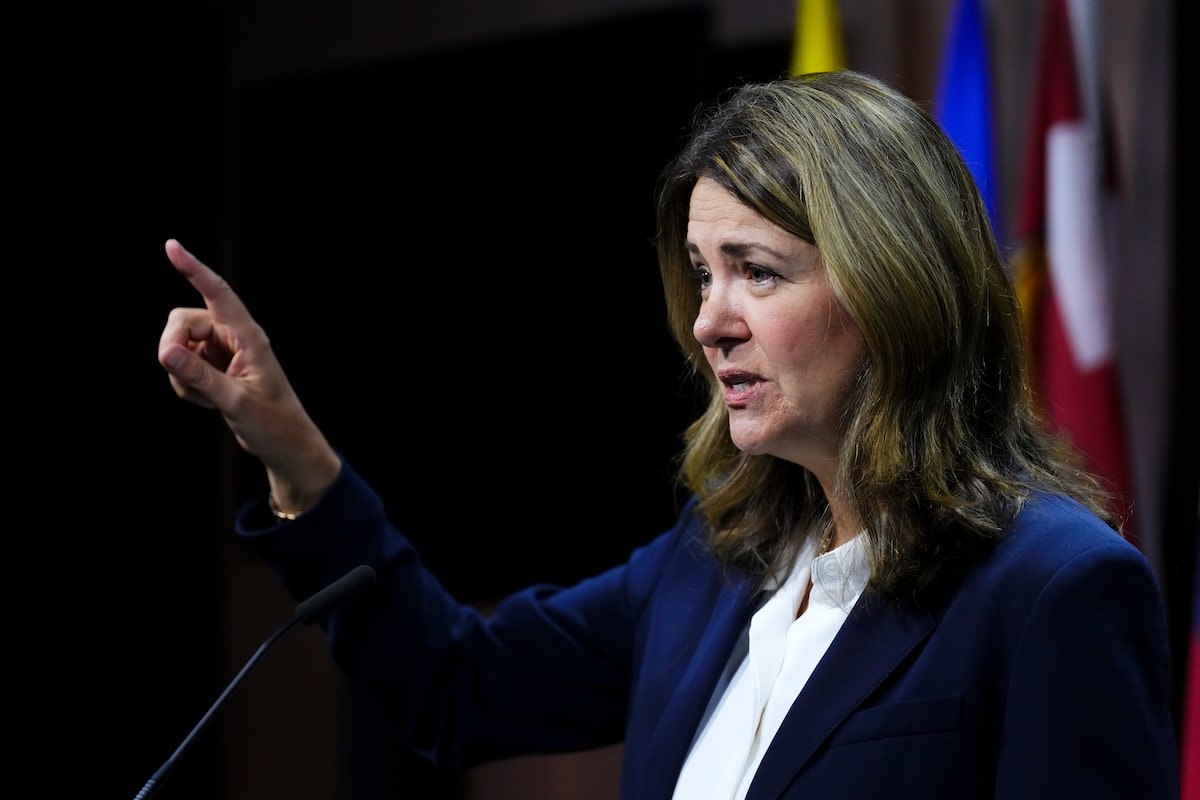
Alberta Premier Danielle Smith said last weekend to a caller to her radio show that she wishes she could ‘direct judges.’Sean Kilpatrick/The Canadian Press
Judicial independence is foundational to a properly functioning democracy, Alberta’s chief justices, representing the province’s three judicial branches, wrote in a pointed statement released days after Premier Danielle Smith said she wished she could “direct” judges.
Tuesday’s public statement, a rare step for the province’s top judges, was signed by Acting Chief Justice Dawn Pentelechuk, with the Court of Appeal; Chief Justice Kent Davidson, with the Court of King’s Bench; and Chief Justice James Hunter, with the Alberta Court of Justice.
The independence of each branch of government “ensures there are checks and balances across the system. It is the foundation of a healthy democracy,” they wrote in the statement, which a court representative said was developed over several weeks.
“Public trust and confidence in our institutions – and all three branches of government – depend on it. It is equally important that each branch respect and support the independence of the others.”
Robyn Urback: If nothing else, Danielle Smith is a disruptor
The statement doesn’t directly call out Ms. Smith or her ruling United Conservative Party, but was released after a series of public remarks she made that appeared to cast doubt on the integrity of the judicial system.
“I wish I could direct the judges, honestly,” Ms. Smith said last weekend to a caller to her radio show, who complained about Canada’s bail laws.
She added that she recently wrote to Prime Minister Mark Carney proposing more provincial involvement in judicial appointments “so that we start choosing judges in Alberta that reflect the values of how we want them to operate here.”
In recent months, she has also repeatedly referred to judges as activists appointed by former prime minister Justin Trudeau and implied that rulings were being made along partisan lines.
Sam Blackett, spokesperson for Ms. Smith, said that while recent court rulings have led Albertans and Canadians to question aspects of the court system, “our government respects the role of each branch of government and supports their independence.”
Alberta invokes notwithstanding clause on three bills affecting trans and gender-diverse youth
Olav Rokne, spokesperson for Alberta’s Court of Justice, said the judges’ statement was not in response to specific comments or an event. He described it as educational.
Ms. Smith’s comments on the judiciary are similar to those of Ontario Premier Doug Ford, who last April called judicial independence “a joke,” and suggested Canada should switch to U.S.-style elected judges. Mr. Ford referred to “bleeding hearts” on the bench who grant bail to those accused of crimes and make decisions against his government based on “ideology.”
His remarks prompted a joint response from Ontario’s top judges at the time who also wrote about judicial independence as “a cornerstone of our constitutional democracy.”
Gerard Kennedy, a constitutional law professor at the University of Alberta, said the implication that judges are deciding matters along partisan lines can seriously undermine faith in the courts. He added it’s not an infraction for governments to criticize court decisions.
“Implying that the judges are making decisions because of partisan affiliation, however, is deeply problematic,” he said.
“We’ve set up the institution of the judiciary very carefully to ensure that that is not a perception, say nothing about not being a reality.”
Alberta Premier Danielle Smith facing recall petition
On Tuesday, federal Justice Minister Sean Fraser announced the appointment of two Calgary lawyers, Jason Wilkins and Peter Banks, to the Court of King’s Bench of Alberta. Mr. Fraser wrote in a statement he is “confident they will serve the people of Alberta.”
Alberta NDP Leader Naheed Nenshi and justice critic Irfan Sabir wrote in a statement that the justices’ letter “shows just how far this irresponsible and anti-democracy premier and her Justice Minister have gone to interfere and create mistrust in our justice system.”
Ms. Smith has come into conflict with the courts in other ways in recent months by using legislative maneuvers – all of which have been legal – to discontinue active proceedings or exempt laws suspended by courts.
Most recently, Ms. Smith’s government in December used legislation to end all court proceedings brought forward by Alberta’s Chief Electoral Officer.
Earlier in 2025, Alberta Chief Electoral Officer Gordon McClure had asked for a court opinion on the constitutionality a proposed independence referendum question.
In December, however, Alberta Justice Minister Mickey Amery tabled legislation that would end any court proceedings electoral officers had sent for a judicial review.
Before that bill was passed into law, Court of King’s Bench Justice Colin Feasby completed his constitutional review into the independence question. In an epilogue to his decision, Mr. Feasby called the provincial government’s decision to circumvent court proceedings “the antithesis of the stable, predictable, and ordered society that the rule of law contemplates, and democracy demands.”
The bill was passed later in December.