
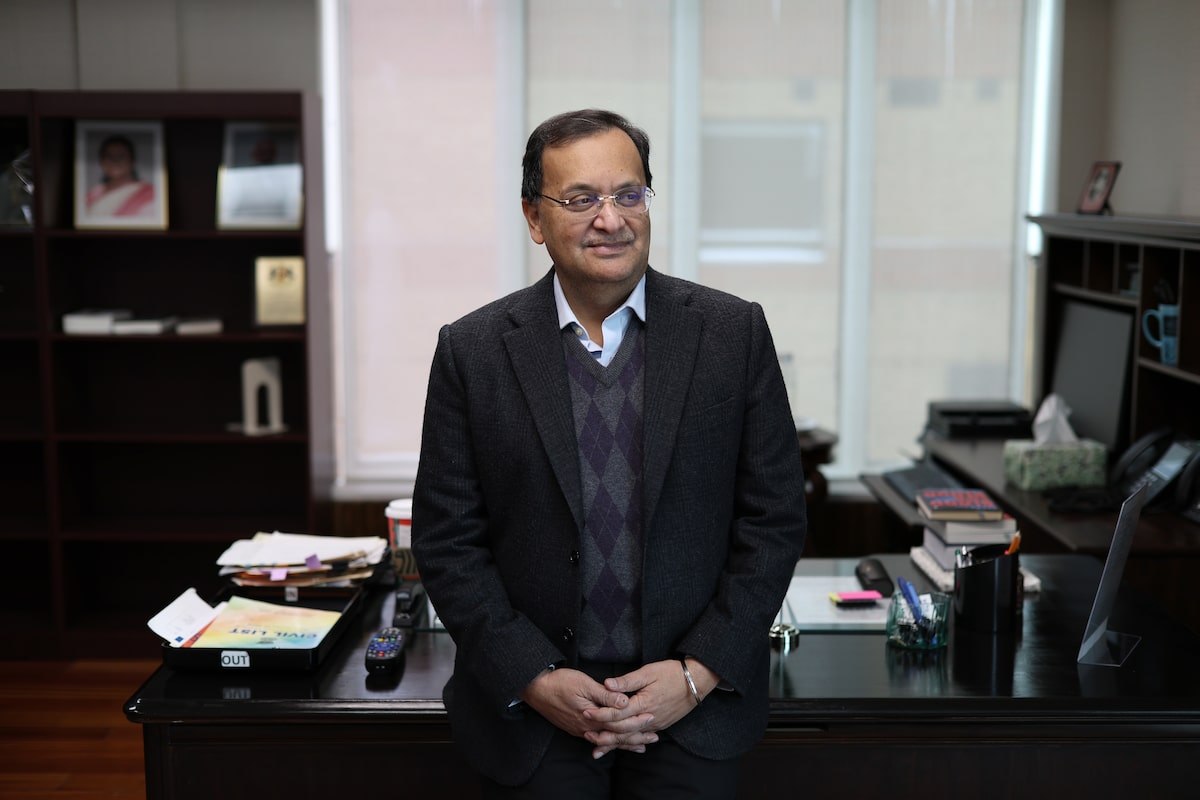
India’s High Commissioner to Canada Dinesh Patnaik says he expects it will take a year for the country to reach a deal with Ottawa.Dave Chan/The Globe and Mail
India has long viewed Canada as the “younger brother” of the United States, slow to approve foreign investment and major projects, but this perception is changing under Prime Minister Mark Carney, the Indian high commissioner to Canada says.
Ottawa and New Delhi are preparing to launch talks on a comprehensive trade deal as the Prime Minister makes plans for a March trip to the Indian subcontinent, his first.
The high commissioner, Dinesh Patnaik, said in an interview on Tuesday that in India’s view Mr. Carney has been carving out a more independent role for Canada, including with his much-lauded Jan. 20 speech at the World Economic Forum.
The speech amounted to a veiled attack on the damage U.S. President Donald Trump has done to the international rules-based order at a time when Mr. Carney has been working to reduce Canada’s dependence on U.S. trade by finding other partners.
India an ideal target for increased Canadian energy exports, analysts say
The envoy spoke as India and the European Union unveiled a comprehensive trade deal that will reduce or eliminate Indian tariffs on more than 96 per cent of European exported goods. Mr. Patnaik said one benefit of this major deal being concluded is that India’s trade negotiators now have more capacity to focus on talks with Canada.
The high commissioner said he expects it will take a year for India to reach a deal with Canada. He added that it’s possible this could be shortened.
He said he anticipates that a uranium supply deal between India and Canada will be announced during Mr. Carney’s trip. The Globe and Mail in November reported both countries were putting finishing touches on a deal worth about US$2.8-billion over 10 years, with terms subject to change before it was unveiled. The uranium would be supplied by Canada’s Cameco Corp., and the export deal could be part of a broader nuclear co-operation effort between Canada and India.
The Prime Minister’s Office has not confirmed Mr. Carney’s trip to India. But Australian Prime Minister Anthony Albanese has announced that Mr. Carney will visit his country in early March. Mr. Patnaik said he expects the Prime Minister will visit India before or after a stop there.
This India trip will mark an official reset of relations after a two-year diplomatic rupture between Ottawa and New Delhi. Relations cratered in 2023 when then-prime minister Justin Trudeau publicly accused India of a role in the murder that year of a Canadian Sikh leader in Surrey, B.C. – an allegation that Ottawa has never retracted.
Opinion: Canada must acknowledge the implications of selling uranium to India
Mr. Patnaik said Canada’s image in India is changing, including the extent to which it’s now considered independent of the United States.
“For a long time, Canada was seen as a younger brother of the U.S. – that if you want Canada to do anything, just get the U.S. to do it and Canadians will follow,” the envoy said. He said that’s no longer the case under Ottawa’s current leadership.
Last week, Mr. Carney’s speech at the World Economic Forum in Davos, Switzerland, called for middle powers to stop pretending the international order is still functioning and, instead, build coalitions to survive in a new era where great powers prey on smaller countries to take what they want. He said the story of the beneficial rules-based order is partly false, and that middle powers went along with this fiction because of the benefits it brought.
Prime Minister Mark Carney delivers a speech at the World Economic Forum in Davos, Switzerland, last week.Sean Kilpatrick/The Associated Press
Mr. Patnaik said Mr. Carney’s remarks reflect what India and the Global South have been saying for a long time: “The strong do what they want and the weak suffer.” He said the “very fact that he spoke shows that the global world order is actually in a rupture.”
Indian investors are keen on buying stakes in Canadian resources. “There’s a large number of people in India who are very interested in investing in infrastructure, oil and gas, minerals, critical minerals, rare earths, artificial intelligence,” Mr. Patnaik said.
The envoy said, however, that Canada has been perceived as “not open for investment” and prone to lengthy delays and “bureaucratic paperwork” when it comes to greenlighting foreign purchases of Canadian assets. “That’s one of the few concerns of investors,” he said.
The same worry extended to approval of major infrastructure projects. “A normal pipeline should take about four years maximum,” Mr. Patnaik said, contrasting that with long delays that pipeline proponents have encountered in Canada.
But Mr. Carney’s efforts to attract new foreign investment, and to expedite approval of major projects, are changing India’s perception of Canada, he said.
“I have a feeling that under your new Prime Minister, investors are more confident that things will be done faster.”
Prime Minister Mark Carney gave a speech at the World Economic Forum that blamed U.S. President Donald Trump, without naming him, for what Carney described as a rupture in global relations.
Energy and Natural Resources Minister Tim Hodgson is currently visiting India in search of energy and critical mineral deals. Mr. Patnaik said his country’s appetite is boundless.
“If you can sell it to us, we will buy it: We want to do deals on minerals, on rare earths, on critical minerals and oil and gas, on agri-foods, on fertilizer, on potash − you name it,” the envoy said, later adding uranium and lumber to the list.
“You have to understand, we are 1.4 billion plus: the world’s most populous country. We’re going to grow no matter what happens. We will consume more, and we will become the biggest consumer the world has seen, similarly to what China was 15 to 20 years back.”
Rita Trichur: Saskatchewan soft power fuelled the Canada-India reset on trade
This reset of relations leaves unresolved Ottawa’s accusation that New Delhi conducted an extrajudicial assassination of Sikh activist Hardeep Singh Nijjar on Canadian soil. India still vehemently denies any involvement but both countries have pledged to co-operate more closely on security going forward.
“We are very clear. We have no role,” Mr. Patnaik said of the Nijjar case. He said if Canada produces evidence of this allegation, India “will take action.”
Canadian authorities continue to investigate alleged transnational repression targeting Sikh activists domestically, with four Indian nationals now facing charges in the Nijjar case.
A suite of Indian officials are planning trips to Canada, Mr. Patnaik said, including National Security Adviser Ajit Doval, Minister for Commerce and Industry, Shri Piyush Goyal, Minister of Finance and Minister of Corporate Affairs Nirmala Sitharaman, Minister of Petroleum and Natural Gas Hardeep Singh Puri and Education Minister Dharmendra Pradhan.