
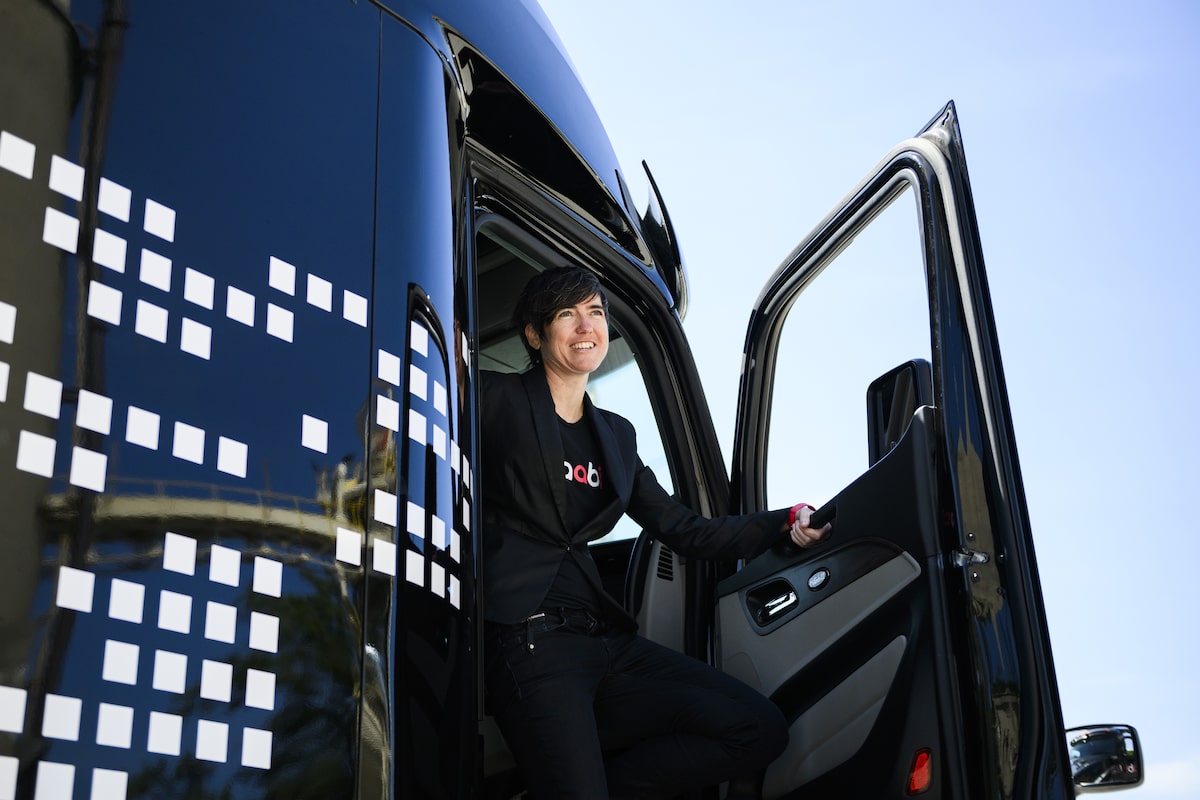
CEO and Founder at Waabi, Raquel Urtasun, in an automated truck in Toronto in June, 2024.Christopher Katsarov/The Globe and Mail
Autonomous vehicle startup Waabi Innovation Inc. has raised US$750-million in one of the largest venture capital financings in Canadian history and announced plans to launch a vast fleet of robotaxis with Uber Technologies Inc.
The Toronto company will use the new funding to continue its expansion into autonomous long-haul trucking, where it already has commercial operations with Uber Freight, in addition to deploying self-driving taxis that will navigate city streets.
Founder and chief executive officer Raquel Urtasun said Waabi is well-equipped to quickly launch robotaxis given the sophistication of its technology and the company’s experience with trucking. “The same brain is going to drive the different form factors. It’s going to drive the trucks and the robotaxis,” she said. “We build all the capabilities you require for robotaxis already.”
Waabi will deploy a minimum of 25,000 autonomous vehicles on Uber’s ride-hailing service, but disclosed few other details of its plan, including where and when the first robotaxis will launch, or whether the company has done on-road testing already. Ms. Urtasun also declined to identify the manufacturer that will build the vehicles powered by Waabi’s artificial intelligence system.
She did, however, emphasize that Waabi is moving quickly. “We’re going to enter and deploy in robotaxi markets much faster than you’ve seen to date,” she said.
Waabi closes in on US$750-million financing, valuing driverless truck company at US$3-billion
Waabi secured additional investment from Uber to support robotaxi development, bringing the total amount of capital announced to US$1-billion, according to the company. The Uber funding is contingent on Waabi hitting certain undisclosed milestones, however.
Waabi’s latest financing was led by existing investors Khosla Ventures and G2 Ventures Partners in the United States, and included funding from Nvidia’s venture arm, Volvo Group Venture Capital, Porsche Automobil Holding SE and Toronto’s Radical Ventures Investments Inc., among others. The company previously raised US$283.5-million in venture financing.
The Globe and Mail reported in December that Waabi was close to finalizing a US$750-million funding round that valued the company at US$3-billion.
Ms. Urtasun declined to comment on Waabi’s valuation.
Uber already a relationship with Waymo, the autonomous vehicle company owned by Alphabet Inc. Waymo has at least 2,500 self-driving cars on streets in San Francisco, Los Angeles, Phoenix, Atlanta, Miami and Austin, Tex., where its vehicles made up 20 per cent of Uber rides at one point last year, Bloomberg reported.
While such statistics suggest growing consumer comfort with autonomous vehicles, the technology is not perfect. The National Transportation Safety Board in the U.S. opened an investigation into Waymo this month after reports of its robotaxis failing to yield for school buses in Austin.
Ms. Urtasun said that self-driving cars come with safety benefits, however. “Robotaxis are going to be much safer than human drivers,” she said. These vehicles may also appeal to women who travel late at night, she continued. (Uber has long faced scrutiny for sexual assaults and misconduct committed by drivers on its network.)
Waymo also competes directly with Uber through its own app. “Uber has an existential threat from Waymo, and they realized that they need to have an alternative,” said G2 co-founder Brook Porter. Waabi will not go head to head with Uber by building its own app and marketing directly to consumers, unlike Waymo.
“Uber will do that,” Mr. Porter said. “Waabi gets to stay focused on what they do incredibly well.”
Ms. Urtasun is considered a star in the field of AI. She grew up in Spain and later became a computer science professor at the University of Toronto. She has a close relationship with Uber, having spent more than three years working on autonomous driving at the company and serving as its chief scientist. (Lior Ron, the former CEO of Uber Freight, joined Waabi as chief operating officer last year.)
Ms. Urtasun started Waabi in 2021 and has said the company is taking a different approach to self-driving than competitors. Waabi has trained its AI models in virtual simulations first so that its technology is more adept by the time the company tests vehicles on real streets, which is time-consuming and expensive.
“Our competitors need many billions of dollars to continue developing,” she said. “One billion of new capital for Waabi is an infinite amount of capital.”
In the trucking market, Waabi has delivered goods in partnership with Uber Freight between Dallas and Houston since 2023. While a safety driver has been on board, ready to take control if necessary, Ms. Urtasun previously said that Waabi would go completely autonomous by the end of 2025.
That did not happen. Ms. Urtasun said Waabi opted last year not to proceed with fully driverless trucks on public roads with vehicles that have been modified to work autonomously. “We don’t believe that’s safe,” she said.
Waabi is instead waiting for its manufacturing partner, Volvo, to release its next-generation truck that will be built to work autonomously from the start, which is a few quarters away, she said.