
Small, budget-friendly electric vehicles sell for less than the equivalent of $20,000 in China. When Prime Minister Mark Carney announced the deal with his Chinese counterpart, it is likely many Canadians were thinking, finally, there will soon be an EV that is in my price range.
A part of the deal will see tariffs on Chinese EVs dropped to 6.1 per cent from 100 per cent and will allow up to 49,000 Chinese EVs into the country. That corresponds to less than 3 per cent of new vehicles sold in Canada, but it’s expected to drive considerable Chinese joint-venture investment in the country.
Fifty per cent of these Chinese EVs will have to come in with an import price of less than $35,000. That is significant because the cheapest EVs in Canada now start around $40,000.
What’s unclear is whether those 49,000 EVs are going to consist of Chinese-branded cars such as the BYD Seagull (which starts at the equivalent of $16,644 in China) or models from established automakers such as Volvo and Tesla that build cars in China. Brands including Volvo, Polestar and Buick imported cars from China to Canada before the tariffs began so it is reasonable to think they could do so again.
The latter would be easier to imagine. The Tesla Model 3 and Y are already sold here directly through Tesla stores, and lower-grade versions produced at its Gigafactory in Shanghai would be obvious candidates.
Exclusive: Chinese car maker Chery eyes expansion into the Canadian EV market
Bubbers: Even with Carney’s new deal, don’t expect to buy a cheap Chinese EV any time soon
Volvo, Polestar and Mini also produce cars in China and have dealer networks throughout Canada. We’ve been denied new cars such as the electric Mini Cooper, mainly because it’s made in China.
While there’s little to go on, we can always speculate on some of the Chinese EVs we could hypothetically get from the new trade deal, with a focus on ones that could potentially come in at that “affordable” $35,000 mark. The problem, for many Canadian drivers, is that to hit that low price, it is likely to be a small car, not the kind most Canadians buy.
Mini Cooper SE
I’ll start with the Mini Cooper SE because when the previous generation was sold here, it was one of the least expensive EVs on the market, although its range of less than 200 kilometres limited its appeal.
I drove the new 2025 model in Spain, which has a bigger battery, nearly 400 kilometres of range and was a blast to drive, but plans to bring it to Canada were shelved because it’s made in China. The SE is the more powerful and more expensive trim, but there are versions with less power and less range sold in Europe and other international markets. There’s also a well-established dealer network here.
The 2025 Mini Cooper SE has 215 horsepower and 243 lb-ft of torque.Kunal D’souza/The Globe and Mail
Polestar 2
The Polestar 2 was an excellent EV that was sold here from 2020 to 2024, but sadly discontinued because of the tariff. It was Polestar’s best-selling vehicle in Canada, and also the least expensive, starting around $55,000.
Despite being a compact vehicle, the Polestar 2 had plenty of room and its liftback design provided lots of cargo space. It was also great to drive with excellent handling and a comfortable ride. A single-motor trim with a smaller screen, cloth seats and fewer bells and whistles for $40,000 shouldn’t be impossible.
The Polestar 2 single-motor charging at an Electrify America station.Jeremy Sinek/The Globe and Mail
Volvo EX30
The EX30 is already sold here, but with a starting price of $50,000, it’s not exactly cheap. Current models are imported from Belgium to circumvent the auto tariffs. Before the tariffs, Volvo imported the EX30 from China, but the cost was about the same, so they would likely need to make some changes to get the price down.
It’s also a small car with limited space in the back for adult passengers, but if it were, let’s say, $35,000 or less and didn’t have some of the fancy trim and tech, it would make for an excellent commuter, personal runabout or viable first car. Volvo also has a solid reputation for safety and winter capability and doesn’t need to be introduced to Canadians.
The EX30 is more like a tall hatchback than an SUV.Matt Bubbers/The Globe and Mail
BYD Seagull
The Seagull is one of the most affordable EVs on sale today.
This quirky EV comes in a range of bright colours, seats four comfortably and has a range of 300-405 kilometres depending on the trim. It’s nicely equipped too, with a digital gauge cluster and a large centre touchscreen that can rotate between landscape and portrait mode. It’s 30- or 39-kilowatt-hour battery can be fast charged from 30 to 80 per cent in 30 minutes.
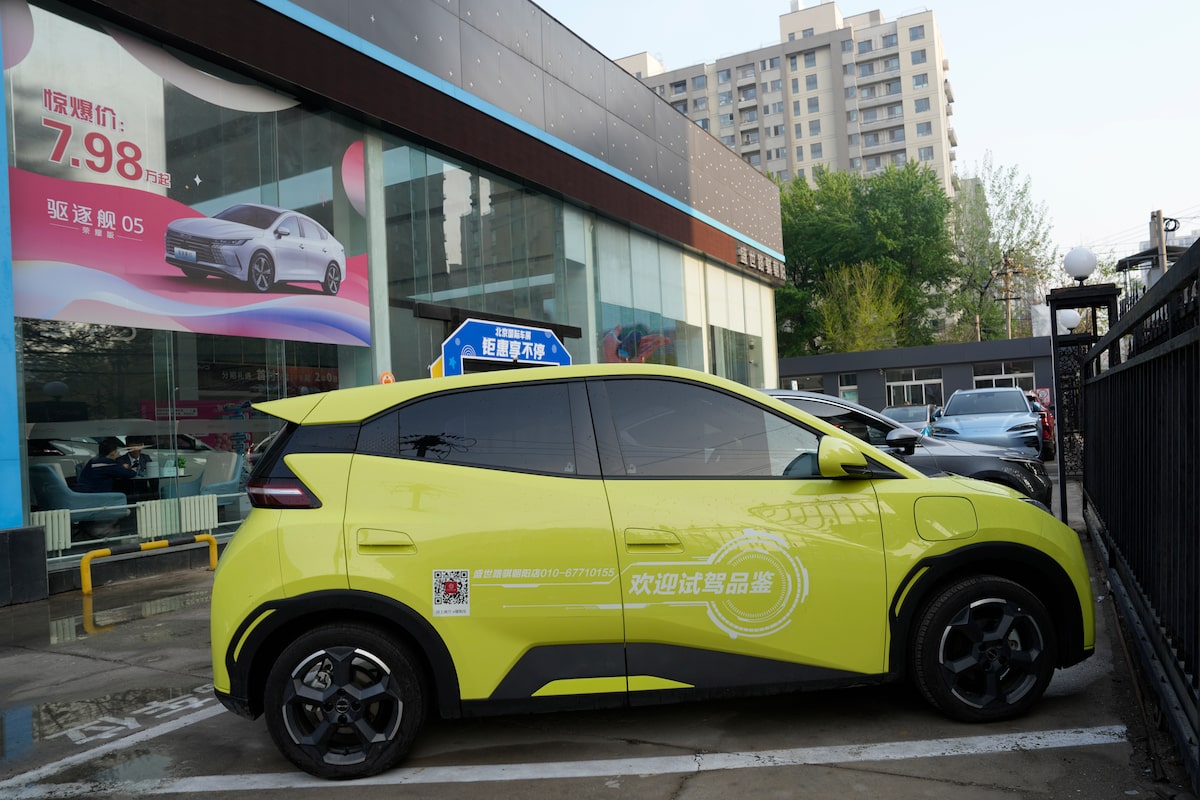
Even if it came in at $20,000, the Seagull would be perfect, but there are currently no BYD dealers in Canada or even a way to get them serviced, which limits the possibility of seeing it here anytime soon.
A Seagull electric vehicle from Chinese automaker BYD for test driving is parked outside a showroom in Beijing, Wednesday, April 10, 2024.Ng Han Guan/The Associated Press
Zeekr X
The Zeekr X might look a bit like the Volvo EX30, but that’s not a coincidence because they share parent company Geely’s Sustainable Experience architecture (SEA) platform. If anything, the Zeekr looks even better, has a more advanced infotainment system and more impressive technology such as an advanced artificial intelligence assistant and facial recognition to enter the vehicle.
It also shares the battery and powertrain with the Volvo and could possibly be sold through Volvo dealerships here. Zeekr is considered a premium brand, but the starting price in China is still the equivalent of less than US$30,000.
Zeekr XCourtesy of manufacturer