
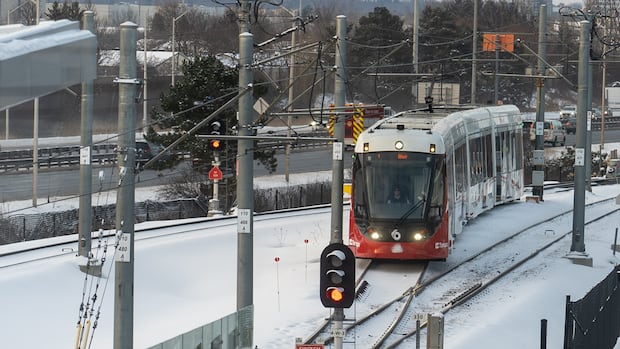
As OC Transpo struggles to get enough train cars on the rails to provide regular LRT service, transit officials say they still have no idea why metal is flaking off inside a vital component.
Troy Charter, interim general manager of transit services, acknowledged this during a Tuesday afternoon technical briefing into the latest problems disrupting Line 1.
“We know what is failing, but the exact reason why it’s failing, we don’t have that information,” he said.
The “what” is a cartridge bearing assembly which joins the axle to the wheels — more specifically, a roller bearing inside it. That’s the exact same component whose failure caused a derailment in 2021.
Marko Kroenke, the city’s director of engineering services, said the type of damage is different this time. It’s affecting a slightly different area. But the risk is the same.
“Ultimately they both lead to the same failure of the axle bearing assembly,” he said.
Charter said he can only speculate about why this new problem is happening after so much previous work on the problem bearings.
“The question is why now?” he said.
He said it could be a bad batch of parts. Maybe it’s contamination, or problems with maintenance or installation. He’s pretty sure it isn’t the rail this time, a possibility OC Transpo hasn’t been able to rule out for the previous bearing issue.
“At this point in time, we believe it is more of a train issue,” Charter said. “But I’m jumping to conclusions at this point. We need to let those analyses and that investigation continue.”
No progress getting cars in service
As the investigation goes on, OC Transpo continues to run some single-car trains on Line 1, leaving passengers to squeeze into crowded vehicles during rush hour. Line 1 trains normally consist of two cars that can hold 300 people each.
WATCH | The first morning of scaled-back service: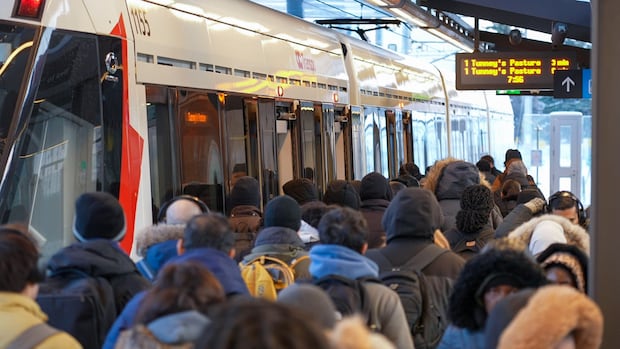
Crowded morning commute for Line 1 riders
OC Transpo has cut the number of O-Train cars in service until further notice after a new bearing problem was identified. As CBC’s Natalia Goodwin reports, it affected morning train riders on Thursday.
Last week, Charter said he was able to put just 18 cars on the rails, far below the 26 that OC Transpo was running and the goal of 30 when the line was being built.
That hadn’t improved at all by the technical briefing on Tuesday. There were still 18 cars. Forty-one were out of commission.
That’s because OC Transpo is forcing its maintainer, Rideau Transit Group (RTG), to replace axles that have exceeded 100,000 kilometres of use. The flaking metal was only found beyond that limit.
It isn’t easy.
“You have to … put up a train on jacks, drop a bogey that weighs thousands of pounds,” he said. “Each axle is very heavy. So it’s a lot of intrusive work that needs to happen”
But it shouldn’t be taking this long. Crews can replace two axles a day and some trains only have one beyond the mileage limit. Charter was expecting to have 20 train cars ready by Monday.
What’s the hold-up? He said OC Transpo has faced “failures for unrelated issues.” Crews also need to remove cartridge bearing assemblies and tear them apart as they try to study the root cause of the problem, adding to the delays.
So far, they’ve inspected 24 and have found eight with spalling, the technical term for the flaking.
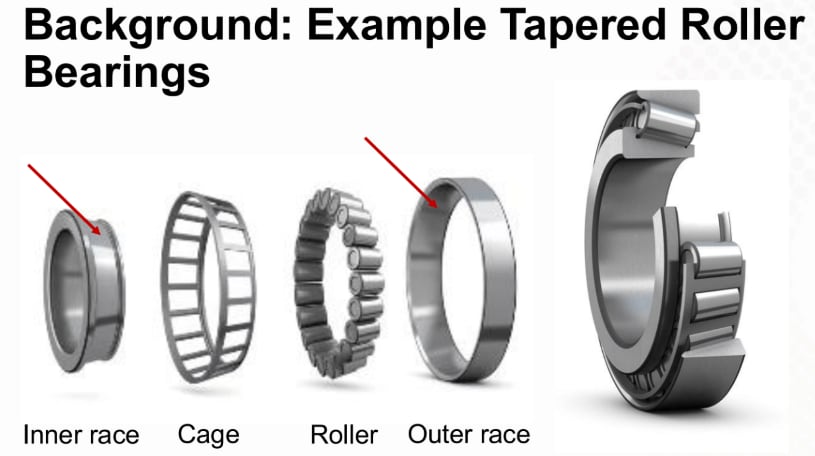 OC Transpo said in its Tuesday presentation that this is the inner workings of the part that is spalling, or flaking. (OC Transpo)Are the trains safe?
All the while, RTG and trainmaker Alstom are insisting the trains are still safe for normal operations. They have “containment and mitigation” measures. Alstom says it can do acoustic monitoring to detect spalling.
Charter and his team say they aren’t yet convinced and will keep the 100,000 kilometre limit in place until they are.
“Safety is too important to just take someone’s word for it,” said chief safety officer Sabrina Pasian.
 Troy Charter, OC Transpo’s interim transit general manager, at a 2023 transit committee meeting. (Jean Delisle/CBC)
Even so, this can only go on for so long. Charter said there were about 68 cartridge bearing assemblies on hand as of Tuesday morning.
Could they run out? The manufacturer can make more. But Charter said OC Transpo has to be cautious. The supply chain, in his words, is “going to be a challenge.”
So OC Transpo has a plan. It will force RTG to keep replacing the assemblies. It will push for more work on mitigation measures and documentation to back it up. And it’s demanding a long-term solution that fixes the root cause — even if there’s still no sign of what that might be.
It’s also unclear what the new bearing issue will mean for efforts to find a long-term solution to the previous problem and derailment.
Charter said the city is still demanding a redesigned assembly that can better withstand pressures from the rails. He said Alstom has a design, but not a prototype.
“Now we’ve got this new failure mode,” he said. “They’ll have to look at that and determine … does the redesign rectify it or is there other work that needs to be done?”
Rebate decision up to council
With all those complications, Charter said it’s too early to give any timeline for when regular LRT service can resume.
Passengers can expect the same single-car trains and more frequent service during weekday rush hours as OC Transpo continues to run trains every three or four minutes.
Can they expect a refund, as reduced train service dovetails with a bus reliability crisis? Charter said that’s not up to him. It’s up to council.
He said the city will hold RTG accountable. The company is bound by a project agreement, and Charter said the city will levy financial penalties for its inability to provide the agreed level of service.
“Our priority will be leveraging the project agreement to ensure that they’re making the decisions to rectify the issue,” he said.
“Ultimately, all costs borne with those solutions are to be borne by RTG.”