

Listen to this article
Estimated 5 minutes
The audio version of this article is generated by AI-based technology. Mispronunciations can occur. We are working with our partners to continually review and improve the results.
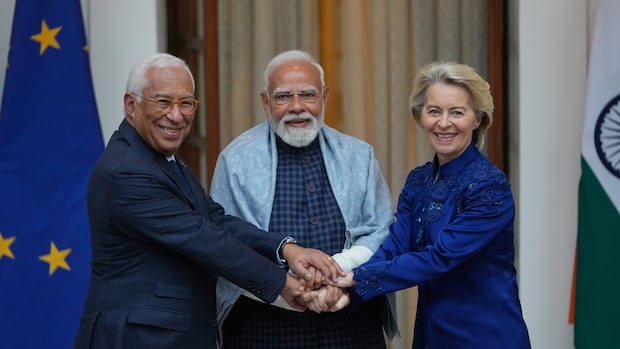
Leaders of the European Union and India announced a wide-ranging trade agreement on Tuesday, which came after nearly two decades of on-and-off negotiations that became increasingly urgent in the last six months after stiff tariffs were imposed by U.S. President Donald Trump.
Both Indian Prime Minister Narendra Modi and Ursula von der Leyen, president of the European Commission, called it “the mother of all deals.”
Modi also emphasized the trade agreement is the largest and most comprehensive that India has ever signed, representing a third of all global trade.
The free trade deal cuts tariffs on nearly 97 per cent of European goods by value imported to India, and it’s expected to double EU exports to the South Asian country by 2032.
“We are creating a market of two billion people,” said von der Leyen as the deal was announced.
“This is the tale of two giants, the world’s second and fourth largest economies. Two giants who choose partnership in a true win-win fashion.”
WATCH | India, EU announce long-delayed trade deal: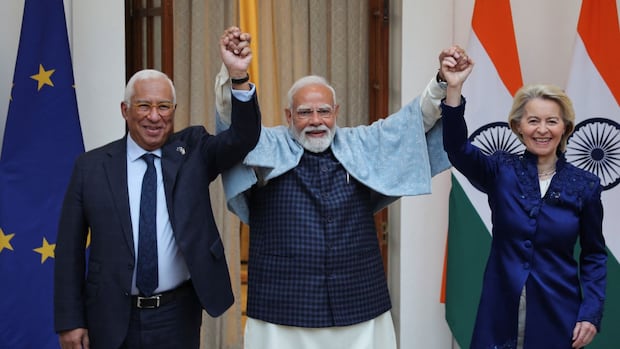
India, EU sign landmark deal to reduce tariffs
India and the European Union have struck a long‑delayed trade deal that will slash tariffs on most goods, aiming to boost two‑way trade and reduce reliance on the U.S.
The announcement of the landmark deal came on the heels of India’s annual ceremonial military parade to mark Republic Day, where von der Leyen and European Council President António Costa were feted as honoured guests. It’s an event that Indian leaders often use to hint at their strategic priorities.
Opening India’s protected domestic market
The deal will chip away at India’s historically high trade barriers and open up its tightly-guarded domestic market for many goods, including European cars.
Tariffs on cars imported from Europe from auto companies such as Volkswagen, Renault and Mercedes-Benz, will be slashed to 10 per cent from what now runs as high as 110 per cent on some vehicles.
India also agreed to reduce duties on European wine, chocolates, olive oil and other products.
For its part, New Delhi will benefit from eliminated tariffs on textiles, leather, gems and jewelry, and other goods entering the EU, and the agreement promises easier access for Indian highly skilled professionals to work in Europe — a major win for the country’s labour force.
Von der Leyen said the deal was “a strong message that co-operation is the best answer to global challenges,” and it would “reduce strategic dependencies at a time when trade is increasingly weaponized.”
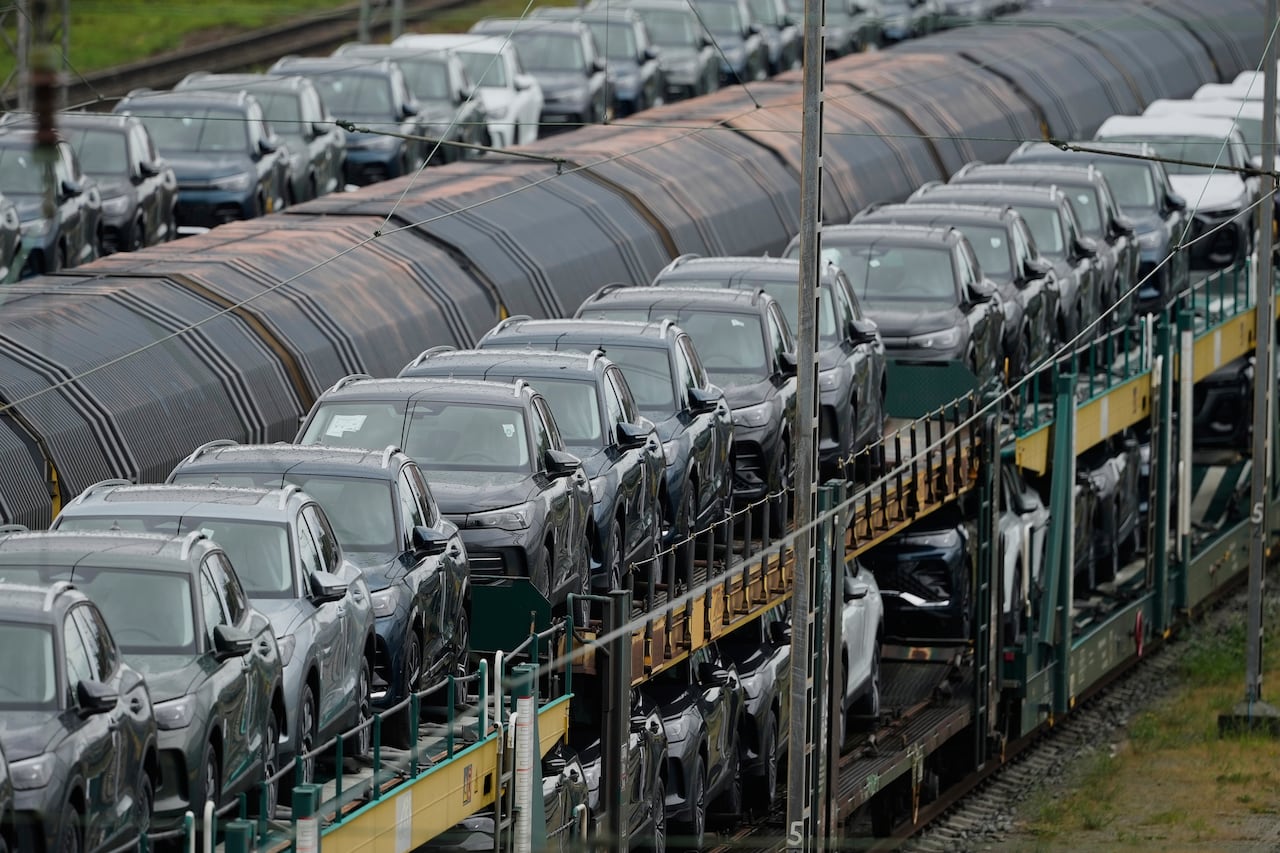 New cars of German car manufacturer Volkswagen and Audi are parked on a freight train in Munich in 2025. Tariffs on cars imported into India from Europe will be slashed to 10 per cent in the new deal. (Matthias Schrader/The Associatd Press)Negotiations in wake of Trump tariffs, war in Ukraine
The global challenge that many countries are grappling with is the Trump administration’s erratic trade policy, which simply accelerated the talks between EU leaders and New Delhi.
“This momentum that we’ve seen is all thanks to President Trump,” said Praveen Donthi, senior analyst for India with the think-tank International Crisis Group.
Indian exports to the U.S. were slapped with a 50 per cent tariff in August, half of which Trump signalled as being punishment for the country’s purchase of cheaper Russian crude oil, after Moscow invaded Ukraine.
The EU, meanwhile, negotiated down to a lower 15 per cent tariff rate last year, but a group of European nations were facing threats of more tariffs after opposing the U.S. president’s attempts to take over Greenland.
India has recently hosted a string of foreign leaders looking to that country to diversify trade ties in the face of growing U.S. threats — Canadian politicians included, despite two years of tense relations that froze trade talks.
Foreign Minister Anita Anand was in Delhi and Mumbai last October, and Prime Minister Mark Carney is planning to visit India in the coming months to try to sign deals on uranium, energy and minerals.
WATCH | Eby pitches India on gas, minerals during trade visit: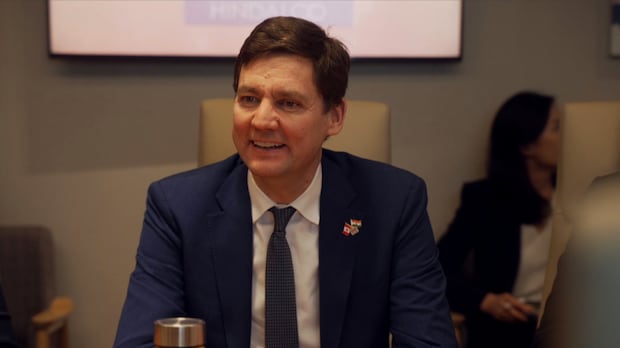
B.C. premier pitches India on gas, mineral deals during trade visit
B.C. Premier David Eby is pitching India on liquefied natural gas and mineral exports during his week-long trade visit, as the two countries ease back from a diplomatic crisis triggered by Canada accusing India of involvement in the murder of a prominent B.C. Sikh activist.
According to Donthi, free trade negotiations between the EU and India, which began in 2007 but later broke down before restarting in 2022, were hampered because Europe was slow to realize the country’s growing importance within the global economy. But that all changed after Russia’s invasion of Ukraine.
“They woke up to the fact that India and Russia are great friends,” Donthi added, and wanted to know how to “get India on [their] side.”
Notably, Tuesday’s wide-ranging agreement does not include contentious sticking points such as more access to India’s agricultural and dairy sector — a further indication that both sides were eager to get a deal signed quickly.
Modi’s government was also under pressure to deliver some good trade news domestically, Donthi said, after talks between India and the U.S. faltered last fall.
“This is New Delhi’s way of sending a message to its own supporters and also to the world at large: We are going to diversify. We are not going to be dependent on one huge country, even if it is the most powerful country in the world.”
Officials said the formal signing of the agreement would take place later this year and, after an extensive legal vetting, could come into effect by early 2027.