

Listen to this article
Estimated 5 minutes
The audio version of this article is generated by AI-based technology. Mispronunciations can occur. We are working with our partners to continually review and improve the results.
The Bank of Canada has held its key interest rate at 2.25 per cent for a second consecutive meeting, though its trajectory could change as the country stares down a risky free trade negotiation with the U.S. and Mexico.
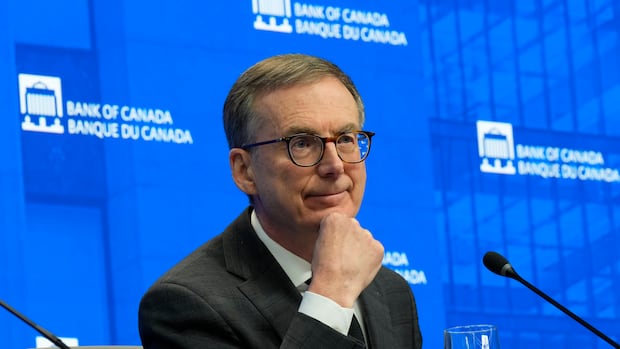
The central bank’s economic outlook has not evolved “significantly” since its projection in October, governor Tiff Macklem told media during a news conference in Ottawa on Wednesday.
“However, uncertainty around our forecast is heightened, and the range of possible outcomes is wider than usual,” he said during his prepared remarks. “U.S. trade policy remains unpredictable, and geopolitical risks are elevated.”
The upcoming review of the Canada-U.S.-Mexico Agreement on trade, or CUSMA, is a key source of economic uncertainty and an “important risk” to Canada’s economic outlook, noted Macklem.
“It’s pretty clear that the days of open, rules-based trade with the United States are over,” he said. “We need to get on and adjust to that.”
WATCH | Days of open trade with the U.S. ‘over,’ says BoC governor: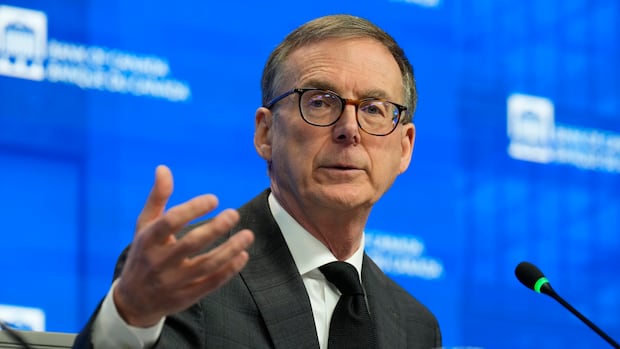
Bank of Canada governor says ‘it’s pretty clear’ days of open rules-based trade with U.S. are over
Tiff Macklem was asked Wednesday how much the government’s trade diversification efforts can offset the impacts of U.S. tariffs. ‘The reality is, there’s more trade friction,’ with tariffs than without, Macklem said.
He also cautioned that Canada’s efforts to diversify trade won’t completely offset “structural” damage inflicted on the economy during the U.S. trade war.
Asked by the Wall Street Journal whether the outcome of the CUSMA negotiation will dictate future interest rate decisions, Macklem said “it is an important risk to our projection.”
The central bank’s current economic projections are based on a scenario in which U.S. tariffs against Canada remain in place and CUSMA-related exemptions maintain some free trade with the U.S. “That could change with the review,” he said.
Ongoing threats to the independence of the U.S. Federal Reserve are also contributing to “heightened” economic uncertainty, said Macklem, in Canada and elsewhere.
The governor recently signed a letter in support of U.S. Fed chair Jerome Powell, who is under investigation by the country’s Department of Justice after defying pressure by U.S. President Donald Trump to cut interest rates.
The U.S. Fed is the “biggest, most important central bank in the world, and we all need it to work well. A loss of independence for the Fed would affect us all,” Canada especially, Macklem said.
Joseph Brusuelas, chief economist at RSM, wrote in a note to clients that he doesn’t expect rates to change further this year. But the upcoming CUSMA review could “prove contentious.”
To that point, “any policy shift on the central bank’s part would likely be in favour of cutting rates should growth slow, labour slack increase or if there is a more pronounced break in economic relations with the U.S.,” he wrote.
Modest GDP gains expected in 2026-27
With Canadian population growth slowing and the economy adjusting to U.S. protectionism, the central bank expects modest GDP gains and that the inflation rate will stay close to its two per cent target.
After a strong third quarter, economic growth likely stalled in the fourth quarter as U.S. tariffs continue to batter Canadian exports.
But domestic spending “appears to be picking up,” and the central bank expects that business investment — which has slowed amid the uncertainty — will improve.
Employment has also risen in recent months, but Canada’s unemployment rate is still elevated at 6.8 per cent and few businesses plan to hire in coming months, according to the Bank of Canada’s most recently Business Outlook Survey.
The central bank is projecting annual average GDP growth of 1.1 per cent in 2026 and 1.5 per cent in 2027, “broadly in line” with the projections it made in its October Monetary Policy Report.
The current interest rate “remains appropriate” in keeping inflation close to target, but the central bank is “prepared to respond” if the outlook changes, Macklem told reporters, echoing remarks he’s made over the last several meetings.
The bank’s assessment that rates are at the right level doesn’t come as a surprise, said Avery Shenfeld, chief economist at CIBC Capital Markets, in a note to clients.
“If there’s a slight leaning here, it’s still towards some worries on the growth front due to uncertainties on trade, and a bit more comfort that underlying inflation is decelerating,” he wrote.
“We’ll stick to our forecast for no interest rate moves by the Bank in 2026, but see the odds of a further cut as more likely than a hike, given the potential minefield in trade negotiations ahead, and a starting point that still has significant economic slack.”