

Toronto Mayor Olivia Chow says the city’s dump sites are at ‘full capacity’ as crews continue removing snow after a major storm earlier this week.
The storm may be over, but the work is only beginning as Toronto now shifts its clean up focus to residential streets and transit routes.
On Wednesday, Mayor Olivia Chow and City Manager Paul Johnson said that Toronto now has nearly 1,500 workers deployed, dump sites operating at full capacity, and snow melters running around the clock as efforts switch from plowing to physically hauling snow out of neighbourhoods — a slower, more disruptive phase of cleanup following Sunday’s record storm.
According to Environment Canada, 56 centimetres of snow fell at Billy Bishop Toronto City Airport, with areas near Lake Ontario seeing the heaviest accumulation. Toronto police reported about 438 collisions in a 24-hour period, while the transit faced widespread disruptions.
As TTC CEO Mandeep Lali put it, Sunday’s storm was “once-in-a-generation.”
From plowing to hauling
Speaking to reporters. Chow said the city has had “1,300 city staff and contractors working non stop” since Sunday and is now adding more crews.
“And we are now redeploying an additional 175 staff. That’s 75 more than yesterday from other divisions. To accelerate the cleanup…”
She said the city has now moved fully into snow removal, not just clearing lanes, but physically taking snow away.
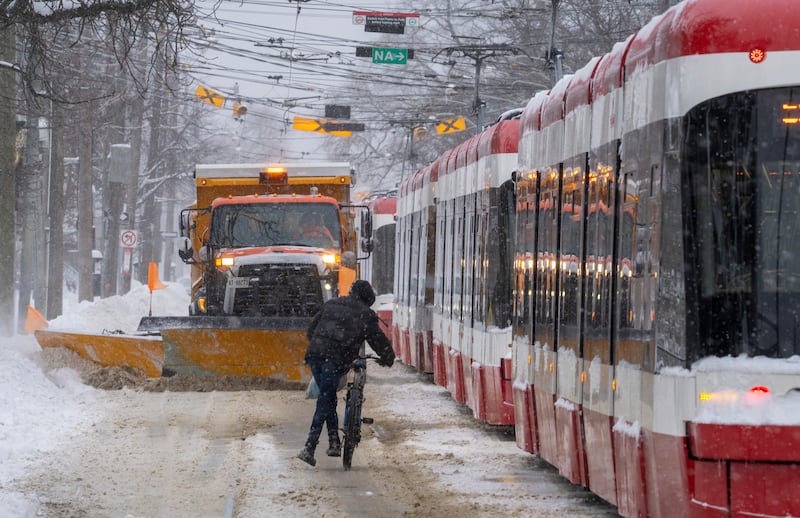 Toronto snowplow A cyclict hops off his bike to get out of the way of a snow plow while making his way past dozens of stranded streetcars during a severe winter storm in Toronto on Monday January 17, 2022. THE CANADIAN PRESS/Frank Gunn
“We began snow removal last night, we have completed clearing around some of the hospitals area. We’re now focusing on bridges, highways, transit routes and residential streets. We are prioritizing the narrow street first.”
Dump sites and snow melters, she said, are now the system’s biggest pressure point.
“Our dump sites are running at full capacity. Snow melters are operating continuously, and staff are identifying additional dump sites. We’re looking at two more to support ongoing operations.”
Residents, she added, should expect advance warning before crews arrive.
“If you see an orange sign coming in to your neighborhood… the crew will have these orange signs 24 hours before they arrive on your block.”
Inside the snow system
Johnson said the city’s snow disposal network is now operating at full tilt, adding that some sites see 50,000 tons of snow.
He said Toronto currently has five snow facilities running.
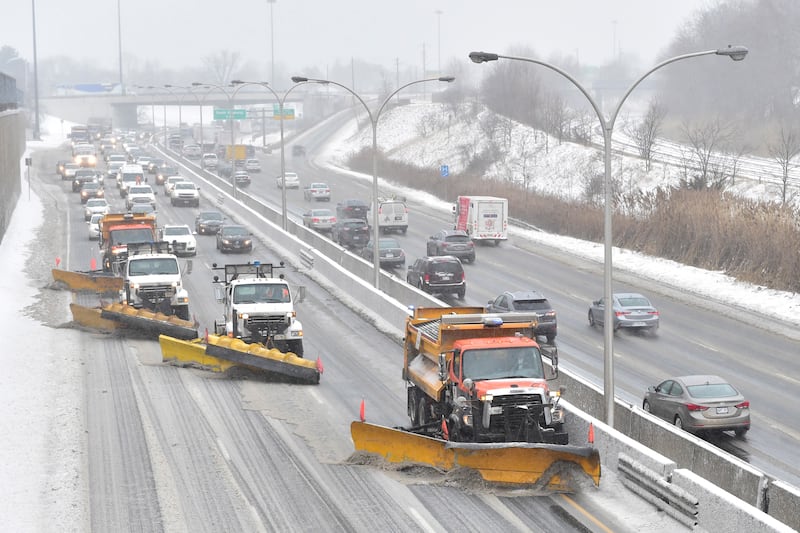 Toronto snow plows A line of snow plows clears the Gardiner Expressway in Toronto on Tuesday, Feb.12, 2019 after a winter storm hit the region. THE CANADIAN PRESS/Frank Gunn
“We have four of these melters in operation, and we are looking at other sites to store snow.”
Despite the scale of the storm, Johnson said the city believes it can keep up.
“In terms of our ability to complete our snow removal efforts over the next coming days, we have the capacity to do that.”
What to know about complaints and ‘orange signs’
While overall 311 call volumes remain high, Johnson said the nature of complaints has shifted.
“We’re still receiving around 3,000 to 4,000 311 calls on a daily basis… what’s ramping up is service requests… our number one service request related to winter is around sidewalks.”
He also acknowledged performance gaps.
“We have more inspections happening. Clearly, there’s a gap in our performance around sidewalks, and we’re hoping to improve that over the next 24-hour cycle.”
Clearing narrow residential streets, he said, depends heavily on residents moving their vehicles.
“When you see those orange signs, it means we’re getting ready… clear off that car, get ready to move that car, because the faster we can get down your street, the faster we can move on to the next…”
It should be noted that the city’s Major Snowstorm Condition remains in effect, meaning vehicles parked on “snow routes” could face a substantial fine and may be towed.
Johnson warned that failure to move cars slows the entire operation.
“Once we start our operation, we need the cars to be moved… so the really important piece is help us, because it saves us from having to do a friendly tow…”
As of Wednesday, he said, “we have up to 25 crews out there doing this work today.”