
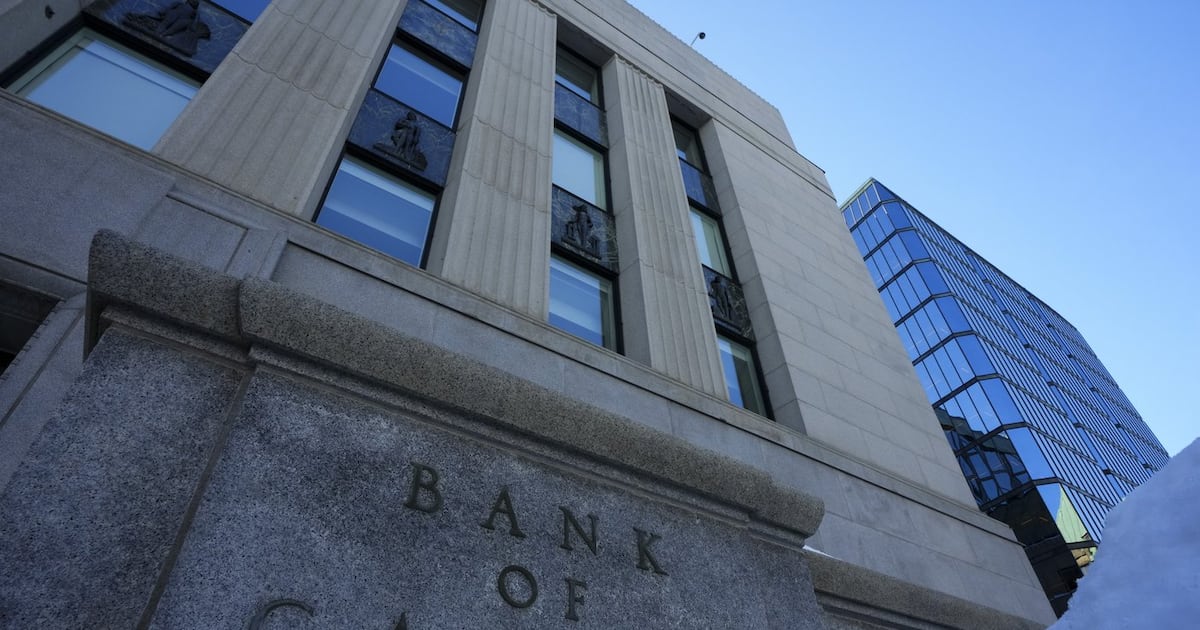
Canada’s central bank is still very worried about inflation, and may even cut rates in the future as the economy tries to recover from U.S. trade policies and geopolitical risks, economists say.
The Bank of Canada held its key interest rate at 2.25 per cent on Wednesday, with Governor Tiff Macklem saying he anticipates modest economic growth this year.
While the rate hold was widely expected, there was a noticeable shift in the tone of communications as the bank made its first rate announcement of the year, said Royce Mendes, managing director and head of macro strategy at Desjardins Group.
“They introduced more language about the uncertainty about the economy moving forward with regards to CUSMA , or with regards to geopolitical events,” said Mendes, adding that the bank sounded ‘dovish’ about the outlook and humble about its ability to forecast a future rate.
He said if the bank was forced into action, an economic shock would likely cause it to cut rates in the near term.
“I think they sort of acknowledge that a little bit more in today’s communications,” said Mendes.
Cutting rates could help exports
Canada’s domestic economy is weak, supported mainly by exports while the American economy thrives, Earl Davis, head of fixed income and money markets at BMO Global Asset Management told BNN Bloomberg.
He said the U.S. is outperforming and showing significant growth, which in turn helps Canada.
From a business perspective, cutting rates would weaken the dollar and attract international investment because the interest rate differential between Canada and the U.S. has a direct impact on the currency.
But there is a downside to that.
“They’re worried about inflation,” said Davis
He said cutting the interest rate further would increase the cost of goods and imports.
“We’re not in a recession. We still have positive growth so when you cut in that environment, it may stoke some inflationary winds,” said Davis.
“We’re above the target for inflation on the margin, they don’t want to push it a bit higher,”
What “Structural adjustment” means
Bank of Canada governor Tiff Macklem stated that the bank is focused on keeping inflation close to the two per cent target “while helping the economy through this period of structural adjustment.”
“What he means by that is, no matter how much he lowers interest rates, it’s not going to impact jobs,” said Davis.
“And the reason why it won’t impact jobs is because we’re not putting shovels in the ground right now.”
Davis said the impact of policy changes to boost project building won’t be visible for another five to 10 years.
He said the reason why the Bank of Canada focuses on inflation first and employment second is because lowering interest rates has an impact on the psyche and the psychology of the market.
“It makes people more willing to spend out there,” said Davis.
The productivity problem
Businesses in Canada are still trying to understand the cross border economics of the CUSMA deal, which is yet to be negotiated, said Davis.
He said when Canadian businesses put shovels in the ground, they’re looking at both the Canadian and American consumer perspective. Once they figure that out, lowering interests can help.
Growth stalled
Macklem said “U.S. trade restrictions and uncertainty continue to disrupt growth in Canada” and GDP growth stalled in the fourth quarter last year after a strong third quarter.
Unemployment numbers also rose in recent months with the unemployment rate currently sitting at 6.8 per cent.
“Businesses aren’t as confident right now,” said Davis pointing to the fact that while he expects Canadian growth to significantly underperform, his forecast remains positive.
Davis said Canada is a commodity-based country, and its potential for increased production depends on how much investment it can pull in by expanding its mines and improving access to its minerals.
“We have everything here in Canada. That’s a positive, but again, that’s a medium-to-long-term story. It takes a while for that to show up in GDP,” said Davis.