

In a win for Prime Minister Benjamin Netanyahu, lawmakers on Wednesday evening voted 62-55 in favor of the first reading of the 2026 state budget, following a two-day delay caused by last-minute Haredi demands related to the coalition’s ultra-Orthodox draft exemption bill. The legislation must pass two further readings to become law.
Under the state budget bill, expenditures for fiscal year 2026 will be around NIS 811.74 billion ($262 billion), consisting of a standard budget of some NIS 580.75 billion ($187 billion) and a development and capital account budget of approximately NIS 230.99 billion ($74.5 billion).
The budget includes NIS 112 billion ($34 billion) for defense, NIS 413 million ($133 million) for the Interior Ministry, NIS 3.34 billion ($1 billion) for the Foreign Ministry, NIS 63 billion ($20.3 billion) for healthcare, and NIS 887 million ($286 million) for religious services.
Among the major reforms featured in the 2026 budget are an opening up of the banking sector, a proposed loosening of tariffs on dairy imports, as well as an NIS 30 ($10) tax on e-cigarettes, marking the first attempt by an Israeli government to regulate the burgeoning market.
While the budget was initially supposed to be placed before the Knesset for its first reading on Monday evening, the vote was delayed after Haredi lawmakers objected to various changes to the military enlistment bill recommended by Knesset Foreign Affairs and Defense Committee legal advisor Miri Frankel Shor, including her call to pass the law “as a temporary provision for a maximum period of five years.”
Get The Times of Israel’s Daily Edition
by email and never miss our top stories
By signing up, you agree to the terms
This delay placed additional pressure on Netanyahu’s coalition, which had to begin voting on the budget this week in order to meet a legally mandated March 31 deadline. Under Israeli law, if the government fails to pass the budget by the end of March, the Knesset will automatically dissolve, triggering early elections three months later. Elections are currently slated to be held by late October.

Prime Minister Benjamin Netanyahu in the Knesset plenum, January 28, 2026. (Noam Moskowitz, Office of the Knesset Spokesperson)
Following feverish last-minute negotiations between Knesset Foreign Affairs and Defense Committee chairman Boaz Bismuth and representatives of the Haredi parties on Wednesday, both the Shas and Degel HaTorah factions supported the bill while Agudat Yisrael’s three MKs voted against it. Shas chairman Aryeh Deri was absent for the vote.
Degel HaTorah and Agudat Yisrael are the two factions comprising the larger United Torah Judaism party.
In a statement following the meeting, a spokesman for Degel Hatorah spiritual leader Rabbi Dov Lando said that the faction would “support the budget law on first reading and will insist that the conscription law be completed before bringing the budget law to second and third readings.”
According to Hebrew media, Bismuth agreed to hold a series of talks to iron out Haredi objections to parts of the bill. Later in the evening, several Yesh Atid MKs entered the staff area outside Bismuth’s office, apparently disrupting further talks with representatives of the ultra-Orthodox parties and drawing condemnation from Likud.
חברי הכנסת של יש עתיד התפרצו ללשכה של ח״כ ביסמוט כדי לעשות בלגן נגד הדיון הפנימי של החרדים על חוק הגיוס. תראו בסרטון המצורף את ח״כ משה טור פז, מרים מסמך שאינו שלו מהשולחן במשרד , מצלם בסלולרי והמשיך הלאה.
נאמר לי שזה מסמך סתמי עם רשימת חברי הוועדה.
נניח.
לכן זה בסדר? pic.twitter.com/T7bJRKy64w
— יקי אדמקר (@YakiAdamker) January 28, 2026
Explaining why his Agudat Yisrael faction was voting against the budget, UTJ chairman Yitzhak Goldknopf told lawmakers ahead of the vote that his community feels “persecuted” by a government that arrests yeshiva students who dodge the IDF draft.
“There are things that are more important than a budget, and in their name we oppose the budget. The State of Israel without the Torah of Israel does not need a budget,” he stated, accusing the government of turning yeshiva students into “criminals” and “second- or third-class citizens.”
“Our intention in this vote is not to overthrow the government,” he continued, adding a direct appeal to Netanyahu to postpone the budget vote until a law regulating the status of yeshiva students can be passed.
Agudat Yisrael opposes the current enlistment bill on the table, despite the fact that it would exempt yeshiva students from conscription, because it contains sanctions.
Opening the debate on the budget, Finance Minister Bezalel Smotrich boasted of Israel’s economic performance over the past two years of war, declaring it “nothing less than amazing.”
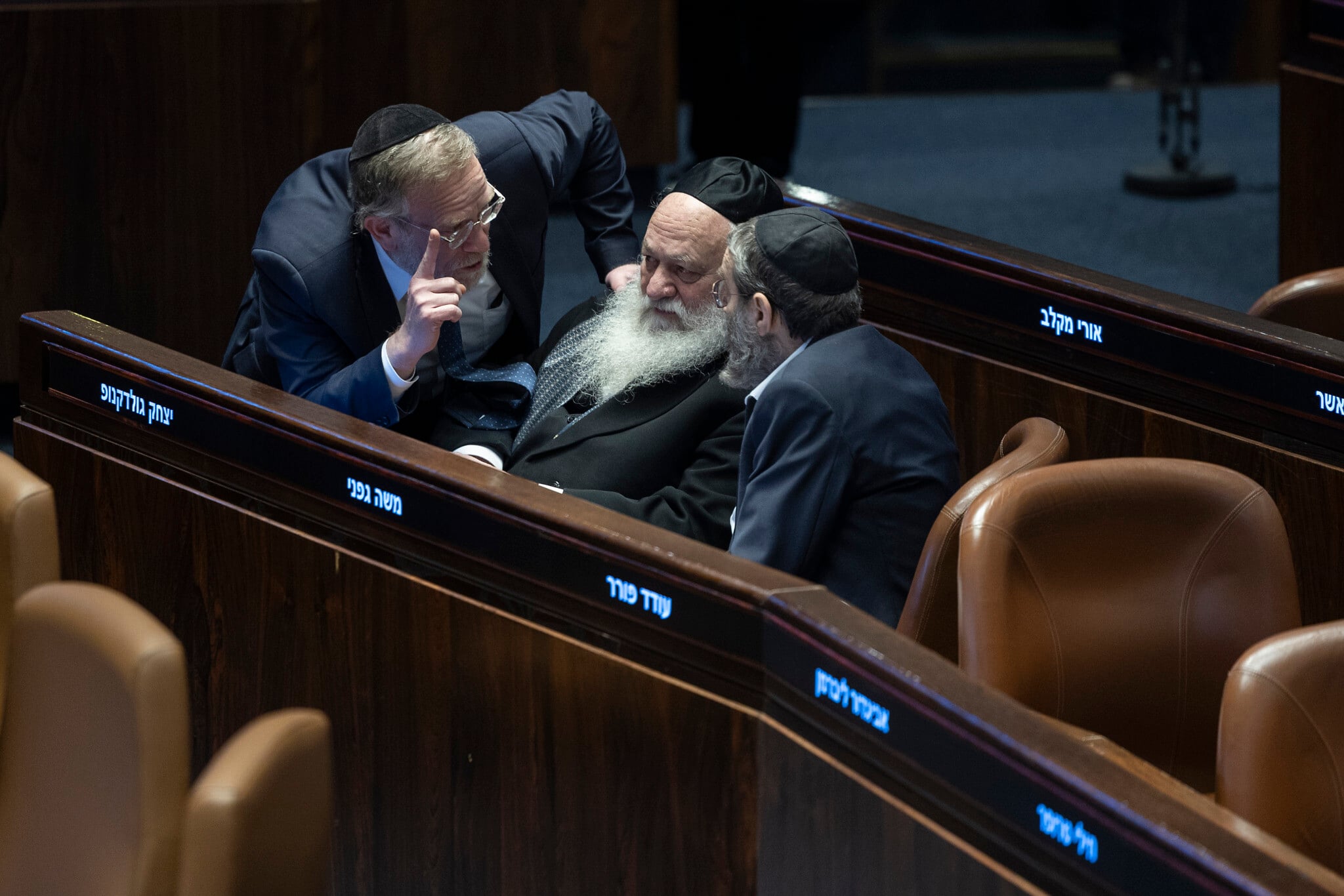
Agudat Yisrael chairman (center) speaks with members of his party during a vote on the 2026 state budget, January 28, 2026. (Oren Ben Hakoon/Flash90)
“After two years of a costly war, the State of Israel is a powerhouse of strength. We predict a 5.2 percent growth in GDP in the coming year. Inflation is returning to the target range, between 2% and 2.5%, we are curbing the cost of living and preserving the value of the money of Israeli citizens,” he said, calling on the governor of the Bank of Israel to “greatly lower the interest rate, quickly, and free the economy for growth.”
The state budget, he asserted, “is not just an economic document, it is a declaration of intentions and tells the world that the State of Israel and the Israeli economy are stronger than ever.”
As Smotrich spoke, several dairy farmers were removed from the visitors’ gallery after donning T-shirts reading “dairy farmer” to protest his proposed dairy reform.
The budget was also slammed by opposition politicians, with Opposition Leader Yair Lapid claiming it benefitted draft dodgers and the corrupt at the expense of the middle class, while Blue and White chairman Benny Gantz accused Netanyahu and Smotrich of drafting a budget more focused on the government’s political survival than the good of the country.
Speaking with The Times of Israel ahead of the vote, Yesh Atid MK Vladimir Beliak complained that “there are almost NIS 7.5 billion ($2.4 billion) in coalition funds, which is an all-time record…and all the benefits are received only by sectors close to the government.”
At the same time, he said, while “there is a cut in building classrooms and a cut in early childhood education.”

Yesh Atid MK Vladimir Beliak being removed from the Special Committee for the Communications Law at the Knesset, December 8, 2025. (Yonatan Sindel/Flash90)
In addition to passing the first reading of the 2026 budget, lawmakers voted 59-54 to pass the 2026 Arrangements Law in its first reading in the Knesset. The Arrangements Law, a key part of the annual budgetary legislative package, determines how funds will be disbursed.
They also voted 62-55 in favor of the first reading of the Deficit Reduction and Budgetary Expenditure Limitation Bill, setting the deficit ceiling for 2026 to 3.9 percent of GDP. The bill will be forwarded to the Knesset Finance Committee for preparation for its final two readings.
The Bank of Israel deems 3.9% as too high, since it does not allow for a reduction in the debt burden.
The budget deficit slipped to 4.7% of GDP in 2025 from 6.8% in 2023. A spike in defense costs due to the Gaza war pushed the deficit higher over the past two years.
Reuters contributed to this report.
You appreciate our journalism

You clearly find our careful reporting valuable, in a time when facts are often distorted and news coverage often lacks context.
Your support is essential to continue our work. We want to continue delivering the professional journalism you value, even as the demands on our newsroom have grown dramatically since October 7.
So today, please consider joining our reader support group, The Times of Israel Community. For as little as $6 a month you’ll become our partners while enjoying The Times of Israel AD-FREE, as well as accessing exclusive content available only to Times of Israel Community members.
Thank you,
David Horovitz, Founding Editor of The Times of Israel