
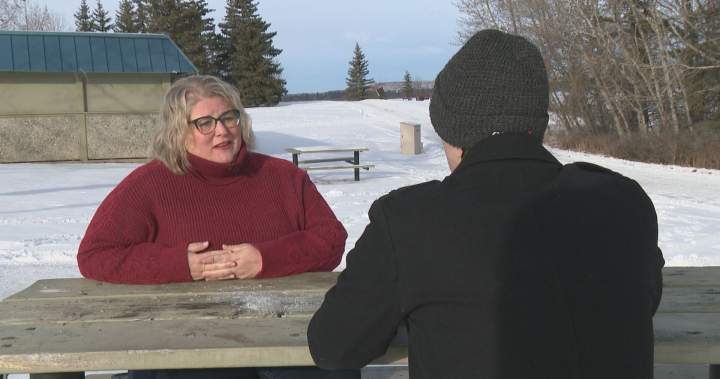
It was near the crack of dawn in June of 2024 when Sheri Stephenson got the call no parent wants to receive.

“He said, ‘Mom, I’m OK… I’m in an accident. Please come,’” she said.
Stephenson says she rushed to the scene of her son’s single-vehicle rollover west of Cochrane, Alta., within 15 minutes.
The scene was horrific — thankfully, her son was battered and bruised, but alive.
Stephenson says that car ride that felt like a lifetime, but for the family, the trouble was only beginning.
“It’s heartbreaking because tow trucks are often rescuers when people need help,” she said. ” I feel like they caused unnecessary harm.”
As she accompanied her son first to urgent care, then the Foothills Medical Centre, his older brother was working with the towing company called to the scene.
Story continues below advertisement
“There was a lot of back-and-forth text, and then the tow truck operator said in cases where there’s an impaired driver, we often get stiffed on the bill, so until you pay the bill, we’re not releasing his items,” she said.
Stephenson said her son wasn’t impaired and had been cleared by police at the scene.
“We had to call the police, the RCMP, who authorized the release of the items. Then the tow truck operator wasn’t able to meet us at a time,” Stephenson said. “He was too busy on a call.”
“Then we… went to the yard directly and it’s open and there’s people working so it felt like he wasn’t being very honest… and we were quite frustrated because we were pushing back when we were made more aware of our rights.
“It was like he was holding my son’s belongings ransom.“
The family soon received an invoice for more than $2,300.
On that bill, the operator stated her son was impaired, beginning a months-long runaround with insurance companies to recoup just some of the costs the family ended up paying.
“Thank goodness the folks at Urgent Care had done a blood lab screen right off the hop and of course it came back and proved that he wasn’t over the legal limit at all,” Stephenson said.
Story continues below advertisement
Stephenson’s story is one becoming all too common for law enforcement and towing officials in Alberta, who’ve dealt with the recent proliferation of what’s being called ‘predatory towing’ practices in the province.

Get daily National news
Get the day’s top news, political, economic, and current affairs headlines, delivered to your inbox once a day.
“Once Ontario came down with some strict regulations (in 2024), we saw a migration of new tow companies opening up in Alberta, and they started engaging in predatory practices,” explained Don Getschel of the Towing & Recovery Association of Alberta.
“We find that they’re taking the vehicles back to private impounds and charging anywhere from $2,000 up to $10,000 to retrieve that vehicle back within a day or two.”

7:42
Calgary mayor talks about several issues impacting the city
Previous Video
Next Video
It spurred a number of changes within the province in the past year — including the creation of the Alberta Motor Association’s Know Before the Tow campaign, bylaw adjustments in Calgary and Edmonton, and the province creating a 200-metre ‘exclusion zone’ around accident scenes in August of 2025 that prohibit tow trucks from entering unless requested by police or the driver of the vehicle.
Story continues below advertisement
Police in Calgary recently charged a 25-year-old owner of a towing company with multiple counts of fraud in relation to a predatory towing investigation.
“I wouldn’t say this one was necessarily a surprise,” explained Insp. Keith Hurley with the Calgary Police Service.
“(This case) came to us via insurance companies who had reported to the police that some of their clients were having difficulty getting their vehicles back.”
Calgary police statistics show more than a half-dozen companies have been investigated and closed their business since the bylaw was enacted last year, while two more are currently under investigation.
Trending Now

F-35 fighter jet purchase ‘remains under review,’ defence minister says

Toronto car exporter accused of laundering money for Hezbollah
Calgary Police detail some of the actions taken across the city since enacting a stiffer by-law against predatory towing practices in 2025.
Global News
“We’re hoping that this sends a very clear message. This won’t be accepted in Calgary. We will come after you and we will find you and we’ll charge you,” Hurley said.
Story continues below advertisement
But Hurley believes grey areas still exist within the province — and others say the tactics used by the companies are always changing.
“Not every small municipality will have (a bylaw like Calgary),” Hurley said. “So there’s a point of vulnerability there, I guess, that they may not be protected or may not have the proper laws to do that. So that’s that’s part of the provincial (law) that kind of does that overarching protection of the of the entire community.”
“Predatory (tow operators) will use people that are part of the public to do the solicitation on their behalf, and say, ‘I know a company that can come help you,’ and that will get around (the provincial exclusion zone law)… the unfortunate thing is there’s a lot of these complaints,” Getschel said.
More on Lifestyle
More videos
Until rules change, experts say knowing your rights is the best way to protect yourself from a bad situation becoming worse.
Getschel says having contact information for one or two local towing companies you trust in your phone or glovebox is a great first step.
“I think the consent one is crucial. Without consent, it is a complete violation of the Consumer Protection Act,” Getschel says. “Whether it be verbal or in writing, you can cancel the service at any point in time.”
“The police will never make you commit to a particular towing agency,” Hurley added. “The only exception that ever would be is if we need to move traffic along and we don’t time to wait for a particular company.”
Story continues below advertisement
Stephenson says she wanted to share her family’s story because she doesn’t want to see anyone else go through the experience they did.
But she’s hopeful for more action in the future to prevent operators like this from even having a home in the province.
“At the end of the day, the only thing I care about is my son’s life,” she said.
“And so a bill is a bill — but it was wrong.”
© 2026 Global News, a division of Corus Entertainment Inc.