
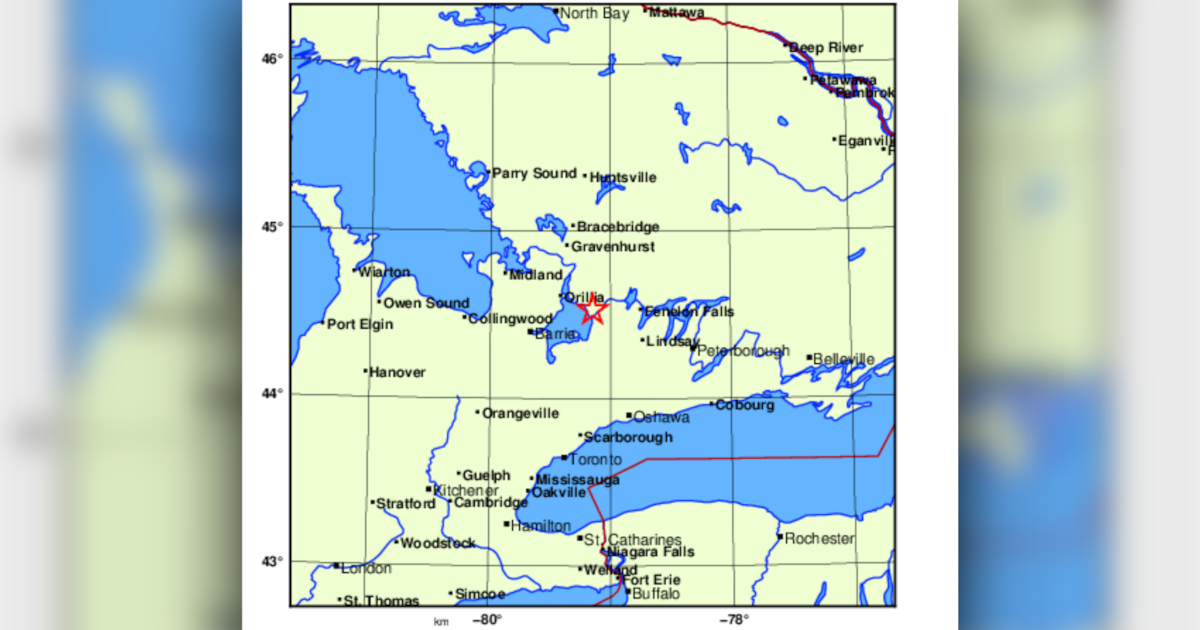
Science and Tech Expert Dan Riskin on the earthquake that struck near Orillia how it could be caused by glaciers melting from 10,000 years ago.
After days of shovelling and snowplows, residents across southern Ontario were reminded that unsettling forces do not always come from the sky. On Tuesday night, an earthquake rippled through a region more recently known for chilling weather extremes rather than tremorous ones—an event one seismologist says is quite rare.
The earthquake occurred 23 kilometres southeast of Orillia, just before 11 p.m. It was measured at a magnitude of 3.7, at a depth of five kilometres.
Robert Shcherbakov, an associate professor at Western University in the Department of Earth Sciences, says it has been decades since this particular area experienced an earthquake of a similar magnitude.
“There was only one probable earthquake in the last 40 years above magnitude 2.5, it was a really small one pretty close to that location where yesterday’s earthquake occurred,” Shcherbakov said.
While an earthquake at this magnitude is generally considered to be light, based on Richter’s scale metrics, which caps at a level of nine, it is considerably large for this part of the province.
“This area, like southern Ontario kind of Great Lakes region, is very much not prone to very large earthquakes at all. So, this was quite a rare event for this region,” Mareike Adams, seismologist with Natural Resources Canada, said in an interview with CTV News Toronto.
Ontario is situated in an intraplate region, Adams explains, which is a stable, continental area within the North American tectonic plate.
Athi Selvadurai, a researcher-programmer at the Ontario Science Centre, says Ontario is sitting right in the middle of that plate.
“Usually, an earthquake happens when stress in the crust builds up and the releases shock waves,” Selvadurai said in an interview with CP24.
According to Adams, this region has a relatively low rate of earthquake activity—though it’s not impossible to get some “large and damaging” earthquakes here, like one would see in the West Coast.
“You have a big subduction zone (in the west). So, there are interplates that (are) right at the interaction of plate boundaries to tectonic plates and you get very large and very active seismic regions there,” Adams said.
In eastern Canada, Adams says the seismic activity is related to regional stress fields, which are the tectonic forces pushing and pulling the Earth’s plates.
“They can also be related to kind of regions of crustal weakness,” Adams said. “We had really old faults that kind of get buried and everything, and so this can get reactivated and kind of move and push.”
Faults, Shcherbakov explains, are fractures inside the Earth’s crust, noting how large ones typically create big earthquakes.
That said, Adams says the exact cause of Tuesday’s quake is unknown.
Did you feel it?
The tremors were still felt by thousands of Ontarians across southern Ontario, going as far south as St. Catharines, Ont., and as far east as Kingston, Ont.
“Since we’re in this intraplate centre, this more homogenous material, this old cratonic material here where the seismic waves can travel quite far without losing a lot of their energy,” Adams said. “That’s something called attenuation, it’s how energy dissipates as earthquake waves move further and further from the source.”
With this part of Canada having low attenuation, Adams says seismic waves can travel further without losing a lot of energy, contributing to why more than 3,300 Ontarians reported feeling the quake.
Frost quake versus earthquake
On the wintry heels of back-to-back snowstorms in southern Ontario, one may have thought the tremors were caused by a “frost quake.” Adams, however, says Tuesday’s disruption was “a true earthquake.”
“Earthquakes, again, are caused by internal forces in the earth whereas a frost quake, it’s not really an earthquake in the sense that it’s related to more weather, meteorological factors,” Adams said, noting frost quakes are more commonly seen following a rapid cooling in temperatures.
Frost quakes are more common along the shores of the Great Lakes, Adams said, particularly after heavy rainfall or a big snow melt due to the excess water saturating the soil.
“If you get a very heavy, deep freeze overnight, all that water then freezes and as water freezes, it expands, and then it pushes on the ground around it, and that can kind of crack and pop,” Adams said. “It’s not related to internal forces and they don’t cause damage.”
Stronger earthquakes ‘extremely rare’ here
It would be “extremely rare” for this part of North America to experience an earthquake with a magnitude greater than five, Adams said. But it has happened in the past.
“There was a magnitude of five in the 1920s near Attica, New York, and then there’s also one near Cleveland that was also relatively that size,” Adams said.
Based off the regional seismicity reports from Earthquakes Canada, the largest earthquake felt in this Great Lakes region was on Aug. 12, 1929, at a magnitude of 5.5.