
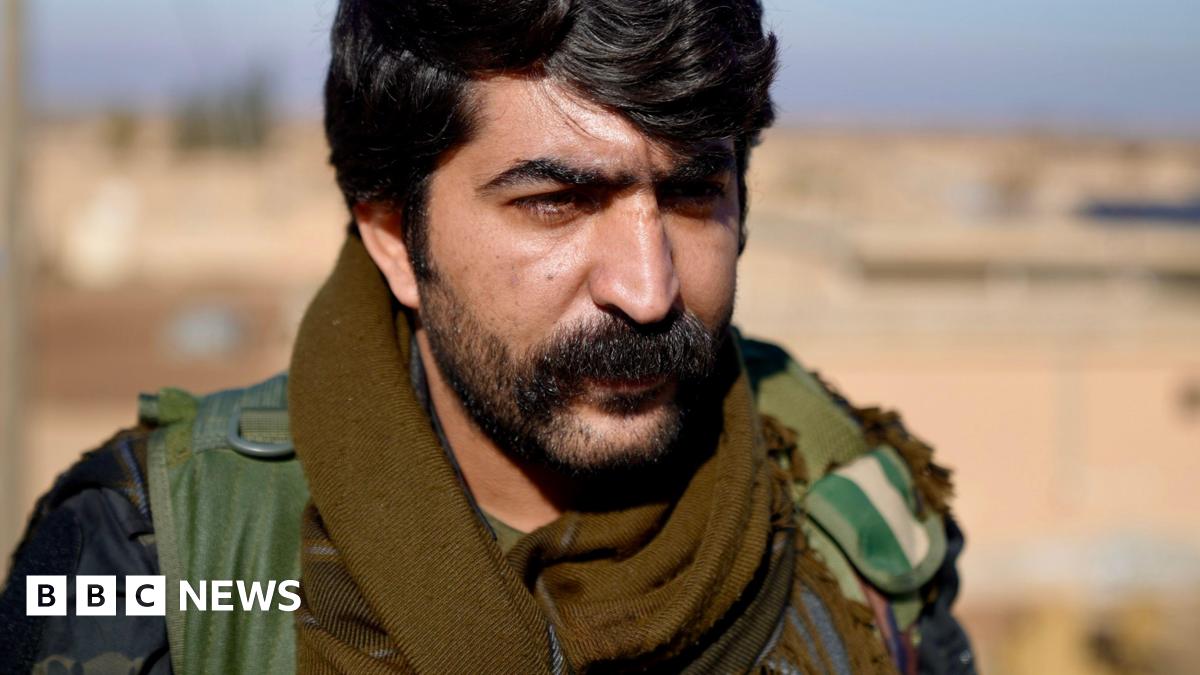
As conflict has flared, the White House has strongly backed Syria’s interim president, Ahmed al-Sharaa – a former Jihadi. That’s a slap in the face for the Kurds. The SDF lost 11,000 fighters battling the jihadis of IS.
Commander Azad compares the president to Abu Bakr al-Baghdadi, the late founder of IS. “They are the same thing. After Jolani took over, Syria will always be a war zone,” he says, referring to the president by his fighting name, Abu Mohammed Al Jolani.
Having fought US troops in Iraq, Al Sharaa set up an al-Qaeda offshoot in Syria, which was in fact fiercely opposed to IS though the groups had similar roots. He later broke with al-Qaeda, then in December 2024 swept to power in Damascus, ousting Bashar al Assad.
In the eyes of the Kurds, Al Sharaa is still a Jihadi, but now in a suit.
Commander Azad stiffly climbs the stairs to an open rooftop with a commanding view of flat countryside.
Below us sheep graze in the fields and clothes flaps on a washing line in a back garden. But a pick-up truck with an anti-aircraft machine gun is parked outside the door, and there is a cluster of troops in camouflage uniforms. This is the SDF’s last checkpoint in their stronghold of Hassakeh province.
“They [Syrian government forces] are in an Arab village seven kilometres from here,” he says, gesturing to the horizon. “So far, there is no danger. I hope there will be no war, but if it comes, ‘Let it be welcome,'” he says, quoting Che Guevara, Cuba’s revolutionary hero.
A fragile ceasefire between the two sides is due to expire on 7 February, but talks are continuing.
“We are focusing all our efforts on reaching a permanent ceasefire or a lengthy one,” says Siyamend Ali, of the People’s Protection Units (YPG), a Kurdish militia that is the backbone of the SDF.
“We don’t want war, but if we are forced down that path we will fight back. Every neighbourhood will turn into a hell for them.”