
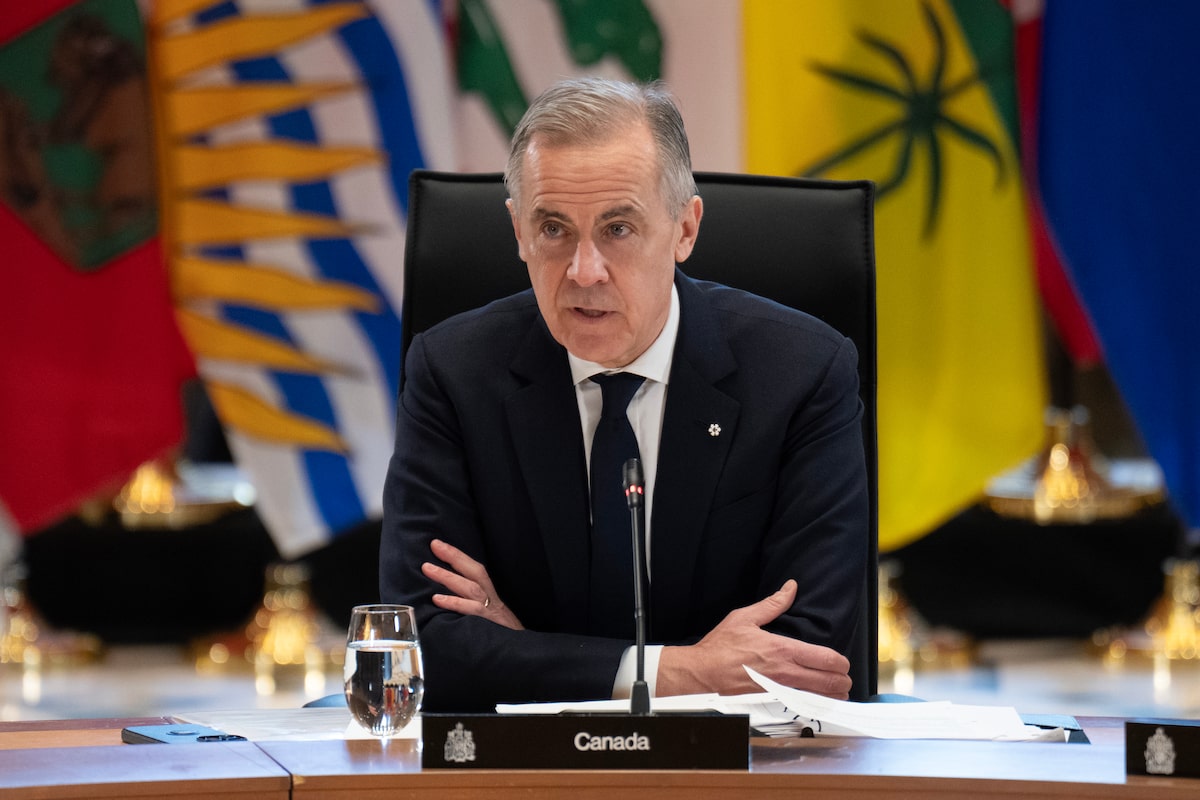
Prime Minister Mark Carney recently cut a deal with China to drop tariffs on some electric vehicles and invited Chinese companies to invest in Canada’s auto industry.Adrian Wyld/The Canadian Press
Prime Minister Mark Carney said Thursday that he would not negotiate in public over the possibility of Canada aligning more closely with the United States on rules for trade with other countries, even as the U.S. and Mexico appear to be heading in this direction in the run-up to a high-stakes review of the North American free-trade pact.
On Wednesday, the U.S. and Mexico agreed to formally start discussions about possible changes to the pact, the United States-Mexico-Canada Agreement, which is up for a mandatory review by the three countries this year.
In a statement, U.S. Trade Representative Jamieson Greer said that he and his Mexican counterpart, Marcelo Ebrard, agreed to look into “possible structural and strategic reforms” to the agreement. These include “stronger rules of origin for key industrial goods, enhanced collaboration on critical minerals, and increased external trade policy alignment.”
Mark Carney’s survival plan: Canada and other ‘middle powers’ must co-operate in order to thrive
This list suggests both countries are open to further integration of the continental market, while working together to reduce outside goods in North American supply chains – a position that analysts sometimes describe as Fortress North America.
This could run counter to Mr. Carney’s efforts to reduce reliance on the increasingly protectionist United States and end what he has called “deepening integration.”
In recent months, Canada and Mexico have moved in opposite directions when it comes to alignment with the U.S. on external trade policies.
Mr. Carney cut a deal with China to drop tariffs on some electric vehicles and invited Chinese companies to invest in Canada’s auto industry, breaking step with Washington. Mexico, meanwhile, has significantly increased tariffs on Asian countries, adding duties of between 5 per cent and 50 per cent on about 1,400 products from countries that don’t have a free-trade agreement with Mexico.
In a statement, U.S. Trade Representative Jamieson Greer said that he and his Mexican counterpart, Marcelo Ebrard, agreed to look into ‘possible structural and strategic reforms’ to the USMCA.Piroschka Van De Wouw/Reuters
Donald Trump initially shrugged off Mr. Carney’s deal with Beijing but subsequently threatened 100-per-cent tariffs on Canada if Ottawa pursued a trade agreement with China, and warned against Canada becoming a transshipment point for Chinese goods entering the U.S.
Asked Thursday whether Ottawa would agree to an external trade policy that’s more aligned with Washington, Mr. Carney declined to answer. And he pushed back on the notion that this review of the deal would lead to negotiations, despite the fact Mr. Greer has already signalled revisions sought by Washington.
“I find one of the most effective ways to negotiate is not to negotiate in public,” the Prime Minister told reporters at a press conference after a meeting with premiers. “We’ll wait until we have the broader discussions with the United States as part of a review, not a renegotiation but a review of” the USMCA, he said.
Opinion: An old idea for North American trade would be bad for Canada
The stakes for a successful renewal of the USMCA are extraordinarily high for Canada. Not only does it provide the framework for more than $1-trillion in annual Canada-U.S. trade, it has become a shield against U.S. tariffs as Mr. Trump has exempted products that comply with free-trade pact rules from his 35-per-cent “fentanyl” levy. This exemption covers more than 90 per cent of Canadian exports to the U.S.
Mr. Trump has suggested several times that he could replace the USMCA with bilateral deals with Canada and Mexico. It’s unclear what would happen to the tariff exemption in that case.
The challenge for both Ottawa and Mexico City is navigating the Trump administration’s disorienting approach to trade and foreign policy, which is at once inward-looking and imperial, hawkish on China yet eager to strike deals with Beijing.
Mr. Trump has said that the USMCA is “irrelevant” and that his country should not buy cars from Canada and Mexico, dismissing the industry that has been at the heart of continental integration for decades. He also put tariffs on key Canadian and Mexican industries, including steel, aluminum and automobiles, in breach of the USMCA.
U.S. President Donald Trump has said that the USMCA is ‘irrelevant’ and that the country shouldn’t buy cars from Canada and Mexico.Allison Robbert/The Associated Press
At the same time, by exempting USMCA-compliant goods from tariffs, he has forced more trade to happen under the auspices of the agreement. And his trade team, led by Mr. Greer, is assembling a policy framework that could bind Canada and Mexico more closely to Washington.
“There’s going to be a real geopolitical lens to the USMCA review … and it’s clear that China looms all over this,” said Geoffrey Gertz, a senior fellow at the Center for a New American Security in Washington and a former White House director for international economics in the Biden administration.
“A lot of those issues are tied to Mexico, in particular Chinese foreign investments into Mexico. But I think there’s a broader set of issues,” he said. “To have deep economic integration in the North American market – which I think ultimately is what USTR is pursuing – is going to come along with more common barriers towards common adversaries, chief among them clearly China.”
Until very recently, Ottawa has tended to march in lockstep with Washington when it comes to China – following its lead on steel and electric-vehicle tariffs and restrictions on Chinese companies operating in strategic sectors.
Opinion: Facing 100% tariff threat, Canada must swallow its pride and compromise
Mr. Greer laid out the U.S. vision for USMCA negotiations in a testimony to Congress in December. He said he would push Canada and Mexico to address specific U.S. grievances – which, in the case of Canada, include improved access to Canadian dairy markets and online streaming rules.
But he also said he would look to shore up a common continental market by pushing for stronger North American content rules for “non-automotive industrial goods,” and more collaboration between the three countries on economic security-related tariffs, export controls and investment screening.
Brian Clow, who served as deputy chief of staff to prime minister Justin Trudeau and played a significant role in the original USMCA negotiations, predicted U.S. demands for more closely co-ordinated trade policy will be a challenge for Canada.
“It’s going to be a significant flashpoint in these talks,” he said. “Putting together Trump and his team’s reactions to the Canada-China deal this month – that they’re not going to let Canada be a backdoor for Chinese components – with the changes Greer is seeking, I think it’s going to be a big, big part of what the Americans push.”
A review of the U.S.-Mexico-Canada free trade deal that is due to start later this year will be robust, Canadian Prime Minister Mark Carney said on Monday, describing U.S. President Donald Trump as a tough negotiator.
Reuters
He said co-ordinated trade policy on China was a major preoccupation of the 2017-18 USMCA negotiations.
U.S. concerns about Chinese involvement in North American supply chains have tended to focus more on Mexico than Canada.
The country lacks the foreign direct investment screening mechanisms that both Canada and the U.S. have in place, which has created concerns in Washington that Chinese auto companies might set up factories inside Mexico to gain duty-free access to the U.S. market. And it’s viewed by many in Washington as a backdoor for Chinese goods entering the North American market.
Mexico City’s move to increase tariffs on 1,400 products – including steel, aluminum, automobiles and home appliances – was welcomed by Mr. Greer in his congressional testimony in December, where he noted that “Mexico has taken significant concrete steps to address our concerns.”
With reports from Ian Bailey