
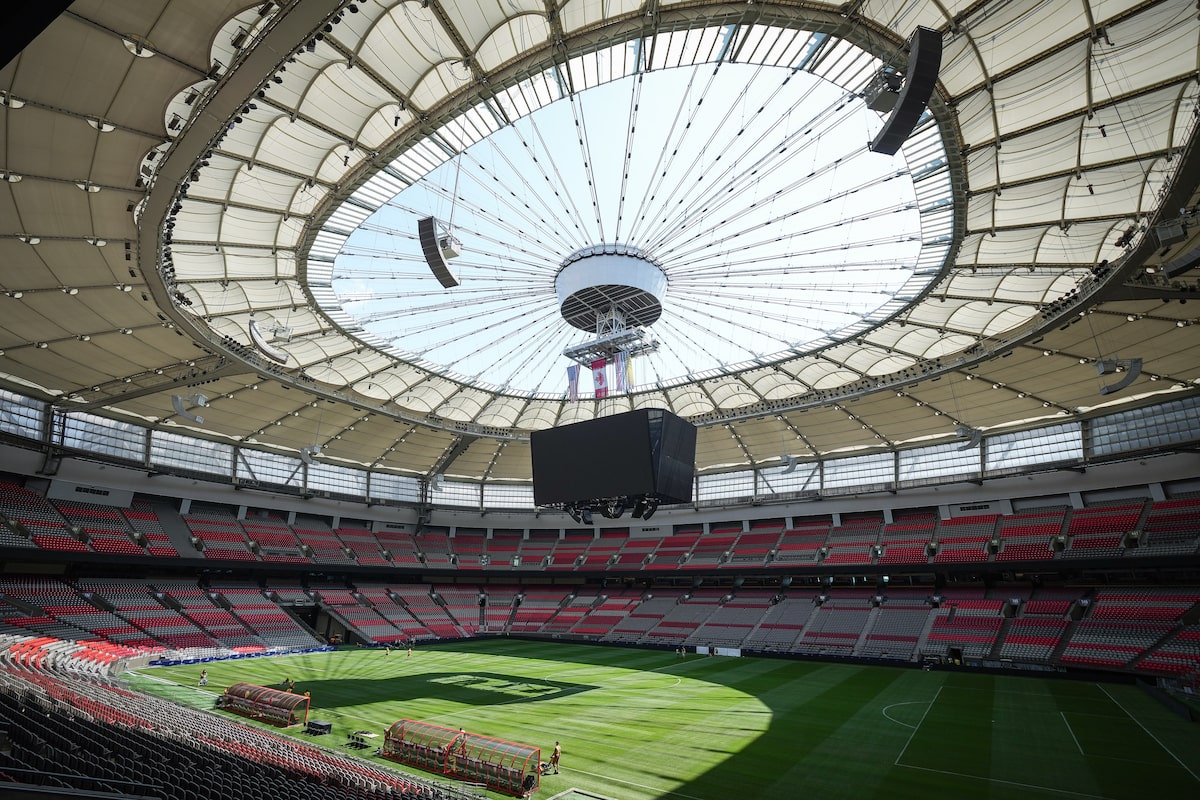
BC Place stadium in Vancouver, which is undergoing hundred of millions of dollars of renovations, is scheduled to host seven matches during the 2026 FIFA World Cup.DARRYL DYCK/The Canadian Press
Cost overruns for Toronto and Vancouver are among the highest of all 16 cities co-hosting the World Cup in June. But unlike their American counterparts, they’re not scaling back their plans for the soccer tournament – they’ve just increased the budget.
All the host cities in Canada, the U.S. and Mexico are feeling the pressure of rising costs, much of it driven by inflation, an expanded tournament format, stadium upgrades required by FIFA and higher than expected security costs.
But the response to these pressures has been different in Canada than in the U.S., because the Toronto and Vancouver host committees are publicly-funded extensions of their municipalities, while their American counterparts are private, non-profit organizations that can more easily fundraise or cut their budgets in the face of financial pressure.
Mexico’s model is different still, where soaring costs are being absorbed by a massive, multi-billion-dollar national infrastructure campaign designed to draw tourists to the country long-term.
Ex-FIFA president Sepp Blatter joins in calls for boycott of World Cup in United States
Toronto’s estimated cost to host FIFA’s marquee event has grown from an estimated $30-million to $45-million in 2018 to $380-million today – roughly ten times what city councillors approved when they first supported a bid. Vancouver’s estimated costs, meanwhile, have swelled from roughly $240-million in 2022 to $624-million shared between all three levels of government, according to the latest update from the province.
Politicians in both cities now swing between celebrating the tournament’s global status and bemoaning its skyrocketing costs.
“The World Cup is going to make a lot of money for a lot of people, but not for the City of Toronto or Vancouver,” Toronto city councillor Josh Matlow told The Globe and Mail. “There’s no rational way to suggest that there’s going to be a good return on investment when it comes to dollars and cents for our cities.”
A watch party during the FIFA World Cup group draws in Toronto in December, 2025.Nathan Denette/The Canadian Press
Similar complaints are being heard in American host cities, but the rising costs there have not been on the same scale as those in Canada. One major difference is the U.S. host cities are using a model that isn’t relying as heavily on public funds, and uses more private donors and local sponsorships in addition to whatever government dollars they can secure. Boston, for example, is raising tens of millions in corporate sponsorships to help pay for hosting costs expected to exceed USD$100-million.
One response by U.S. World Cup host cities to rising costs has been to cut back on their obligations for fan festivals, part of their original commitment to FIFA to hold outdoor watch parties for large crowds during the entire length of the tournament. Under backlash from host cities, FIFA has quietly relaxed these requirements, and has allowed them to plan more affordable, smaller-scale festival celebrations.
Seattle, where hosting costs are expected to be between US$45-million to US$65-million, is planning more limited fan festivals as a cost-saving measure – after dumping official FIFA FanFest branding events projected to cost US$1-million a day. Los Angeles, projected to spend more than USD$150-million on the World Cup, is running a shorter FIFA-approved celebration, before switching to smaller regional events operated outside the soccer federation’s control. New York, meanwhile, has said it will charge people for entering its organized fan events.
Seattle’s Lumen Field in June, 2023. Hosting costs for the city are expected to be between US$45-million and US$65-million.Steph Chambers/Getty Images
When asked if they’re cutting back on fan festival spending, Canada’s two host cities said they had no immediate plans to scale down these free events, or move to more budget-friendly celebrations outside of FIFA’s purview.
Vancouver says it will share cost estimates this spring for its FanFest events, which will include live concerts, game broadcasts and “immersive” fan experiences – all taking place at the PNE Fairgrounds at Hastings Park, with space for 25,000 people.
“While we are watching other host cities, our responsibility is to make decisions based on the realities and opportunities that most benefit our local community. We are taking a disciplined approach to ensure we deliver the strongest possible outcome within budget, and the total number of operating days will reflect that,” Elayne Sun, a spokesperson for the City of Vancouver, told The Globe.
There is a massive demand for World Cup tickets and savvy resellers could be big winners
She added that the city can offset some of those costs by selling premium tickets to FanFest events, which will include elevated seating, as well as food and commercial partnerships.
Sharon Bollenbach, executive director of Toronto’s bid committee, meanwhile, said the city can’t yet share an estimate for its FanFest costs, but “more details will be shared as plans are solidified.”
Sharon Bollenbach, executive director for FIFA World Cup 2026 at BMO Field in May, 2023.Tijana Martin/The Canadian Press
Toronto’s mayor Olivia Chow has questioned how the city wound up contractually obligated to host the World Cup when its costs are rising out of its control. Other cities, such as Chicago, Minneapolis and Calgary, walked away early in the bid stage when they lost their appetite to meet FIFA’s financial requirements. Montreal, meanwhile, dropped its bid when the Quebec provincial government withdrew financial support, saying the budget would have been difficult to justify.
Toronto’s city council first directed its deputy city manager to consider a joint bid to co-host the 2026 World Cup in April, 2014. Nearly four years later, it still didn’t have a memorandum of understanding with other levels of government to share hosting costs. That meant the city had to bid to host the tournament before it had any commitment from the province or the federal government that they would support it financially, according to a June report from the city’s auditor general.
FIFA President Gianni Infantino, United States President Donald Trump and Mexican President Claudia Sheinbaum look on as Prime Minister Mark Carney draws Canada during the FIFA World Cup draw at the Kennedy Center in Washington in December, 2025.Adrian Wyld/The Canadian Press
Ontario later committed up to $97-million, but as much of a third of that will be in the form of provincial services, not cash. Mr. Matlow says it’s all left the city in a compromised position as it’s moved forward with a plan to host – something former mayor John Tory called a “once in a generation opportunity to showcase Toronto to the world” in January, 2018.
“It was more than a risk. It was irresponsible and reckless and should never have happened,” the councillor said.
One of the largest costs to Toronto is the $123-million needed to upgrade city-owned BMO Field to meet FIFA’s strict requirements for World Cup games. Those renovations, which will add 15,000 temporary seats to the 30,000-seat stadium, will include four new videoboards and upgrades to the stadium’s hospitality suites, locker rooms, lighting, audio and broadcast infrastructure. Maple Leaf Sports & Entertainment, which owns the Toronto FC and the Toronto Argonauts, is contributing $23-million to the upgrades at BMO Field.
A worker tends to the pitch at BMO Field in September, 2025.Sarah Espedido/The Globe and Mail
Other World Cup host cities, such as Miami, didn’t have to take on major stadium renovations because they had NFL facilities big enough to meet FIFA’s requirements. Miami’s stadium, home to the Miami Dolphins, seats 65,000 people and has already hosted eight games during the FIFA Club World Cup 2025. Miami‑Dade County’s official hosting cost estimate is around USD$46-million.
Vancouver’s host stadium, the 54,000-seat B.C. Place, is also undergoing major renovations to meet FIFA requirements for hosting matches – including installing a temporary natural grass pitch. But unlike Toronto, which is paying for upgrades out of municipal coffers, the $196-million for stadium upgrades in Vancouver is coming from the provincial government. That’s because BC Place is owned by a provincial Crown corporation, and belongs to the British Columbia government.
Vancouver’s host committee says inflation and security expenses have been the biggest sources of its cost increases since 2022, the year it was confirmed as one of 16 host cities. The city’s projected costs, estimated to be over $600-million, are now among the highest of all host locations in the tournament.
To help pay for the games, the City of Vancouver introduced a Major Events Municipal and Regional District Tax of 2.5 per cent on short-term accommodations. The city said the tax, which came into effect on Feb. 1, 2023, could generate $230-million over seven years. The province estimates the tournament could draw 350,000 spectators to BC Place.
Youth soccer players kick a ball around on the field at B.C. Place in June, 2022.DARRYL DYCK/The Canadian Press
While Ontario premier Doug Ford has balked at giving more World Cup funds to Toronto, B.C. Premier David Eby has doubled down on his support for the tournament’s costs, saying more games in Vancouver “would not only be possible, but they would be incredibly welcome.” Vancouver is hosting seven games, while Toronto has six.
FIFA, meanwhile, defends the high cost of hosting, arguing there is a long-term return that will benefit host cities. According to the soccer federation’s own assessment, Canada will see $3.8-billion in positive economic output, including $2-billion in GDP, $1.3-billion in labour income and 24,100 jobs created between 2023 and 2026.
A look at past World Cups raises questions about whether these investments truly pay off, however. Taxation and Economic Policy, a Washington, D.C.-based thinktank, said 12 of the last 14 World Cups hosted since 1966 have resulted in financial losses for their host countries. The last three World Cups have had an average negative return on investment of 31 per cent, according to a recent report from the group.
“FIFA justifies these high costs and lofty demands with the promise of economic returns. It says North American cities will receive a huge influx of tourists eager to spend their money on hotels, restaurants, and other parts of the local economy which will make up for the lost revenues,” the report’s author, Page Gray, said.
“Other countries’ experiences are less convincing.”
The FIFA World Cup Trophy is displayed during the FIFA World Cup playoff draw in Zurich in November, 2025.Claudio Thoma/The Associated Press
-with a report from Andrea Woo