

Released: 2026-01-30
Real GDP by industry
November 2025
0.0%
(monthly change)
Real gross domestic product (GDP) was essentially unchanged in November, following a 0.3% decline in October, as contractions in goods-producing industries offset expansions in services-producing industries.
Chart 1

Real gross domestic product is essentially unchanged in November
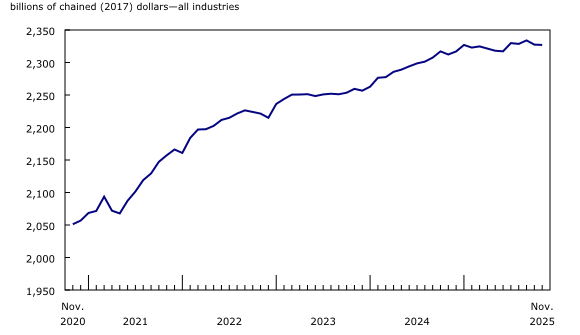
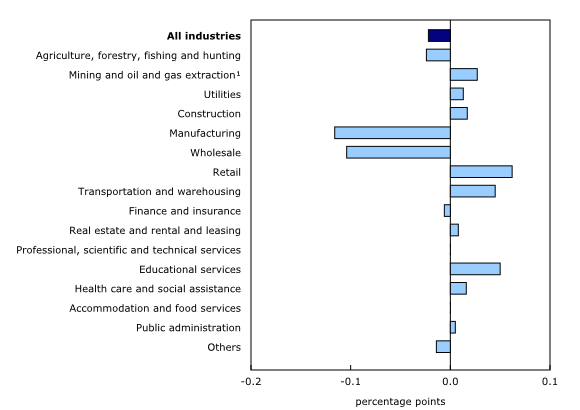
Goods-producing industries declined 0.3% in November, down for the third time in four months, driven by contractions in the manufacturing and agriculture, forestry, fishing and hunting sectors in the month. Services-producing industries edged up 0.1%, with expansions in the retail trade, educational services and transportation and warehousing sectors. Overall, 10 of the 20 industrial sectors grew in November.
Manufacturing sector down on supply chain bottlenecks
The manufacturing sector fell 1.3% in November, with decreases in both durable-goods and non-durable-goods manufacturing industries.
Chart 2
Manufacturing sector continues to contract in November
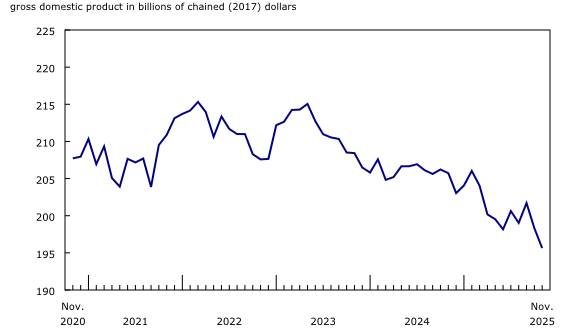
Durable-goods manufacturing industries declined 1.9% in November, following a 2.6% drop in October. Transportation equipment manufacturing (-3.8%), machinery manufacturing (-2.5%) and fabricated metal product manufacturing (-2.1%) contributed the most to November’s decline. Output of motor vehicles and parts manufacturing (-6.4%) was largely constrained by a global semiconductor shortage, curtailing auto production at a major assembly plant in November.
Durable-goods manufacturing has declined in November to levels last seen in mid-2011, excluding the first half of 2020 when the COVID-19 pandemic began. Since the aggregate’s peak in March 2023, machinery manufacturing, fabricated metal product manufacturing, and primary metal manufacturing have contributed the most to the decline.
Non-durable-goods manufacturing industries decreased 0.8% in November 2025, driven in large part by monthly contractions in food manufacturing (-1.6%) and plastics and rubber products manufacturing (-3.7%). Meanwhile, chemical manufacturing (+1.9%) and petroleum and coal product manufacturing (+0.2%) tempered the decline. The increase in petroleum and coal product manufacturing reflected continued strength in petroleum refineries (+0.7%), where output rose following the completion of maintenance and subsequent re-opening of a major refinery.
Wholesale trade sector down for the second straight month
The wholesale trade sector contracted 2.1% in November, the largest contraction since April 2025. Contractions in motor vehicle and motor vehicle parts and accessories wholesaling and building material and supplies wholesaling drove the decline in November.
Chart 3
Wholesale trade declines in November
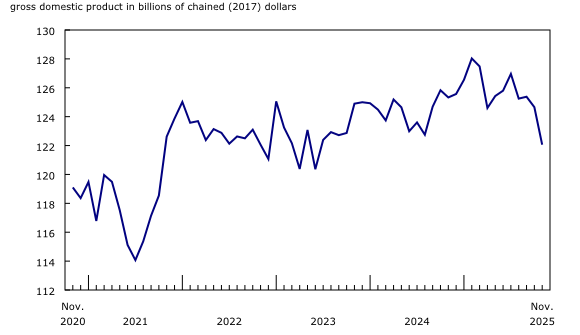
In November, motor vehicle and motor vehicle parts and accessories merchant wholesalers dropped 12.6%, reflecting lower activity in both the motor vehicle and used motor vehicle parts and accessories industry groups, coinciding with disrupted motor vehicle production activity due to the global semiconductor shortage.
Retail trade up on widespread strengths across all subsectors
The retail trade sector expanded 1.3% in November, as all subsectors grew in the month. This increase more than offset the back-to-back monthly declines in the two preceding months.
Chart 4
Retail trade sector grows in November
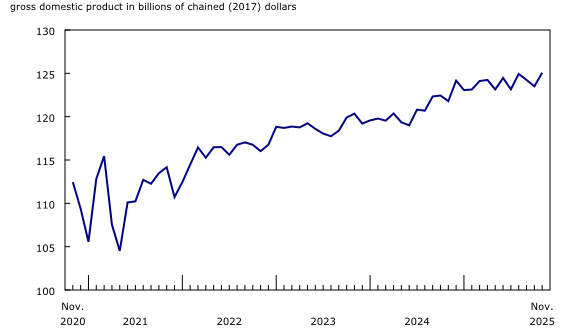
Food and beverage retailers (+2.5%) rebounded in November, reflecting higher beer, wine and liquor retailing activity, following the conclusion of a work action in British Columbia on October 26 that had disrupted activity since September 2.
A rebound in educational services largely boosts public sector growth
The public sector aggregate (comprising educational services, health care and social assistance, and public administration) rose 0.4% in November, more than offsetting October’s 0.3% decline.
Educational services (+1.0%) contributed the most to the increase in the aggregate in November, partially offsetting October’s contraction. The increase in educational services was driven in large part by a rise in elementary and secondary schools (+1.7%), as classes resumed in Alberta following the end to the teachers’ strike on October 29.
Expansions in health care and social assistance (+0.2%) and public administration (+0.1%) further supported the increase in the public sector in November.
Transportation and warehousing sector grows on postal service recovery
Transportation and warehousing rose 0.9% in November, as most subsectors expanded in the month. This increase more than offset October’s 0.8% decline.
The postal service subsector jumped 41.7% in November, largely offsetting October’s 31.4% decline. Mail and parcel delivery activities resumed after all job actions were suspended on November 21, following an agreement in principle between Canada Post and the Canadian Union of Postal Workers.
Chart 5
The postal service recovers in November
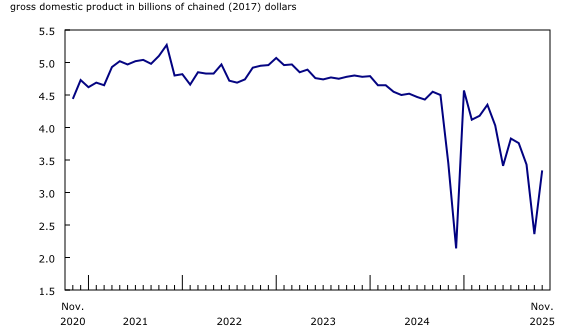
Warehousing and storage (+2.7%) further contributed to the growth in November, along with pipeline transportation (+1.4%). This was the pipeline transportation subsector’s first increase in four months, led by growth in pipeline transportation of natural gas (+2.1%) and higher crude oil and other pipeline transportation (+0.6%).
Agriculture, forestry, fishing and hunting contracts for the second consecutive month
The agriculture, forestry, fishing and hunting sector declined 1.1% in November, following a 0.6% decrease in October, as nearly all subsectors were down in November. Crop production (except cannabis) (-1.3%) was the largest contributor to the back-to-back monthly contractions in October and November, driven by declines in other grains and wheat crops.
Forestry and logging (-2.8%) declined for the third straight month in November. This was the subsector’s largest contraction since May 2023, bringing activity to a record low level, as timber harvesting companies scaled back production in response to sawmill production cutbacks and weak lumber markets.
Chart 6
Main industrial sectors’ contribution to the percent change in gross domestic product in November
Advance estimate for real gross domestic product by industry for December 2025
Advance information indicates that real GDP increased 0.1% in December. Increases in manufacturing and wholesale trade were partially offset by decreases in mining, quarrying, and oil and gas extraction. Owing to its preliminary nature, this estimate will be updated on February 27, 2026, with the release of the official GDP by industry data for December 2025.
With this advance estimate for December, information on real GDP by industry suggests that the economy decreased 0.1% in the fourth quarter and increased 1.3% in 2025. The official estimates for the fourth quarter and the year will be available on February 27, 2026, when the official estimate of GDP by income and expenditure is released.
100 years of measuring Canada’s economic conditions
In January 1926, the Dominion Bureau of Statistics, the predecessor of Statistics Canada, released the first issue of the Monthly Review of Canadian Business Statistics. That publication marked the beginning of Canada’s practice of issuing monthly statistics to monitor current economic conditions, bringing together timely indicators such as manufacturing production, employment, prices and trade figures to provide a coherent picture of the national economy.
In 2026, 100 years later, the Monthly GDP by Industry program proudly continues this tradition. While today’s estimates are compiled within the integrated framework of the Canadian System of Macroeconomic Accounts, the underlying objective remains unchanged: to provide timely, reliable and impartial statistics that inform understanding of Canada’s economic activity across industries on a monthly basis.
This release of monthly GDP by industry therefore marks a century of national, monthly reporting on economic conditions in Canada, reflecting the evolution of statistical methods and concepts over time, while maintaining a long-standing commitment to serving Canadians with high-quality economic information.
Sustainable development goals
On January 1, 2016, the world officially began implementing the 2030 Agenda for Sustainable Development—the United Nations’ transformative plan of action that addresses urgent global challenges over the following 15 years. The plan is based on 17 specific sustainable development goals.
The release on gross domestic product by industry is an example of how Statistics Canada supports monitoring the progress of global sustainable development goals. This release will be used to help measure the following goal:

Note to readers
General information
Monthly data on gross domestic product (GDP) by industry at basic prices are chained volume estimates with 2017 as the reference year. This means that the data for each industry and each aggregate are obtained from a chained volume index multiplied by the industry’s value added in 2017. The monthly data are benchmarked to annually chained Fisher volume indexes of GDP obtained from the constant-price supply and use tables (SUTs) up to the latest SUTs year (2022).
For the period starting in January 2023, data are derived by chaining a fixed-weight Laspeyres volume index to the prior period. The fixed weights are 2022 industry current price estimates.
Statistics Canada also produces expenditure-based GDP estimates at market prices, which are chained quarterly based on a Fisher volume index. Due to conceptual and statistical differences, GDP by industry and GDP by expenditure percent change estimates can diverge slightly.
All data in this release are seasonally adjusted. For information on seasonal adjustment, see Seasonally adjusted data – Frequently asked questions.
An advance estimate of industrial production for December 2025 is available upon request.
For more information on GDP, see the video “What is Gross Domestic Product (GDP)?.”
For more information on the impact of tariffs on key economic statistics, please consult: “How tariffs are conceptually reflected in key economic statistics.”
Revisions
Each month, newly available administrative and survey data from various industries in the economy are integrated, resulting in statistical revisions. Updated and revised administrative data (including taxation statistics), new information provided by respondents to industry surveys, and standard changes to seasonal adjustment calculations are incorporated with each release.
With this release of monthly GDP by industry, revisions have been made back to January 2025.
To satisfy the opposing goals for both timeliness and accuracy, Statistics Canada regularly updates (revises) its estimates of GDP. For more information about GDP revision cycles, please consult the “Revisions to Canada’s GDP” article in the Latest Developments in the Canadian Economic Accounts (Catalogue number13-605-X).
Real-time table
Real-time table 36-10-0491-01 will be updated on February 9, 2026.
Next release
Data on real GDP by industry for December 2025 will be released on February 27, 2026, including an advance estimate for the January 2026 reference month.
Products
The User Guide: Canadian System of Macroeconomic Accounts (Catalogue number13-606-G) is available.
The Methodological Guide: Canadian System of Macroeconomic Accounts (Catalogue number13-607-X) is also available.
The Economic accounts statistics portal, accessible from the Subjects module of the Statistics Canada website, features an up-to-date portrait of national and provincial economies and their structure.
Contact information
For more information, or to enquire about the concepts, methods or data quality of this release, contact us (toll-free 1-800-263-1136; 514-283-8300; infostats@statcan.gc.ca) or Media Relations (statcan.mediahotline-ligneinfomedias.statcan@statcan.gc.ca).