
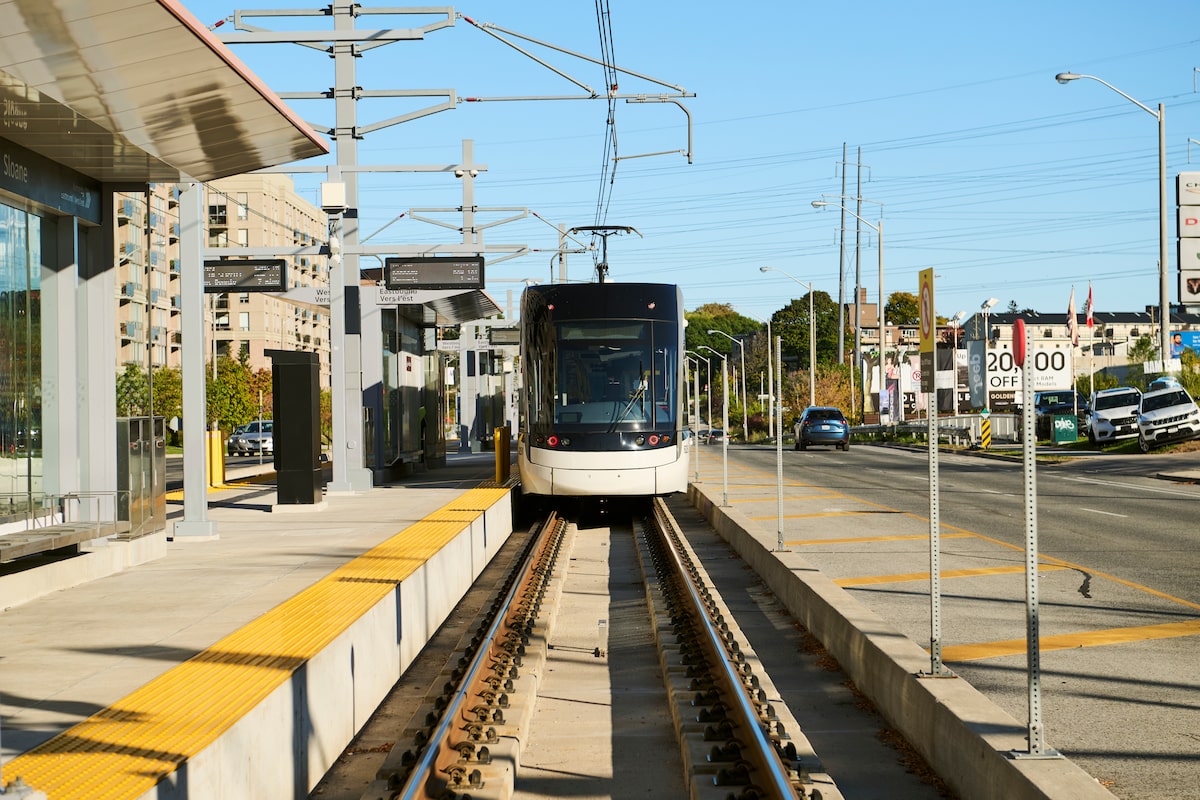
A test train departs Sloane Station during ongoing system testing for the Eglinton Crosstown LRT in Toronto in October, 2025.GABRIEL HUTCHINSON/The Globe and Mail
Just days before a potential opening of the long-delayed Eglinton Crosstown light-rail line, Ontario’s Metrolinx agency and the Toronto Transit Commission were at odds over a small number of incidents in which the vehicles’ automatic emergency brakes appeared to activate for no reason.
Two sources with knowledge of the 11th-hour efforts to launch the 19-kilometre line − which has been under construction for 15 years, at a cost of $13-billion − said the TTC had recently identified the problem as a potential safety issue.
The sources said TTC officials had found that a handful of times in recent testing, what appeared to be random emergency braking had brought cars to a halt. The Globe and Mail is not identifying the sources, as they were not authorized to discuss internal deliberations.
The TTC, which will operate the line, has been testing the Crosstown’s systems for months. Unlike most other existing TTC rapid-transit lines, the Crosstown was designed and built by a private consortium, overseen by the province’s Metrolinx agency. The consortium, Crosslinx, is also responsible for the line’s long-term maintenance, under what is known as a private-public partnership, or P3.
Toronto’s Eglinton LRT could open on Feb. 8, Ford says
On Tuesday, TTC chief executive officer Mandeep Lali declined to confirm to reporters that the transit line would finally open on Feb. 8, a date reported by local media and that Premier Doug Ford had acknowledged was the target.
By late Thursday afternoon, however, after meetings involving city officials, TTC brass and Metrolinx, the sources said technical explanations had been provided for the braking incidents, but would not elaborate. The two sources also said that Feb. 8 − Super Bowl Sunday − could still be the kickoff date for the Crosstown, although nothing official had been announced.
Asked whether the TTC had identified a safety issue with the Crosstown that could hold up the line’s launch, Metrolinx spokeswoman Lyndsay Miller referred The Globe’s questions to the TTC.
However, in an e-mail, she said that at a Jan. 20 meeting of top TTC and Metrolinx officials, the TTC had confirmed that “no safety critical issues were outstanding.” A thousand TTC and Metrolinx staff participated in a successful simulation of full operations last week, she added.
Ms. Miller also said that Metrolinx “has been working around the clock with the TTC to provide information and data in direct response to all TTC requests.”
The TTC did not immediately provide a comment. Alstom, the maker of the vehicles, declined to comment.
City officials had already undertaken planning for an event to commemorate the launch on Feb. 8. They had even approached local jazz-funk ensemble the Shuffle Demons to perform, 40 years after the release of their 1986 hit Spadina Bus, a rap-infused ode to the now-defunct TTC route.
The group’s Richard Underhill told The Globe that the band had not yet secured the gig and that he did not know where the ceremony would take place.
“As Trump might say, there is a concept of a plan. I was asked about availability and that’s about it so far,” Mr. Underhill said in an e-mail. “The idea was for the eighth, but that’s all I really know. No time, location or anything like that.”
The Crosstown project has become a poster child for a botched transit project, costing more than double early estimates and blowing more than five years past its initial 2020 completion date.
A Globe investigation found that the Ontario government of the day had ignored warnings that its plan to strip control of the construction from the TTC and hand it to its then-new Metrolinx agency and run it as a massive public-private partnership would result in delays, higher costs and legal wrangling.