
Mitch Sylvestre arrives at the heart of his message midway through an hour-long presentation.
With a series of infographics, screengrabs of tweets and headlines pulled from supportive news outlets projected on a screen behind him, he makes his case: thousands of kilograms of fentanyl are being sent to the U.S. from Canada; immigration is an effort to replace “old stock” white Canadians; money earned in Alberta is sent East and never returns.
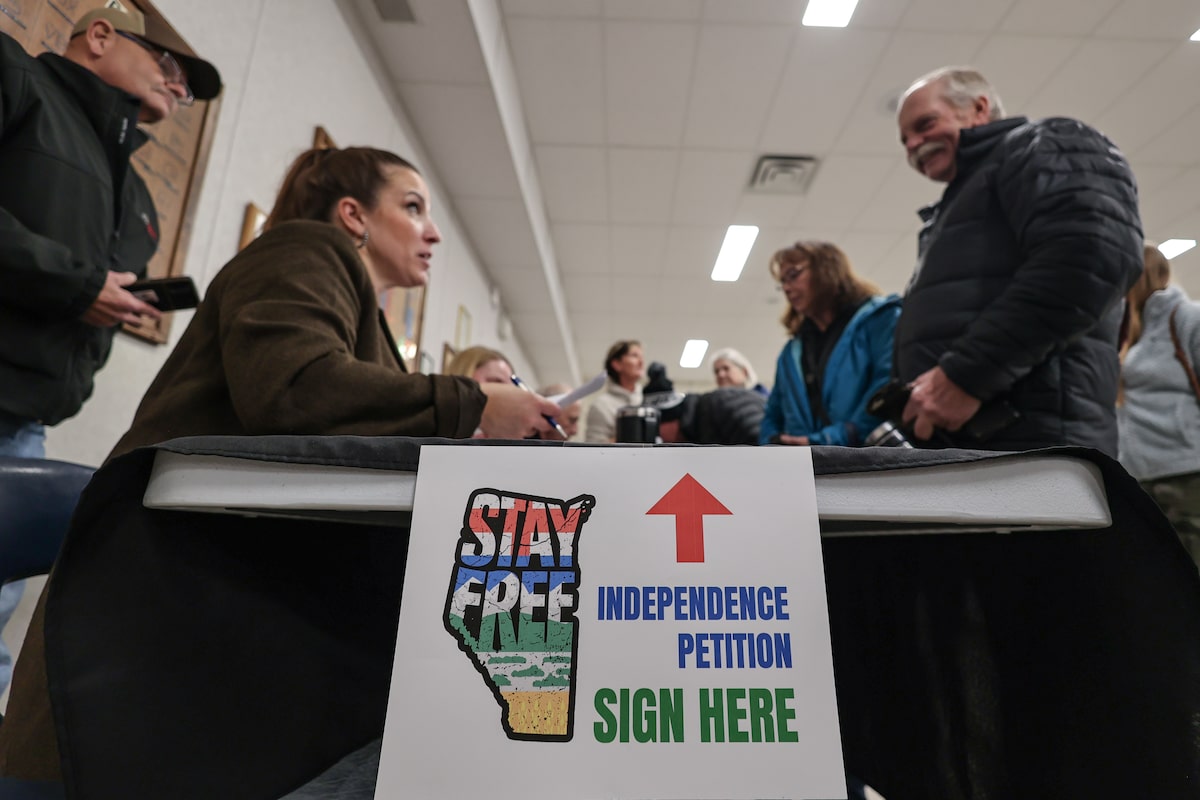
Listing grievances directed at Ottawa and standing at a lectern draped in an Alberta flag, Mr. Sylvestre is speaking on this cold January night at a community hall in Eckville, about two hours northwest of Calgary. At least 400 people have come to listen. Even more are just there to sign the petition trying to force Alberta’s first-ever separation referendum.
Mitch Sylvestre, speaking in Calgary on Jan. 26, has been travelling around Alberta making his pitch for the province’s independence.Amir Salehi/The Globe and Mail
“They’re lying to you,” says Mr. Sylvestre, about the “elites” in the East. “They don’t respect you and they’re stealing from you.”
“So, do they like you? They absolutely hate you.”
Mr. Sylvestre, 70, a United Conservative Party constituency president and sports-store owner from Bonnyville, has given this presentation nearly 100 times over the past year, continually tweaking to keep it relevant. Most recently, he added Prime Minister Mark Carney’s remarks in China about adapting to the “new world order.”
This is his pitch for Alberta independence.
The Globe and Mail attended three separatism campaign events in January, in Donalda, Eckville and Calgary, conducting interviews with movement leaders and speaking with nearly two-dozen supporters.
The referendum push, coming as Quebec voters consider a renewed dalliance with the separatist Parti Québécois, is happening during a period of sharpened focus on Canadian national unity that hasn’t occurred in generations.
Mr. Sylvestre’s campaign hinges on contempt for Ottawa, and the sense that the feeling is mutual. It’s a jacked-up version of the anger and frustration that has pervaded the province for decades: that despite Alberta’s abundant natural resources, and the revenue it produces for the country, the federal government continues to act against the province’s best interests.
Coen and Cali Panas and their children, draped in Albertan and American flags, attend an independence campaign event in Calgary.Amir Salehi/The Globe and Mail
This moment, however, is new. The landscape shifted with U.S. President Donald Trump’s “51st state” provocations and tariff threats.
Premier Danielle Smith, in response, embraced gentle diplomacy, punctuated by her trip early last year to meet Mr. Trump at his Florida Mar-a-Lago resort and her suggestion that the U.S. delay its trade war with Canada until after last year’s federal election to help the more “aligned” Conservative Leader Pierre Poilievre.
Mr. Trump’s threats undoubtedly propelled Mark Carney’s rise to Prime Minister – an outcome that many staunch independence supporters, Mr. Sylvestre included, cite as their breaking point with Canada.
The day after Mr. Carney’s election last April, Ms. Smith – who was partly elected UCP Leader on a pledge to wrestle more control from Ottawa – announced that she would be making it easier for Albertans to engage in “direct democracy.” This concept allows the electorate to force votes on government policy through petitions, changes that have ushered new life into the possibility of an independence vote, coming as soon as this year.
Alberta’s separatists, with their referendum question approved by Elections Alberta, have until May 2 to collect nearly 178,000 signatures, or 10 per cent of votes cast in the past election. If successful, Albertans will have to answer yes or no: “Do you agree that the province of Alberta should cease to be a part of Canada to become an independent state?” The referendum would be non-binding, but a Yes vote could trigger fraught negotiations between Alberta and Ottawa.
People queue to sign the petition in favour of Alberta’s independence at Eckville Community Centre. Organizers must collect nearly 178,000 signatures by May 2 to force a separation referendum.
Ahmed Zakot/The Globe and Mail
Support for independence, floating between 20 and 30 per cent according to most polling, has remained stagnant, despite several flashpoints in the past year.
Ahead of last year’s election, in March, Ms. Smith threatened a national-unity crisis if Mr. Carney didn’t respond to her demands to change federal energy and environmental policies and pave the way for a new bitumen pipeline. Ms. Smith then hit the road, holding a series of raucous provincewide town halls through the summer where separatism featured prominently.
In November, most of Ms. Smith’s demands were met in a milestone agreement signed with Mr. Carney, which she hoped would signal to Albertans that Canada can work – a sentiment for which she was booed days later at her party’s annual convention.
Throughout it all, Ms. Smith has continued to advocate for a “sovereign Alberta within a united Canada,” a position described by University of Calgary political-science professor Barry Cooper as “calculated ambiguity.”
Lawyer Jeffrey Rath is one of the people touring Alberta to garner support for the movement.AHMED ZAKOT/The Globe and Mail
Meanwhile, Mr. Sylvestre, his right-hand man, lawyer Jeffrey Rath, and a cadre of separatists have built their campaign organization, Stay Free Alberta. Events, popping up in cities and towns across the province, vary in shape and size. On a Tuesday night in Donalda, population 216, there is coffee, tea and bite-size snacks, and about 40 chairs set up in rows, about half of which are filled.
Stay Free Alberta has a list of speakers who show up to their events. In Donalda, it’s Chris Scott, a cafe owner from the town of Mirror, who was acquitted in 2023 of charges related to breaking COVID-19 public-health restrictions. He went on to build an online presence, currently dedicated to advocating for independence.
Mr. Scott boasts that they will reach a million signatures, which they hope will force the province to negotiate with Ottawa on the movement’s terms. “We are going to hold their feet to the fire. And when there’s a million plus signatures on this petition, that becomes much easier,” he says.
Organizers gathered donations and signatures for their petition at a Jan. 26 event at the Big Four Roadhouse in Calgary.
Amir Salehi/Globe and Mail
Independence leaders are unconcerned with the risks of separation and steadfastly believe Alberta would be better off without Canada, arguing that its natural resources offer leverage over Ottawa. And if they believe the provincial government is failing in negotiations, Mr. Rath says they’ll just “replace the government.”
“We’re building a political movement that will control the government of Alberta,” he said.
For months, Mr. Rath and his colleagues have trumpeted two meetings with U.S. State Department officials in Washington and say their message has been received by the Oval Office.
The White House and the State Department on Thursday confirmed those meetings, inviting accusations of treason from B.C. Premier David Eby; the day before, Ontario Premier Doug Ford asked Ms. Smith to pick a side.
B.C. Premier David Eby, right, accused separatists who went to Washington to seek U.S. support of engaging in treason.Patrick Doyle/Reuters
The Premier didn’t denounce the meetings, but said she expects the U.S. administration to respect Canadian sovereignty.
“I’m not going to demonize or marginalize a million of my fellow citizens when they’ve got legitimate grievances,” she said. “What we need to do is we need to give Albertans hope.”
Separatists’ rejection of U.S. statehood has not stopped Mr. Trump’s explicitly expansionist administration from weighing in on a potential referendum, raising concern that the campaign is laying out the welcome mat for unchecked foreign interference.
So far, despite images on social media showing crowds at rallies and lines to sign the petition, there is little evidence that the movement is growing.
Polling aside, the only metric of support came in a by-election last June when the separatist Republican Party of Alberta was trounced by the UCP in a riding where a strong strain of independence was believed to exist. The Alberta New Democrats secured more votes than the Republican candidate.
Prof. Cooper, with the University of Calgary, describes the current movement as a “warning” to Ottawa. Though Ms. Smith and Mr. Carney have signalled that their relationship is evolving, even warming, he said there are significant risks if their energy deal fails to yield results.
“I’m convinced that there will be a crisis between Alberta and Ottawa some time,” said Prof. Cooper.
Mr. Rath speaks at a campaign event in Eckville. Mr. Rath and his colleagues have said they attended two meetings with U.S. State Department officials in Washington, which has been confirmed by both the State Department and the White House.AHMED ZAKOT/The Globe and Mail
At their stop in Eckville, Mr. Rath works up a sweat as he riffs on a number of subjects while arguing that Ottawa is engaging in “the planned destruction of our province.”
He doesn’t fear being landlocked. Alberta, he says, would hold up trucks in transit to Ontario from B.C. and impose a punishing tariff on those goods: “Or would you rather let us have a pipeline? We’ll see how quickly Alberta remains landlocked under those circumstances.”
Sandra Shippelt, a canvasser in Eckville, says Canada’s cost of living is untenable, and she believes that an independent Alberta would be more affordable. She “loved Canada” but changed her mind about a year ago.
“If we were asked to come into Confederation with the deal that we have now, would you?” says Ms. Shippelt.
On Monday, Spencer Burton and Alicia Ward were among several hundred people adding their names to the petition at the Big Four Roadhouse on Calgary Stampede grounds. The young couple, 33 and 35, view independence as a bargaining chip.
“Change needs to happen, whether it ends up being Alberta separating or we end up working with Ottawa,” said Mr. Burton, who lives in Calgary.
Thomas and Jean Limqueco were among the people who signed the petition at the campaign event in Calgary.Amir Salehi/The Globe and Mail
Thomas Limqueco and his partner, Jean, who moved to Calgary from the Philippines 15 years ago, said they’re disillusioned with Canada’s immigration policy. Mr. Limqueco, calling Mr. Trump “the main guy” and “big dog,” said he felt Canada has no business standing up to the U.S. and didn’t object to joining Alberta’s southern neighbour.
“Here in the West, we’re more aligned with the U.S. I don’t see us being aligned with the people in the East,” he said.
Later that evening, over four thousand people packed the Stampede venue for a rally, many wearing blue ballcaps reading “Republic of Alberta,” some with Alberta flags draped over their shoulders, nary a Canadian flag in sight.
At the end of the night, as people left to make their way home, a catchy anthem, composed by an artificial-intelligence algorithm, boomed through the speakers: “Goodbye, elites, in Ottawa.”