
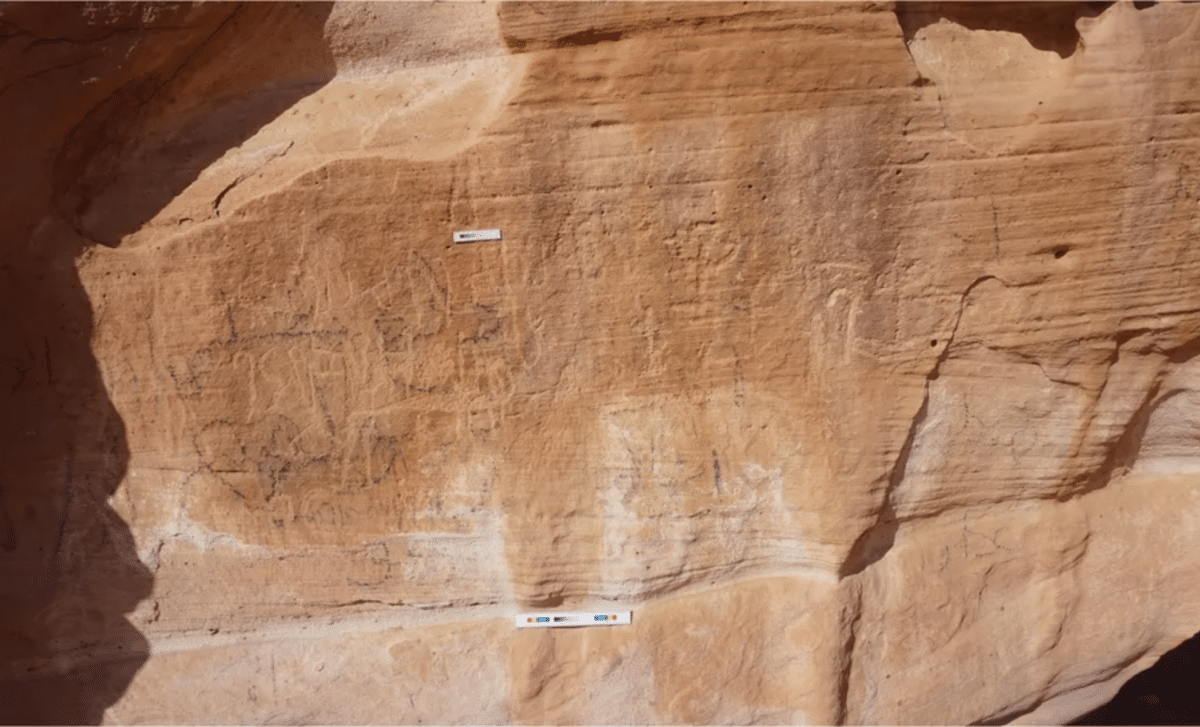
A newly documented rock panel in the Sinai Desert is shedding light on how early ancient Egypt projected power beyond the Nile Valley nearly 5,000 years ago. The findings, linked to a recent academic study published via idw-online.de, suggest that Egypt’s expansion into the Sinai Peninsula involved organized domination tied closely to resource control, rather than symbolic presence alone.
A Violent Scene Carved Into the Desert
The rock art panel presents a striking composition that leaves little ambiguity about its message. A victorious standing figure raises his arms in a dominant pose, while a bound, kneeling man is shown pierced by an arrow. Nearby, a carved boat reinforces the symbolism of authority and movement, a motif deeply rooted in early Egyptian ideology. Together, these elements form a narrative that communicates subjugation, power, and control with visual clarity.
Archaeologists interpret this imagery as deliberate political messaging rather than abstract ritual art. “[Looking] at the entire composition, we can assume the boat to have been associated with the Egyptian ruler, the triumphant man with god Min … and the subdued and killed man with the local inhabitants,” the archaeologists wrote in the journal.
This alignment of divine authority, royal symbolism, and defeated enemies points to an early form of state propaganda carved directly into the landscape.
The choice of location in the Sinai Desert reinforces the intent. This was not a hidden or ceremonial space. It was a frontier zone where visibility mattered and messages needed to endure.
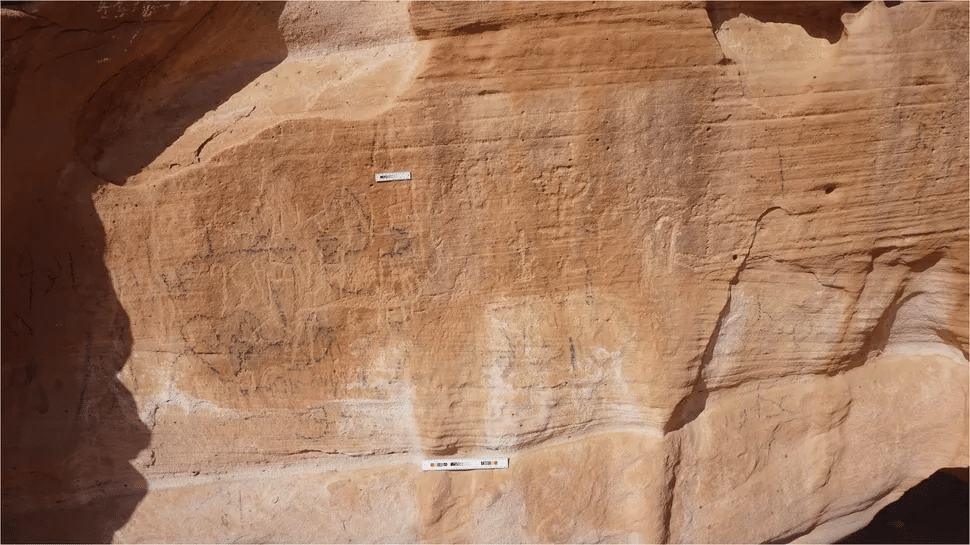 The 5,000-year-old rock art reads “God Min, ruler of copper region.” (Image credit: M. Nour El-Din)
Why the Sinai Mattered to Early Egypt
The motivation behind Egypt’s push into the Sinai was grounded in material reality. The region was rich in copper and turquoise, resources essential for tools, ornamentation, and elite status during the Early Dynastic period. Control over these materials translated directly into economic and political advantage.
“The motivation for the Egyptian expeditions to the south-western Sinai was not simply an abstract expansion of territory, but more specifically the availability of mineral resources, especially copper and turquoise,” the team wrote.
This framing places the rock art within a broader strategy of extraction and domination rather than isolated violence.
The study, referenced by idw-online.de, highlights how expeditions into the Sinai were structured and purposeful. Egypt was not reacting to threats but actively reshaping neighboring regions to serve its growing state apparatus. The rock panel functions as both evidence and declaration of that process.
One of the Earliest Images of Territorial Power
What makes this discovery particularly significant is its age and clarity. Visual representations of one society asserting control over another are rare from this early period. According to Ludwig Morenz, an Egyptologist at the University of Bonn, the importance of the panel extends well beyond its artistic value.
The “rock panel certainly represents one of the earliest depictions of dominance in another territory,” Morenz told Live Science in an email. This places the carving among the earliest known expressions of imperial behavior in human history.
The presence of an erased inscription near the boat adds another layer of intrigue. Archaeologists believe the name of a ruler was deliberately removed, hinting at political change or internal power struggles even at this early stage. The act of erasure itself underscores how seriously names, images, and authority were treated in ancient Egypt.
A Message Meant to Last
Carved into exposed rock, the panel was designed for permanence. Unlike papyrus or wood, stone ensured that the message would survive long after the individuals involved were gone. This choice reflects an understanding of time, memory, and landscape as tools of power.
The Sinai rock art shows that Egypt’s rise was neither quiet nor accidental. It was marked by calculated actions, symbolic violence, and a clear awareness of how images could enforce authority across space. As ongoing surveys continue in the region, researchers expect additional panels to emerge, potentially expanding this early chapter of Egyptian expansion.
What already stands clear is that long before monumental temples and royal inscriptions, Egypt was carving its dominance directly into the edges of its world.