
Toplines
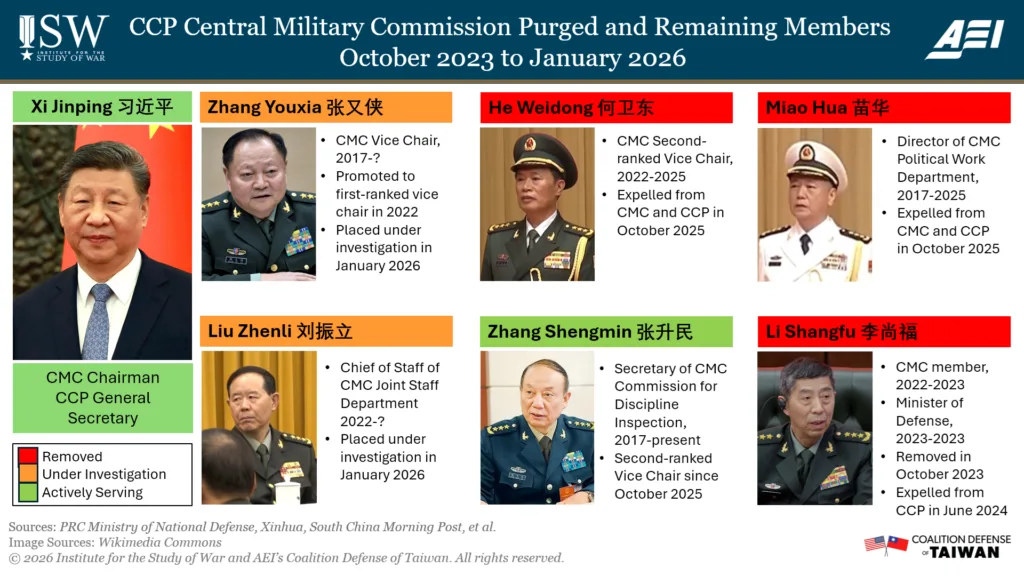
Chinese Communist Party (CCP) General Security Xi Jinping has expanded his military purges to include two of the most senior People’s Liberation Army (PLA) officers. Xi may have purged them because he saw them as undermining his leadership and military objectives. The continued purges have reduced the Central Military Commission (CMC) since 2023 from seven members to two members, including Xi, transforming the body into an extension of Xi’s will rather than a major military decision-making forum. The CMC purges consolidate Xi’s control over the military but risk isolating him or surrounding him with sycophants, which in turn risks military miscalculations.
Note: The ISW-CDOT January 30Special Reportprovides additional information and analysis on the purges.
The 2026 US National Defense Strategy (NDS) emphasized the need to bolster US and partner military strength in the Indo-Pacific but deemphasized competition with the PRC relative to previous NDS iterations. The PRC could perceive that framing as reflecting an opportunity to further assert its own regional influence. The Pentagon released the 2026 NDS on January 23.[1] The strategy prioritizes threats to the US homeland and in the Western Hemisphere over threats posed by the PRC or other US adversaries. The NDS did not mention Taiwan—unlike the 2022 NDS—which focused on strategic competition with the PRC and framed its aggressive behavior toward Taiwan as a central challenge to US national security.[2]
The 2026 NDS acknowledged growing PRC military power and the United States’ economic interest in preventing PRC dominance of the Indo-Pacific. The NDS characterized US strategy toward the PRC as not being “unnecessarily confrontational.”[3] The NDS focused on achieving US and partner defenses through burden-sharing, strengthening partner defense capabilities, and increasing partner responsibility for regional security in order to fortify the first island chain.
The PRC could perceive the NDS as signaling US reluctance to provoke the PRC or become entangled in protracted conflict. The CCP may feel emboldened if it concludes that the United States will not accept significant costs to defend its regional influence and interests.
Key Takeaways
PLA purges: CCP General Secretary Xi Jinping has expanded his military purges to include two of the most senior PLA officers. The purges risk isolating Xi while further consolidating his control and influence.
US policy: The 2026 US NDS emphasized the need to bolster US and partner military strength in the Indo-Pacific but deemphasized competition with the People’s Republic of China (PRC) relative to previous NDS iterations.
Cross-Strait Relations
Taiwan
Taiwan is hosting a Northrop Grumman ammunition testing range, reflecting increased efforts to test and integrate new defensive systems. Taiwan can enhance its defensive power by developing private-public defense partnerships and integrating into global defense supply chains. American Institute in Taiwan (AIT) Director Raymond Greene said in a speech on January 22 that the ammunition test range enables Taiwan to test ammunition to global industry standards and supports the development of Taiwanese indigenous defense projects.[4]
The Taiwanese decision to host the testing range reflects a growing interest in cultivating public-private partnerships critical to Taiwanese defense. Northrop Grumman announced a memorandum of understanding in September 2025 to cooperate with Taiwanese state-owned military research and development corporation National Chung-Shan Institute of Science and Technology (NCSIST) on “air and missile defense modernization for the Taiwan Ministry of National Defense.”[5] Taiwanese Vice President Hsiao Bi-khim previously highlighted the importance of public-private sector collaboration in preparing Taiwan for disasters or wars.[6]
Taiwan also launched a Joint Firepower Coordination Center in collaboration with the United States. Taiwanese media reported that that the center opened in Dazhi, Taipei, “to coordinate the asymmetric firepower deployment of various branches of the armed forces” and that the center employed US personnel.[7] Taiwanese Defense Minister Wellington Koo denied reports that the center housed US troops on January 26.[8] Taiwanese opposition Kuomintang (KMT) legislator Chen Yeong-kang said that the center supported the “T-dome” defense concept.[9] The T-dome concept aims to procure large amounts of mobile air defense systems and establish an Integrated Air and Missile Defense (IAMD) network through advanced sensor and command and control (C2) technology.[10] The PRC state-affiliated media outlet Global Times published an editorial on January 26, citing a source who called the center a “futile attempt to resist reunification,” a common narrative that the PRC levies at US-Taiwanese defense cooperation.[11]
The opposition Taiwan People’s Party (TPP) proposed an alternative special defense budget on January 26 that lacks funds to improve Taiwan’s air defense network. The KMT and TPP voted together on January 23 to block President William Lai Ching-te’s Special Budget for Asymmetric Warfare for the eighth time since December 2025.[12] TPP Chairman Huang Kuo-chang held a press conference on January 26 to announce the TPP’s own version of the special budget.[13] The TPP version of the bill reduces the maximum spending to approximately 12.8 billion US dollars, a significant decrease from the Lai administration’s version of the bill, which capped spending at approximately 40 billion US dollars.[14]
The TPP version of the bill cut spending for the “T-Dome.”[15] The TPP version of the bill also cut funds for establishing “non-red” supply chains in the defense sector that would reduce Taiwanese reliance on the PRC for any of its systems or parts.[16] Both the ruling Democratic Progressive Party (DPP) and Taiwan’s Ministry of National Defense (MND) have criticized these omissions.[17]
An advanced IAMD network would support Taiwanese efforts to implement an asymmetric defense strategy because it would greatly improve the survivability of its other systems and platforms. The PLA assumes that a “joint firepower strike campaign” that coordinates ground- and air-based precision fires against key elements of Taiwan’s military, such as its C2 network, would degrade Taiwan’s ability to defend itself prior to an amphibious landing on the island.[18] The PLA will likely target high-end systems for which both the administration and TPP versions of the special budget provide, such as the Paladin 155mm howitzer and HIMARS multiple launch rocket system (MLRS), in a precision strike campaign. A Taiwanese IAMD network that integrates lessons from conflicts in Ukraine and the Middle East, where IAMD networks have proven effective against large-scale missile and drone strikes, would greatly improve the survivability of those platforms needed to defend the island from a PLA landing.[19]
The KMT’s reaction to the TPP’s alternative budget proposal suggests that the final opposition-backed defense spending bill will include significant cuts to the DPP’s version of the bill. KMT caucus chair Lo Chih-chiang did not directly respond to questions regarding the KMT’s position on the TPP’s version of the bill.[20] Lo instead insisted that the KMT’s position toward the administration’s version of the bill has remained consistent, and reiterated KMT demands that President William Lai Ching-te appear before the Legislative Yuan (LY) to answer questions.[21] The KMT made this demand of President Lai following the budget’s introduction in December, claiming that the proposal lacked “clarity.”[22] Deputy Secretary General of the KMT caucus Lin Pei-hsiang stated that the KMT would wait to convene the entire caucus before making a decision on the TPP version of the bill. KMT legislator Niu Hsu-ting alternatively stated that the KMT was preparing its own version of the special budget in accordance with its own priorities.[23]
The KMT criticized the administration’s version of the bill for lacking salary increases for military personnel and overspending on expensive and possibly delayed US equipment.[24] These criticisms suggest that a KMT version of the bill would contain significant cuts mirroring the TPP’s version. It is unclear whether the KMT can unite its members to support a significant decrease in defense spending, however. More pro-defense spending members of the KMT, such as Admiral Richard Chen, may be willing to support a robust, DPP defense budget with some concessions to KMT domestic priorities.[25]
Taiwanese prosecutors indicted a businessman and a retired government official on January 26 for allegedly attempting to recruit Taiwanese politicians and soldiers to spy for the PRC.[26] The PRC likely aims to embed compromised politicians in Taiwan’s government and political parties as spies and agents of PRC influence. Taiwanese prosecutors stated that Taiwanese businessman Cheng Ming-chia worked for several United Front organizations to protect his business interests in the PRC beginning in 2016, including serving in high-ranking positions in two organizations targeting Taiwanese youth.[27] The United Front is a whole-of-government and -society effort by the CCP to co-opt non-government segments of society that the PRC deems subject to its rule.[28] United Front work targets various sectors of Taiwanese society through civil organizations, academic exchange programs, religious and cultural exchanges, business communities, ancestral hometown associations, and co-opted Taiwanese online influencers.[29]
Cheng also recruited Hu Peng-nian, reportedly a former section chief in the public relations office of Taiwan’s Executive Yuan, in 2021.[30] Cheng arranged a meeting between Hu and a PRC United Front Work Department (UFWD) official surnamed Chen.[31] Chen allegedly ordered Hu to form an espionage network in Taiwan targeting former and active-duty Taiwanese military and young politicians from various parties who recently entered politics to gain access to sensitive government information.[32] The prosecutors stated that most of the targets Hu and Cheng approached refused their offers.[33]
The PRC may view younger politicians as easier recruits due to their potential political inexperience and need for campaign funding. PRC espionage operations have targeted staffers and politicians from all three of Taiwan’s major parties in recent years, including illegally providing campaign funding to candidates.[34] The PRC may also be attempting to cultivate influence within the next generation of Taiwanese leadership. PRC efforts to influence Taiwanese politics ultimately aim to subvert Taiwan’s democracy and cause Taiwanese political leaders to accept PRC claims of sovereignty over Taiwan.
China
The PLA is enhancing its efforts to integrate unmanned systems into its operational concept for an amphibious invasion. The PLA is developing and testing unmanned vehicles to conduct reconnaissance and precision strikes in advance of a major amphibious landing. The PRC state broadcasting service CCTV released footage on January 16 of several kinds of unmanned aerial vehicles (UAV) supporting PLA Navy (PLAN) maritime operations. The CCTV footage highlighted the “Xuange-500CJ” unmanned helicopter shown taking off from what is likely the rear helipad of a Type 071 Landing Platform Dock (LPD).[35] The accompanying CCTV article stated that the unmanned helicopter could stay on the deck of PLAN amphibious assault vessels amid rough conditions with waves up to four meters. The article further stated that the Xuange-500CJ primarily has a reconnaissance function but could also act as an “information node,” possibly to coordinate with multiple other unmanned systems.[36]
CCTV quoted an expert who stated that the PLA would use UAVs and unmanned surface vessels (USV) to set favorable conditions for an amphibious landing force. The expert stated that various unmanned vehicles could clear obstacles ahead of the landing zone, conduct reconnaissance, and perform precision strike missions to ensure the main landing effort faced minimal resistance.[37] CCTV also released footage on January 21 showcasing the PLA’s ability to coordinate large-scale drone swarms with centralized C2 software.[38]
PLA journals published several articles in 2025 discussing integrating unmanned systems in a variety of roles into its operational concept for an amphibious landing.[39] PRC sources have described the PLA’s newest amphibious assault vessel–the Type 076 Landing Helicopter Dock Sichuan–as a “drone carrier,” suggesting it will provide unmanned system support to PLA amphibious forces.[40] The PRC greatly increased its drone production capacity through state-owned enterprises and private companies, with the value of the PRC’s domestic drone industry nearly doubling from 2024 to 2025.[41] PRC drone manufacturer DJI currently accounts for around 70 percent of the world’s commercial drone market.[42]
These developments will likely improve the PLA’s amphibious warfare capabilities in a Taiwan invasion scenario. Unmanned systems in the air, surface, and undersea could conduct shaping operations ahead of a main landing echelon to enhance the survivability of the PLA’s amphibious units as they approach their landing zones. UAVs could increase battlefield transparency, aiding PLA precision strikes against prepared defenses. USVs and Unmanned Underwater Vehicles (UUV) could clear mines and other obstacles impeding an amphibious landing while creating a screen around the main landing force to detect or neutralize Taiwanese USVs and UUVs aiming to interdict the landing echelon.
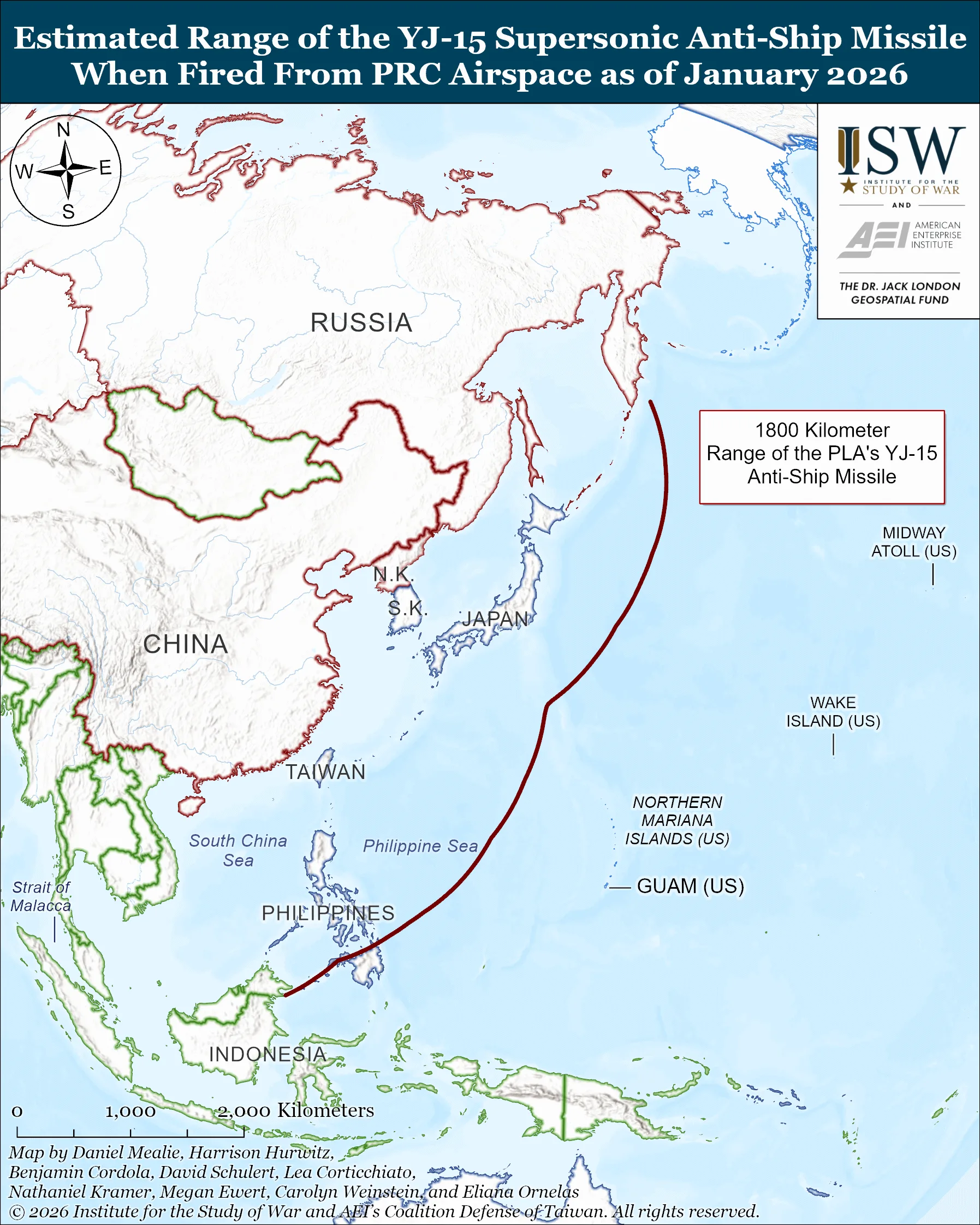
The PLA is aiming to improve the range and targeting of its H-6J naval bomber. This would enhance the PLA’s ability to prevent large US surface combatants, such as aircraft carriers, from maintaining a presence in the Western Pacific during a conflict around Taiwan. The PRC state broadcasting service CCTV released a video on January 14 on the PLA air force’s (PLAAF) bomber fleet, highlighting the H-6J’s enhanced capabilities.[43] The PRC-affiliated news site South China Morning Post published an analysis of the video that claimed the H-6J is now equipped with two reconnaissance pods and eight hardpoints for carrying anti-ship missiles. South China Morning Post likewise claimed that the H-6J would equip the PLA’s new YJ-15 supersonic anti-ship missile with an estimated range up to 1,800 kilometers, a significant improvement on its predecessor–the YJ-12 missile–which has an estimated maximum range of 400 kilometers.[44]
These improvements, although not confirmed, could greatly improve the H-6J’s ability to target US Navy surface combatants in the Western Pacific. The extended range of the YJ-15 would allow the H-6J to fire its armament at a much greater distance from its target. The presence of multiple reconnaissance pods may improve the H-6J’s situational awareness and targeting. US Air Force targeting pods typically use forward looking infrared (FLIR) imaging and a laser designator to detect and engage targets well beyond visual range with precision guided munitions.[45] Improving the H-6J’s targeting ability with similar reconnaissance pods would maximize the effectiveness of the YJ-15’s range. Neither CCTV nor South China Morning Post disclosed the specifications of the reconnaissance pods mounted on the H-6J, however.
The PLA is likely aiming to improve the H-6J’s targeting and armament to extend the range and increase the effectiveness of its anti-access area denial (A2/AD) strategy intended to prevent the US Navy from aiding Taiwan in the event of a conflict. The H-6J is likely meant to operate in tandem with PLA Rocket Force (PLARF) systems to saturate a US surface fleet with anti-ship missiles, should one attempt to penetrate the PRC’s A2/AD network. The 1,800-kilometer range of the YJ-15 would allow the H-6J to target much of the Pacific Ocean west of Guam and possibly interdict the sea lines of communication (SLOCs) between Taiwan, Japan, and Guam without leaving PRC airspace.
TikTok and ByteDance, announced on January 22 that they finalized a deal to establish a majority-US owned joint venture in compliance with US national security requirements. It remains unclear whether these changes satisfy the requirements of the 2024 Protecting Americans from Adversary Controlled Applications Act. TikTok announced on January 22 the establishment of TikTok USDS Joint Venture LLC and a series of changes to TikTok’s policies intended to mitigate national security risks posed by the app.[46] TikTok USDS Joint Venture will host US user data on Oracle servers in the United States, to assuage US government concerns over potential PRC access to large amounts of data from American citizens. US officials have also raised concerns about TikTok’s algorithm and the potential for the PRC to use the app to influence users.[47] The PRC previously stated that divesting ownership of the algorithm would go against PRC law.[48] TikTok’s January 22 announcement stated that the Joint Venture would retrain the algorithm using only US user data. It is unclear whether this change will satisfy the 2024 Congressional Act that mandated that the PRC sell TikTok to an American entity or face a ban in the United States.[49] The Act prohibits “cooperation” between ByteDance and the US version of TikTok for operating the algorithm. ByteDance will maintain 19.9 percent ownership of TikTok, with US and other global entities owning the remainder. US President Donald Trump thanked CCP General Secretary Xi Jinping on Truth Social on January 23 for approving the deal.[50] US politicians, including Chairman of the Select Committee on the Chinese Communist Party John Molenaar, stated that questions remained regarding the CCP’s continued influence over TikTok’s algorithm and the security of US user data, though no efforts to halt the deal’s progress have been taken at the time of writing.[51]
Northeast Asia
Japan
The PRC Foreign Affairs Ministry (MFA) issued another travel advisory on January 26, urging PRC citizens to refrain from traveling to Japan during the upcoming lunar new year holidays. The PRC has issued multiple travel advisories for Japan since mid-November 2025, shortly after Japanese Prime Minister Sanae Takaichi publicly linked Japan’s survival to Taiwan’s security.[52] The travel advisories are likely part of the PRC’s multi-pronged effort to punish Japan in response to Takaichi’s statement and her refusal to retract it. The PRC likely seeks to economically punish Japan by affecting its tourism-related industry; the PRC was Japan’s second-largest source of tourists in 2024.[53] PRC state media reported the cancellation of 49 flights between Japan and the PRC in February, at the time of writing.[54] PRC state media also reported that Japan saw a 45 percent decrease in Chinese tourists in December 2025 compared to December 2024.[55]
The travel advisories are just one component of PRC economic coercion against Japan, including a ban on Japanese seafood imports and export restrictions on dual-use items to Japan. PRC economic coercion has seen only limited effects so far, however.[56]
Japanese Prime Minister Sanae Takaichi may have softened her position on the Japan Self Defense Force’s (JSDF) role in a Taiwan contingency in response to criticism of her statement, which linked Japan’s survival to Taiwan’s security. Takaichi explained on January 27 that Japan will not proactively engage in military actions if the United States and the PRC go to war over Taiwan.[57] Takaichi emphasized that the JSDF will only act “within the limits of the law” during a Taiwan contingency, including taking combined actions with the US military to rescue Japanese and American citizens in Taiwan and responding to PRC attacks on the combined forces.[58] Takaichi did not retract her November statement, however, and stressed that the US-Japan coalition would collapse if Japan “runs away.”[59]
The Japanese government previously insisted that Takaichi’s statement in November aligned with Japan’s longstanding policy on Taiwan.[60] A Japanese national poll from December 2025 showed that roughly one-third of the respondents expressed concerns with Takaichi’s November remarks. Criticism from opposition parties, academics, and certain civic groups may have influenced Takaichi to adjust her stance, however.[61] Takaichi’s shift in tone may be an attempt to appease the opposition in order for her to remain prime minister and regain seats for the ruling Liberal Democratic Party in the National Diet ahead of the general election on February 8.[62]
It is unlikely that the PRC will find Takaichi’s latest shift satisfactory, however. The PRC has repeatedly demanded that Takaichi fully retract her November remarks.[63] PRC MFA spokesperson Guo Jiakun on January 27 expressed doubt over Japan’s sincerity in “acting within the limits of the law” and repeated standard PRC criticisms over Japanese militarism and interference in PRC national affairs.[64]
North Korea
Nothing Significant To Report.
South Korea
The PRC is relocating an unauthorized maritime structure in the Yellow Sea following South Korean President Lee Jae Myung’s January 5 summit with CCP General Secretary Xi Jinping, signaling warming bilateral relations. The PRC MFA on January 27 said that a PRC company responsible for three unauthorized maritime installations in the bilateral Provisional Measures Zone (PMZ) in the Yellow Sea is “relocating” one of the structures.[65] The PRC firm is set to complete the relocation by January 31.[66] South Korea and the PRC signed a fisheries agreement in 2000 and established the PMZ within the overlapping waters of their exclusive economic zones (EEZ) to manage fishing disputes.[67] The PRC installed three steel-frame structures from 2018 to 2025, ostensibly as salmon farming and research facilities, despite the agreement prohibiting unauthorized construction of facilities. South Korea has called for their removal since their installation. President Lee raised the issue during his January 5 summit with General Secretary Xi, according to reports.[68] The two other structures remain in the PMZ, however.
The PRC likely seeks to improve relations with South Korea at a time when the United States is introducing trade barriers and shifting the security burden to its allies.[69] General Secretary Xi possibly views the Lee administration as more favorable than the previous Yoon Suk-yeol administration, which prioritized alignment with the United States.[70] President Lee has instead emphasized diplomacy centered on national interests rather than values-based alignment.[71] President Lee called for a PRC role in facilitating dialogue with North Korea, alongside the easing of the PRC’s import restrictions on South Korean cultural products.[72] The PRC may see an opportunity to accommodate certain South Korean demands to deepen bilateral alignment. The relocation of all three structures would still require continued consultations, and the PRC has yet to signal signs of lifting the cultural import ban or engage North Korea in dialogue with Seoul. Strategic-level cooperation between South Korea and the PRC remains unlikely, although positive diplomatic exchanges are likely to continue.
Southeast Asia
Philippines
The PLA Southern Theater Command (STC) Navy conducted a patrol in the South China Sea from January 25-26, likely in response to a US-Philippine Maritime Cooperative Activity (MCA). This naval activity occurred amidst a period of heightened diplomatic tensions between the Philippines and the PRC. Spokesperson for the STC Tian Junli stated in a January 27 press conference that the STC Navy conducted a routine patrol, amid a Philippine joint patrol that disrupted peace and stability in the South China Sea.[73] The United States and the Philippines conducted an MCA from January 25-26 in the Philippines Exclusive Economic Zone (EEZ).[74] The MCA focused on improving interoperability between the United States and the Philippines through “maneuver exercises, replenishment-at-sea evolutions, communications checks, and shared maritime domain awareness.”[75] The PRC typically characterizes US-Philippine cooperation in the South China Sea as provocative and accuses the two states of undermining regional stability.
These operations occurred amid an ongoing diplomatic spat between the Philippines and the PRC. The PRC Embassy in Manila accused Philippine Coast Guard spokesperson Jay Tarriela of defaming CCP General Secretary Xi Jinping on January 23 and rejected Philippine claims over the West Philippine Sea, which the PRC calls the South China Sea.[76] Diplomatic sparring between the PRC and the Philippines continued, leading up to the Philippines Department of Foreign Affairs releasing a statement on January 26 conveying its serious concerns over escalating tensions, but maintaining the need for calm exchanges going forward.[77] The Philippines is the current chair of the Association of Southeast Asian Nations (ASEAN) and has stated that one of its main goals during its tenure is finalizing the long-awaited Code of Conduct in the South China Sea with the PRC.[78] The Code of Conduct, despite years of negotiations between ASEAN and the PRC, will be difficult to pass given competing territorial claims.
Europe
Czech authorities arrested a PRC national on January 24 for allegedly spying on Czech and Slovak politicians.[79] Authorities suspect Yang Yiming, a journalist for the CCP media outlet Guangming Daily, of using his role to illegally gather information for PRC intelligence on Czech and Slovak politicians and their travel to Taiwan.[80] The PRC’s Ministry of State Security (MSS) often uses Guangming Daily’s overseas operations as a cover for MSS spies abroad.[81]
The PRC is likely spying on Czech and Slovak politicians to subvert and disrupt European Union (EU)-Taiwan engagement in order to diplomatically isolate Taiwan. PRC diplomats in European countries reportedly urged their host nations’ governments not to grant visas to visiting Taiwanese officials in November and December, denying the validity of Taiwanese passports and government offices and threatening that hosting Taiwanese officials would disrupt relations between the PRC and their host nations.[82]
Three PRC diplomats in Czechia reportedly planned but did not carry out, a “demonstrative” car crash targeting then-Vice President-elect Hsiao Bi-khim during her visit in March 2024.[83] It is unclear whether Yang, who has reportedly worked for Guangming Daily in Czechia for many years, played a role in the plot. The planned assault on Vice President Hsiao highlights the PRC’s willingness to use its diplomats abroad in its coercive efforts to intimidate Taiwanese leaders and deter them from supporting policies that uphold Taiwan’s sovereignty.

Endnotes
[1] https://media.defense.gov/2026/Jan/23/2003864773/-1/-1/0/2026-NATIONAL-DEFENSE-STRATEGY.PDF
[2] https://media.defense.gov/2022/Oct/27/2003103845/-1/-1/1/2022-NATIONAL-DEFENSE-STRATEGY-NPR-MDR.PDF
[3] https://media.defense.gov/2026/Jan/23/2003864773/-1/-1/0/2026-NATIONAL-DEFENSE-STRATEGY.PDF
[4] https://www.ait.org.tw/speech-by-ait-dir-greene-at-indsr-seminar/
[5] https://news.northropgrumman.com/partnerships/northrop-grumman-and-ncsist-sign-mou-to-collaborate-on-air-and-missile-defense-capabilities
[6] https://focustaiwan dot tw/politics/202409020007
[7] https://udn dot com/news/story/10930/9288161
[8] https://www.taiwannews.com dot tw/news/6289532
[9] https://www.scmp dot com/news/china/military/article/3341291/taiwan-launches-firepower-hub-us-beijing-steps-military-pressure
[10] https://understandingwar.org/research/china-taiwan/china-taiwan-weekly-update-october-20-2025/
[11] https://www.globaltimes dot cn/page/202601/1354181.shtml
[12] https://www.taiwannews.com dot tw/news/6288737
[13] https://www.cna.com dot tw/news/aipl/202601260192.aspx
[14] https://www.cna.com dot tw/news/aipl/202601260280.aspx; https://understandingwar.org/research/china-taiwan/china-taiwan-update-december-5-2025/
[15] https://www.cna.com dot tw/news/aipl/202601260244.aspx
[16] https://www.cna.com dot tw/news/aipl/202601260244.aspx
[17] https://www.cna.com dot tw/news/aipl/202601260244.aspx; https://www.cna.com dot tw/news/aipl/202601260280.aspx
[18] https://www.airuniversity.af.edu/CASI/Display/Article/2421219/in-their-own-words-plas-science-of-campaigns/; https://www.airuniversity.af.edu/CASI/Display/Article/2913216/in-their-own-words-2020-science-of-military-strategy/
[19] https://understandingwar.org/research/russia-ukraine/a-defense-of-taiwan-with-ukrainian-characteristics-lessons-from-the-war-in-ukraine-for-the-western-pacific/
[20] https://tw.news dot yahoo.com/%E6%B0%91%E7%9C%BE%E9%BB%A8%E8%BB%8D%E8%B3%BC%E6%A2%9D%E4%BE%8B-%E7%AA%92%E7%A4%99%E9%9B%A3%E8%A1%8C-%E5%9C%8B%E6%B0%91%E9%BB%A8%E5%9C%98-%E8%B3%B4%E6%B8%85%E5%BE%B7%E5%85%88%E7%AB%8B%E9%99%A2%E5%A0%B1%E5%91%8A-%E5%82%99%E8%A9%A2-034456773.html?guce_referrer=aHR0cHM6Ly93d3cuZ29vZ2xlLmNvbS8&guce_referrer_sig=AQAAAA2jJ67DgfCKmWqEry1VcvTiG_Vmi1rN2R0sPZVH6mZRILO0m_qbxSxL1jZckPXj8AzyXgvK-bqJM5n7cIpGDTI6i322hNOq7gSUGNrjaGqZcaD-Nen4XBnhT0uXQtCr5ZR2XhQlOTGhHAJIp7mhJpHI1yRjHZ8ypc9SKAtntmqW&guccounter=2
[21] https://tw.news dot yahoo.com/%E6%B0%91%E7%9C%BE%E9%BB%A8%E8%BB%8D%E8%B3%BC%E6%A2%9D%E4%BE%8B-%E7%AA%92%E7%A4%99%E9%9B%A3%E8%A1%8C-%E5%9C%8B%E6%B0%91%E9%BB%A8%E5%9C%98-%E8%B3%B4%E6%B8%85%E5%BE%B7%E5%85%88%E7%AB%8B%E9%99%A2%E5%A0%B1%E5%91%8A-%E5%82%99%E8%A9%A2-034456773.html?guce_referrer=aHR0cHM6Ly93d3cuZ29vZ2xlLmNvbS8&guce_referrer_sig=AQAAAA2jJ67DgfCKmWqEry1VcvTiG_Vmi1rN2R0sPZVH6mZRILO0m_qbxSxL1jZckPXj8AzyXgvK-bqJM5n7cIpGDTI6i322hNOq7gSUGNrjaGqZcaD-Nen4XBnhT0uXQtCr5ZR2XhQlOTGhHAJIp7mhJpHI1yRjHZ8ypc9SKAtntmqW&guccounter=2
[22] https://www.taiwannews.com dot tw/news/6264606
[23] https://newtalk dot tw/news/view/2026-01-27/1017044
[24] https://www.taiwannews.com dot tw/news/6264606;
[25] https://newbloommag.net/2025/04/26/kmt-security-powers-legislation/
[26] https://focustaiwan dot tw/society/202601260017
[27] https://www.cna.com dot tw/news/asoc/202601260220.aspx; https://www.taipeitimes dot com/News/taiwan/archives/2026/01/27/2003851285
[28] https://www.aei.org/articles/china-taiwan-weekly-update-november-17-2025/; https://understandingwar.org/research/china-taiwan/china-taiwan-update-november-17-2025/
[29] https://www.aei.org/articles/china-taiwan-weekly-update-june-16-2025/; https://understandingwar.org/research/china-taiwan/china-taiwan-weekly-update-june-16-2025/; https://www.aei.org/articles/china-taiwan-weekly-update-july-11-2025/; https://understandingwar.org/research/china-taiwan/china-taiwan-weekly-update-july-11-2025/; https://understandingwar.org/research/china-taiwan/china-taiwan-weekly-update-june-6-2025/; https://www.aei.org/articles/china-taiwan-weekly-update-june-6-2025/; https://globaltaiwan.org/wp-content/uploads/2025/03/OR_CCP-Covert-Operations-Against-TW.pdf
[30] https://www.taipeitimes dot com/News/taiwan/archives/2026/01/27/2003851285
[31] https://www.taipeitimes dot com/News/taiwan/archives/2026/01/27/2003851285; https://udn dot com/news/story/7321/9289554; https://news.ltn.com dot tw/news/politics/paper/1741489
[32] https://www.taipeitimes dot com/News/taiwan/archives/2026/01/27/2003851285
[33] https://www.taipeitimes dot com/News/taiwan/archives/2026/01/27/2003851285
[34] https://www.taipeitimes dot com/News/taiwan/archives/2022/02/18/2003773334; https://www.aei.org/articles/china-taiwan-weekly-update-october-24-2025/; https://understandingwar.org/research/china-taiwan/china-taiwan-weekly-update-october-24-2025/; https://www.taipeitimes dot com/News/taiwan/archives/2025/10/16/2003845586;
https://www.aei.org/articles/china-taiwan-weekly-update-october-24-2025/; https://understandingwar.org/research/china-taiwan/china-taiwan-weekly-update-october-24-2025/;
https://www.aei.org/articles/china-taiwan-weekly-update-october-3-2025/; https://understandingwar.org/research/china-taiwan/china-taiwan-weekly-update-october-3-2025/; https://www.taipeitimes dot com/News/taiwan/archives/2025/10/16/2003845586
[35] https://military.cctv dot cn/2026/01/16/ARTIOjDFjvGMcKIcKsZSyy2p260116.shtml?spm=C95414.PuW4ufGzN1Pq.EEQoWn88VBnG.726
[36] https://military.cctv dot cn/2026/01/16/ARTIOjDFjvGMcKIcKsZSyy2p260116.shtml?spm=C95414.PuW4ufGzN1Pq.EEQoWn88VBnG.726
[37] https://military.cctv dot cn/2026/01/16/ARTIOjDFjvGMcKIcKsZSyy2p260116.shtml?spm=C95414.PuW4ufGzN1Pq.EEQoWn88VBnG.726
[38] http://v.cctv dot cn/2026/01/21/VIDEnA3mxv7zMnG26NUg9Bor260121.shtml?spm=C90324.PE6LRxWJhH5P.S23920.235
[39] https://www.andrewerickson.com/wp-content/uploads/2024/11/CMSI-Translation-9_Mine-Countermeasure-Operations-in-a-Cross-Strait-Island-Landing-Campaign_20241105.pdf; Sun Xue, Wang Donghui, Zhan Zhengyong, Liu Wenjin, Cui Yuwei. “System Requirements Analysis and Simulation of Unmanned Amphibious Combat Vehicle Based on ABMS,” Ordnance Industry Automation, 44, no. 5 (May 2025); Guo Ya’nan, Cao Xiaoqun He You, Zhang Yuanyuan, Peng Kecheng. “Application and Prospect of Shipborne UAV in Amphibious Warfare,” Ordnance Industry Automation, 44, no. 2 (February 2025).
[40] https://www.globaltimes dot cn/page/202511/1348173.shtml ; https://understandingwar.org/research/china-taiwan/china-taiwan-update-november-21-2025/
[41] https://www.sourceready.com/report/detail/china-drone-manufacturing-market-report-2025
[42] https://www.thebridgechronicle dot com/tech/china-drone-boom-uses
[43] https://tv.cctv dot cn/2026/01/14/VIDEM8R7RLD2bezP975xfO1l260114.shtml
[44] https://www.janes.com/osint-insights/defence-and-national-security-analysis/china-a2ad-posture-in-indo-pacific-enhanced; https://www.missiledefenseadvocacy.org/missile-threat-and-proliferation/todays-missile-threat/china/yj-12/
[45] https://www.af.mil/About-Us/Fact-Sheets/Display/Article/104571/litening-advance-targeting/
[46] https://newsroom.tiktok.com/announcement-from-the-new-tiktok-usds-joint-venture-llc?lang=en
[47] https://www.congress.gov/bill/118th-congress/house-bill/7521; https://chinaselectcommittee.house.gov/media/press-releases/chairman-john-moolenaar-delivers-remarks-capitol-hill-event-tiktok-and
[48] https://apnews.com/article/tiktok-deal-us-china-eccb46c3bfee4cf3d362a01fe4968a4f
[49] https://www.congress.gov/bill/118th-congress/house-bill/7521/text
[50] https://truthsocial.com/@realDonaldTrump/posts/115942147803684675
[51] https://chinaselectcommittee.house.gov/media/press-releases/moolenaar-questions-need-to-be-answered-on-tiktok-deal
[52] https://www.aei.org/articles/china-taiwan-update-november-21-2025/
[53] https://www.tourism dot jp/en/tourism-database/stats/inbound/
[54] dot cn/page/202601/1354198.shtml
[55] https://www.globaltimes dot cn/page/202601/1353687.shtml
[56] dot net/articles/-/65198; https://mainichi dot jp/english/articles/20260106/p2g/00m/0in/037000c
[57] https://www.reuters.com/world/china/japan-us-alliance-would-crumble-if-tokyo-ignored-taiwan-crisis-pm-takaichi-says-2026-01-27/
[58] https://www.reuters.com/world/china/japan-us-alliance-would-crumble-if-tokyo-ignored-taiwan-crisis-pm-takaichi-says-2026-01-27/
[59] https://www.reuters.com/world/china/japan-us-alliance-would-crumble-if-tokyo-ignored-taiwan-crisis-pm-takaichi-says-2026-01-27/
[60] https://jp.reuters.com/markets/japan/64KLACKVIVOMZLLBVCY5MS64Q4-2025-11-25/?utm_source=chatgpt.com
[61] https://mainichi dot jp/articles/20260112/k00/00m/010/060000c ; https://www.globaltimes dot cn/page/202512/1351001.shtml ; https://www.aei.org/articles/china-taiwan-update-november-21-2025/
[62] https://apnews.com/article/japan-politics-takaichi-parliament-dissolution-election-74e9b32eb12a6f9823242255b92150b2
[63] https://www.mfa.gov dot cn/fyrbt_673021/202511/t20251113_11752486.shtml
[64] https://www.mfa.gov dot cn/web/wjdt_674879/fyrbt_674889/202601/t20260127_11846080.shtml
[65] https://www.yna.co dot kr/view/AKR20260127156300504
[66] https://www.yna.co dot kr/view/AKR20260127156300504
[67] https://dic.hankyung dot com/economy/view/?seq=16275
[68] https://imnews.imbc dot com/replay/2026/nwdesk/article/6791903_37004.html
[69] https://media.defense dot gov/2026/Jan/23/2003864773/-1/-1/0/2026-NATIONAL-DEFENSE-STRATEGY.PDF
[70] http://www.kcfr.or dot kr/bbs/download.php?bo_table=816b&wr_id=330&no=0&page=4; https://www.cfr dot org/blog/strengthening-south-korean-value-diplomacy-us-south-korean-normative-alignment
[71] https://keia dot org/the-peninsula/lee-jae-myung-tests-south-koreas-pragmatic-diplomacy-between-china-and-japan/
[72] https://www.reuters dot com/business/media-telecom/china-may-take-time-lift-unofficial-ban-korean-culture-south-korean-official-2026-01-05/
[73] dot cn/world/20260127/25e4865265e44b9c837cac1090a36c3f/c.html
[74] https://www.c7f.navy.mil/Media/News/Display/Article/4390130/philippines-us-conduct-bilateral-maritime-cooperative-activity/
[75] https://www.c7f.navy.mil/Media/News/Display/Article/4390130/philippines-us-conduct-bilateral-maritime-cooperative-activity/
[76] https://mb.com dot ph/2026/01/23/tarriela-crossed-the-line-for-defaming-xi-chinese-embassy
[77] https://www.bloomberg.com/news/articles/2026-01-26/philippines-calls-for-calm-amid-officials-spat-with-china-envoy?srnd=phx-markets
[78] https://www.scmp dot com/week-asia/politics/article/3331976/philippines-no-1-asean-chair-priority-south-china-sea-code-then-visit-xi
[79] https://www.taiwannews.com dot tw/news/6288636
[80] https://www.taiwannews.com dot tw/news/6288636
[81] Alex Joske, Spies and Lies: How China’s Greatest Covert Operations Fooled the World. Hardie Grant Books, 2022.
[82] https://www.theguardian.com/world/2026/jan/13/china-europe-pressure-block-taiwanese-politicians-visas
[83] https://www.aei.org/articles/china-taiwan-weekly-update-july-3-2025/; https://understandingwar.org/research/middle-east/china-taiwan-weekly-update-july-3-2025/