
Stay informed with free updates
Simply sign up to the Aerospace & Defence myFT Digest — delivered directly to your inbox.
Several thousand Boeing defence workers were set to strike on Monday after rejecting the company’s latest contract offer, spelling new trouble for the aerospace giant.
Roughly 3,200 members of the International Association of Machinists and Aerospace Workers (IAM) working at Boeing defence manufacturing facilities in the St Louis area voted to reject Boeing’s latest four-year labour proposal.
“A strike will begin at midnight on Monday,” the union said in a statement on Sunday.
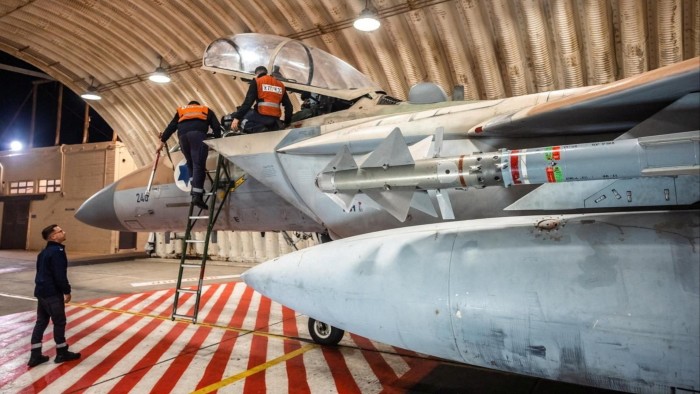
The workers build F-15 Eagle and F/A-18 Super Hornet fighter jets, as well as various missiles and munitions.
Boeing’s defence business, which has more than 19,000 employees, brought in about 29 per cent of the company’s $22.75bn second-quarter revenue.
The defence unit, which in March won the contract to build the US’s next generation F-47 fighter jet, has been improving its performance.
For the second quarter, it reported an operating profit of $110mn, compared with an operating loss of $913mn in the same period a year earlier.
Over the years, the defence business has been plagued by charges due to cost overruns on fixed-price contracts and production delays, including for two new Air Force One presidential jets.
The potential work stoppage comes less than a year after 33,000 workers at Boeing’s Washington state factories went on strike for two months, costing the company several billion dollars and halted production of the 737 Max commercial jet.
It also comes as Boeing pursues a broader turnaround after the 2024 strike and the blowout of a door panel on an Alaska Airlines jet mid-flight that sparked fresh questions over its manufacturing quality and led to a regulator-imposed production cap on the 737 Max.
An Air India crash in June which involved a Boeing 787-8 plane also cast a shadow over the company’s recovery efforts, though preliminary findings by Indian investigators recommended “no actions” against the company.
The Missouri workers “build the aircraft and defence systems that keep our country safe,” said IAM Midwest territory general vice-president Sam Cicinelli. “They deserve nothing less than a contract that keeps their families secure and recognises their unmatched expertise.”
“We’re disappointed our employees rejected an offer that featured 40 per cent average wage growth and resolved their primary issue on alternative work schedules”, said Dan Gillian, Boeing air dominance vice-president, in a statement.
But the company brushed off the potential impact of any walk off, stressing its comparatively smaller scale to the 2024 strike.
“We are prepared for a strike and have fully implemented our contingency plan to ensure our non-striking workforce can continue supporting our customers,” Gillian said.
Boeing chief executive Kelly Ortberg told analysts on an earnings call on Tuesday that the company would “manage through this”.
“The order of magnitude of this is much, much less than what we saw last fall . . . I wouldn’t worry too much about the implications of the strike”, he said, adding that any work stoppage would not knock Boeing off course as it aims to get its defence business back to high single-digit margins.
The Pentagon, Boeing’s primary defence customer, did not immediately respond to a request for comment.
Additional reporting by Jamie John in New York