
Winter menus also lean heavily on fonduta (a rich melted-cheese dish, served on its own or spooned over pasta, vegetables or eggs) and fritto misto (a mixed platter of lightly battered, fried meats, vegetables and sometimes fruit); while meat-lovers will find comfort in gran bollito misto (a procession of slow-simmered cuts served with green sauces) and veal brasato al Barolo, slowly braised in what locals call “the king of wines, the wine of kings”. Meals often end with bunet, a dense chocolate-and-amaretto pudding that feels entirely in keeping with the season.
A day trip to Ivrea: The Battle of the Oranges
For those keen to punctuate Turin’s winter rituals with something louder, Ivrea offers a striking contrast. Around an hour by train, the town’s historic Carnival builds through processions and ceremonies before erupting in the Battle of the Oranges, its best-known tradition.
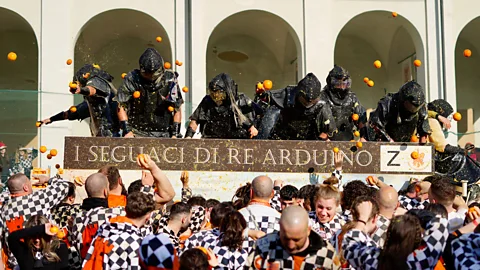 Zsofia SafarThe Battle of the Oranges in Ivrea is one of northern Italy’s most unusual Carnival traditions (Credit: Zsofia Safar)

Held over three days from Carnival Sunday to Shrove Tuesday, the battle pits teams of aranceri (orange throwers) on foot against rivals riding in carts in a symbolic reenactment of a medieval revolt. I’ve watched from behind the safety nets and from inside the squares, close to the throwers and carts. It is loud, chaotic and strangely exhilarating.
Locals share a few rules for first-time visitors: dress warmly, keep a cup of vin brûlé (Piedmont’s mulled wine) close at hand, and wear the red berretto frigio – the Phrygian cap that signals neutrality – unless you’re ready to join the fray.
—
If you liked this story, sign up for The Essential List newsletter – a handpicked selection of features, videos and can’t-miss news, delivered to your inbox twice a week.
For more Travel stories from the BBC, follow us on Facebook and Instagram.