
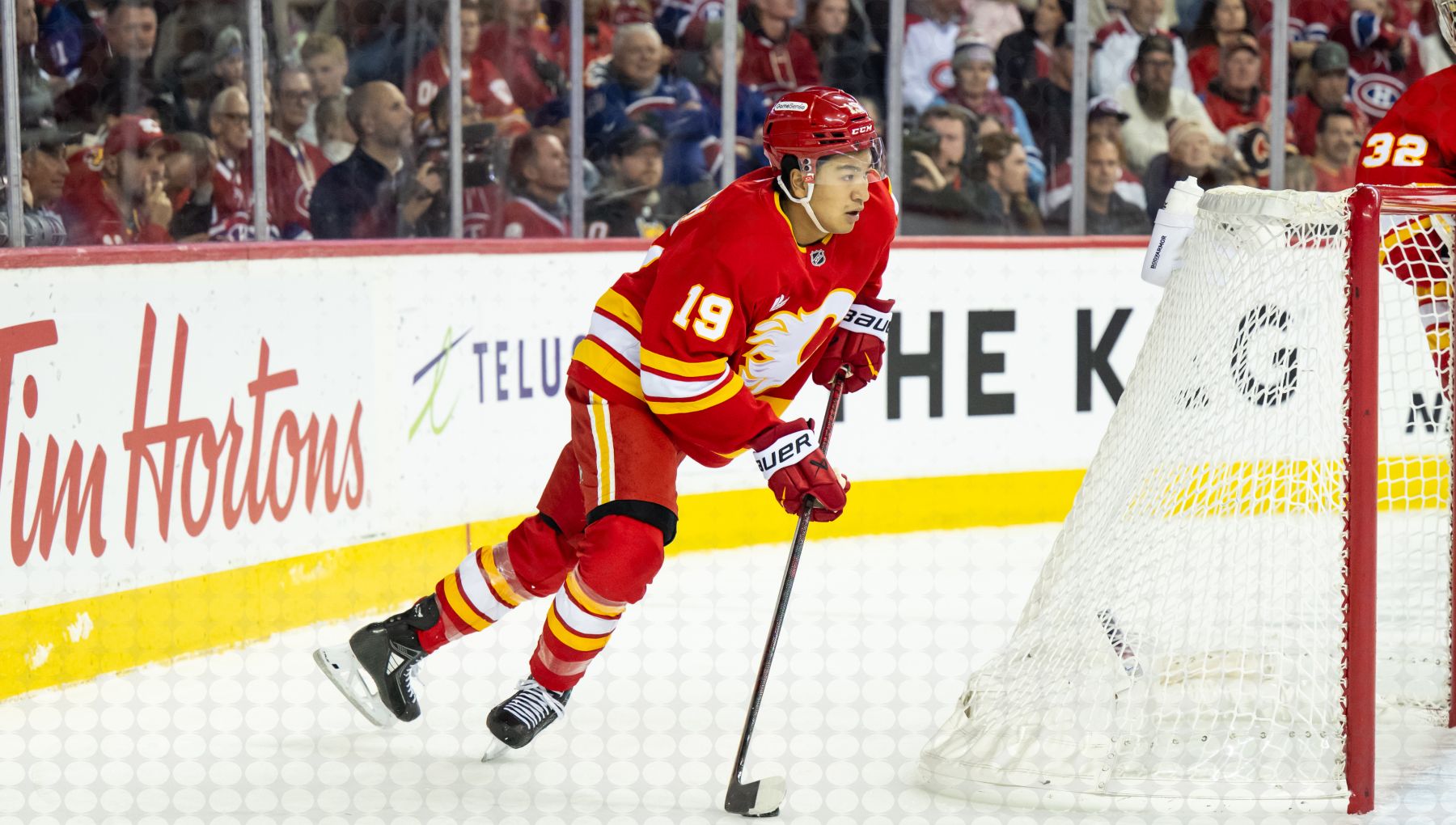
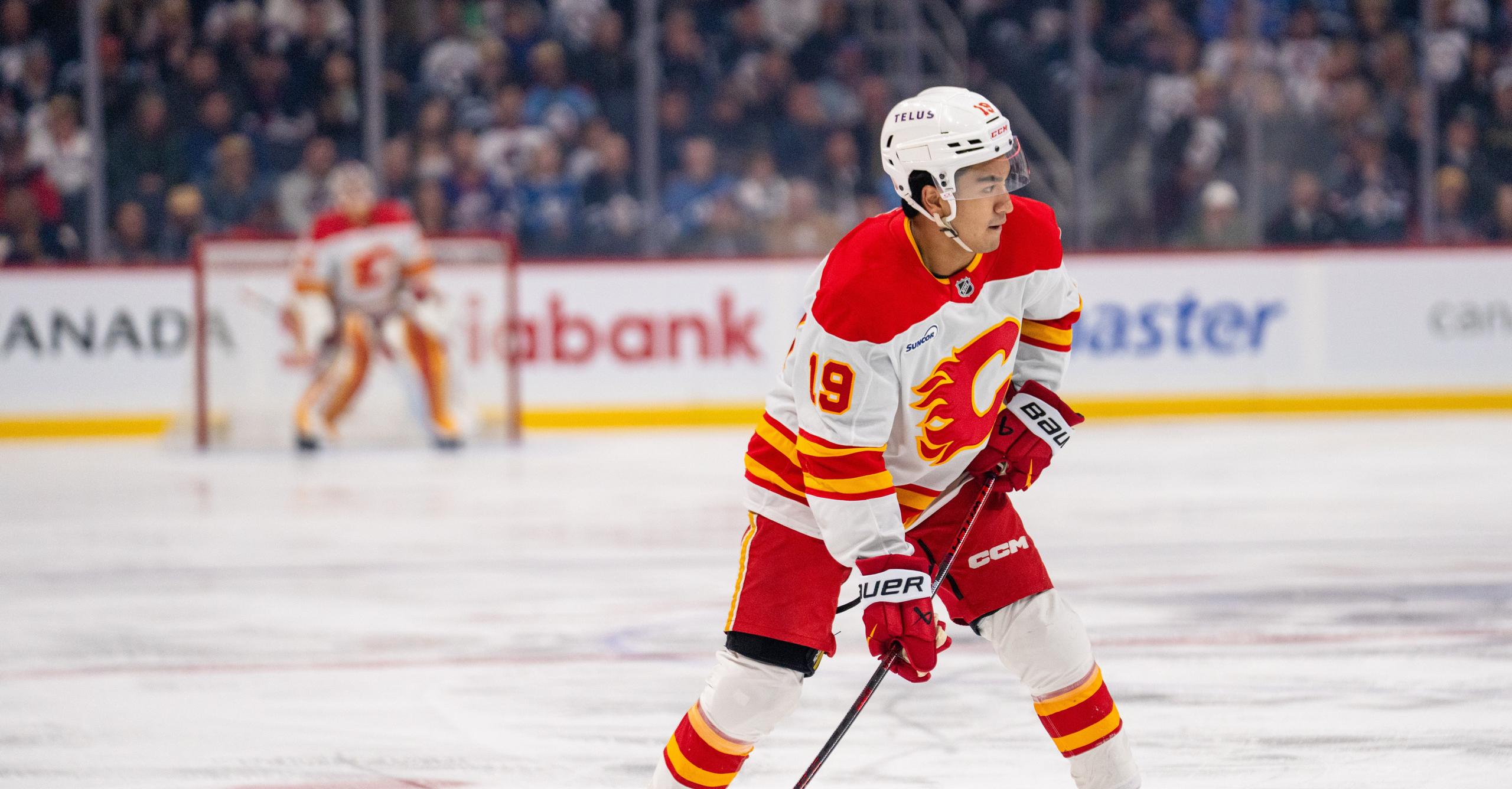
Zayne Parekh (Photo by Cameron Bartlett/Getty Images)
For most 19-year-old defensemen, the next step after being drafted is straightforward: return to junior, dominate, and come back a year later stronger and more polished.
Zayne Parekh’s situation was anything but normal.
Despite still being OHL-eligible, Parekh had already outgrown the junior level after one of the most productive seasons by a defenseman in modern CHL history. Last year with the Saginaw Spirit, he erupted for 107 points in only 61 games, finishing as the highest-scoring defenseman in the entire Canadian Hockey League.
The Flames believed sending him back would offer little developmental value. Instead, Calgary made the rare decision to keep their ninth-overall pick in the NHL environment immediately, beginning an unconventional season split between professional hockey, international play, and now a stint in the American League.
He played his first 11 games in the NHL between October and November, effectively burning the first year of his contract. He was then loaned to Team Canada from December to early January, where he led the World Juniors in scoring for defensemen.
Upon joining the Calgary Flames on their road trip post World Juniors, there didn’t look like there could be much opportunity for him to play, especially with veteran, pending free agent, Rasmus Andersson, being put in the spotlight for a trade.
GM Craig Conroy then came to him with a proposition of heading down to the AHL to play with the Flames’ affiliate, the Calgary Wranglers, for two weeks on a conditioning stint.
With little option for playing time on the NHL roster, a minor upper-body injury that kept him out of the lineup for the last week, and an opportunity to continue on his momentum from the World Juniors, the young defenseman agreed.
On January 17th, the Calgary Flames officially assigned Parekh to the AHL on a conditioning stint.
“He came up to me and asked me if I would be okay with going down to the AHL to play some games and I said yes,” explained Parekh. “After we got back from the road trip, I was sent down and I think it worked out well for me.”
For a player whose development has been anything but traditional, the assignment wasn’t seen as a step back; it was a chance to stay sharp. But it also spoke to the 19-year-old’s maturity, as a conditioning stint isn’t possible without the consent of the player.
Parekh viewed it as a learning opportunity, and above all, an opportunity to get good minutes.
“Playing on different teams this year has been good for me,” said Parekh. “It’s allowed me to learn as much as possible in different environments.”
His year has taken him through more hockey environments than most prospects experience in three seasons; from NHL practices, to the World Juniors spotlight, to the grind of the AHL.
“It was good for me to go to the AHL and get my confidence going,” said Parekh. “Just about finding your game and working hard in practice.”
And find his game he did, notching two goals and five points in four games with the Calgary Wranglers.
The stint also gave him time to focus on the physical side of his development as he continues adjusting to the pro game.
“It’s also good because I was able to spend more time in the gym, getting stronger and preparing for the next opportunity.”
World Junior Reset With Old Friends
If you asked Parekh, the World Juniors proved to be the tipping point so far in his season, àfter the Calgary Flames loaned him to Team Canada.
Following an adjustment-heavy start to his first pro season, the tournament gave Parekh something he hadn’t felt consistently since junior: freedom to express himself on the ice.
Joining many of his old junior friends, the tournament was a breath of fresh air for the young defenseman, as he was able to get back to playing for the love of the game.
“It was unbelievable for me. It brought the fun of playing hockey back for me. You know, Michael Misa and I are best friends, and it was incredible to be able to play with him again. I really felt like the tournament got me going.”
By the end of the tournament, Parekh had authored a historic performance.
He led the tournament in scoring for a Canadian defenseman with five goals and 13 points in just seven games.
“I got a lot of my confidence playing for my country and with a great group of guys in that room. I was able to play my game and I feel like I left a good impression.”
Parekh was second only to his childhood friend and Montreal Canadiens prospect Michael Hage, who notched 15 points in seven games. Both Hage and Parekh were Canada’s two most dangerous players at the tournament, and their chemistry became a defining feature of Canada’s offense.
The two have been connected for years, not just as teammates on the ice, but as friends who grew up alongside each other in the hockey world. Playing together on the international stage wasn’t something new. It was something familiar.
“He’s unbelievable,” Parekh said.
And it wasn’t just praise for what Hage did at the tournament, it was admiration built over a lifetime of watching him.
“He has a lot more skill than I do, and he just plays such a high-tempo game.”
Whenever Canada needed a spark, Hage was pushing the pace, and Parekh was right there firing pucks off from the blue line, the two of them running the power play like they’d been doing it for years.
“When we would go out on the power play together,” Parekh said, “I think our success rate was like 52%, it would just be incredible to watch him go.”
For Parekh, it was one of the most enjoyable stretches of hockey he had played all season, not only because of his personal success, but because of who he was sharing them with.
“I’ve known him since we were about 8 or 9,” Parekh said.
The memories run deeper than one tournament. They run back to childhood skates, minor hockey practices, and years of dreaming about moments like this.
“We’ve grown up together on the ice,” he added, “and it was really great to be able to play with him one last time before we both go pro.”
It made the World Juniors feel like more than a record-setting performance. It felt like a closing chapter, one last run with the people who helped shape his love for the game, and a reminder of the fire that still drives him forward.
Opportunity in Calgary?
With Parekh’s conditioning stint set to expire on January 31, the timing could be lining up perfectly for the Flames’ top defense prospect.
Last week, Calgary traded longtime blue-line pillar Rasmus Andersson to the Vegas Golden Knights, a major move that signals both a shift in direction for the organization and a sudden opening on the right side of the defense corps.
Andersson, who logged heavy minutes in all situations and served as Calgary’s top power-play quarterback, leaves behind a role that will need to be filled.
With his conditioning stint over, Parekh can draw in the lineup and get some regular power play time on one of Calgary’s two waves as they prepare for the future.
“Losing Rasmus is a huge loss for the team, be it at even strength or on the power play. He was a pillar for the team,” said Parekh. “But it also opens up ice time on the team, especially on the power play.”
The Flames didn’t draft Parekh ninth overall to be a sheltered defender; they drafted him because players who can create offense from the backend the way he can are rare.
And if that power play opportunity comes sooner than expected, Parekh is eager to embrace it.
“If I get the opportunity to play on the power play when I get called up, I’d love to take that challenge and run with it.”
After months of adjustment, movement between leagues, and a confidence reset at the World Juniors, Parekh believes his game is trending exactly where it needs to.
“I’m loving what I’m doing right now and how I’m playing. The start of the year was tough for me, I was struggling to find my groove on the ice, but now I feel primed and confident in my game and I’m ready for the next challenge.”