
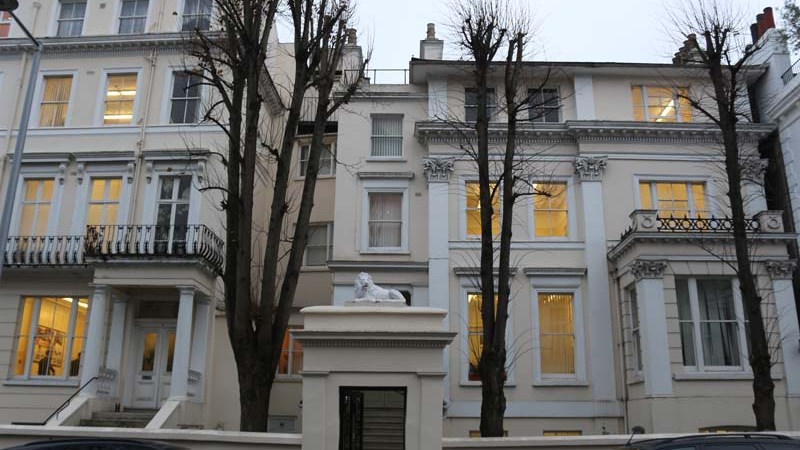
Children are being taught how to use battlefield drones at a school in west London run by the Russian foreign ministry.
The Russian Embassy School in Notting Hill educates the children of diplomats and spies, as well as a small number of children whose parents are not Russian officials, including those who hold British citizenship.
Lesson plans for the 2025-26 academic year seen by The Times show that Year 10 pupils — aged 15 and 16 — were given an hour-long lesson last month in the “basics of technical preparation and communications” for combat drones.
• Smuggled film exposing Putin’s classroom brainwashing up for Oscar
Other classes taught last term included one on fortifications engineering; two on first aid on the battlefield; and another on how to protect oneself against radiological, biological and chemical weapons.
The teaching is part of a course called Fundamentals of Security and Protection of the Motherland, known as OBZR, which was introduced across Russian schools at the start of the 2024/2025 academic year.
Since the invasion of Ukraine in February 2022, the Russian state curriculum has become increasingly propagandised and militaristic.
OBZR replaced a course known as Fundamentals of Life Safety, which also contained elements of military instruction but was more focused on civilian life and centred on risk prevention.
The Times reported previously that as part of the Fundamentals of Life Safety course children at the embassy school were being taught how to assemble Kalashnikovs and were throwing tennis balls around the playground to simulate grenade use.
The new OBZR course reflects the changing nature of warfare, accelerated by the Russo-Ukrainian war, in which three in every four casualties on both sides are now caused by drone strikes.
A curriculum plan for the course states that children between the ages of 15 and 17 should be taught about “the methods of combat use of unmanned autonomous vehicles” as well as “the history of the emergence and development of robotic systems”.
The document is specific to the embassy school and was signed off last September by Alexander Pogorelov, the school’s headmaster.
It also stipulates that children at the school be given instruction in how to fire a weapon accurately, how to build trenches and how to march in formation, as well as provided with practical information as to the differences between conscripted and contracted military service.
“Students [at the embassy school] are learning very real military skills,” said Ian Garner, author of the book Z Generation. “This isn’t a course designed to keep safe in the event of an emergency.
“These are courses that are saying to kids who are studying in England that you need to align yourself with a military identity, you need to be able to fight because the war is already happening and it is surrounding you as a Russian.”
Situated in a white Victorian townhouse, the school was founded in 1954 and is one of the oldest of 80 Russian embassy schools around the world, all of which teach the state curriculum and are overseen by the foreign ministry.
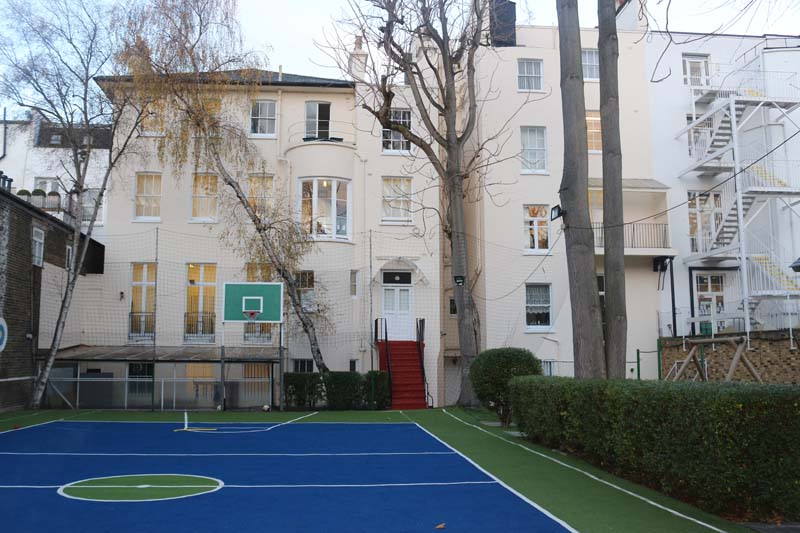
The school’s pupils include the children of known and suspected Russian spies
A portrait of Putin hangs in the entrance hallway, as well as on the walls of several of the classrooms.
There are about 60 pupils aged between seven and 18 who attend five days a week, for three terms a year. A further 40 or so attend evening classes.
History lessons are taught using the latest state-prescribed textbook, which presents the war in Ukraine as part of Russia’s historical mission. The book, written by Vladimir Medinsky, a presidential aide, characterises Ukraine as a puppet of the West, whose main goal, it states, is to “destabilise the situation inside Russia”.
The school has also held fundraising events in the past for Russia’s war effort in Ukraine.
Those who attend have included the children of suspected Russian spies. Colonel Maxim Elovik, who served as defence attaché at the embassy from 2012, was expelled in May 2024 after he was identified as an “undeclared” military intelligence officer. His two daughters, who now live in Russia, were pupils at the school.
As a branch of the embassy, the school is subject to diplomatic exemptions and therefore does not come under the oversight of the Department for Education or the schools inspectorate.
The Russian embassy was contact for comment.