
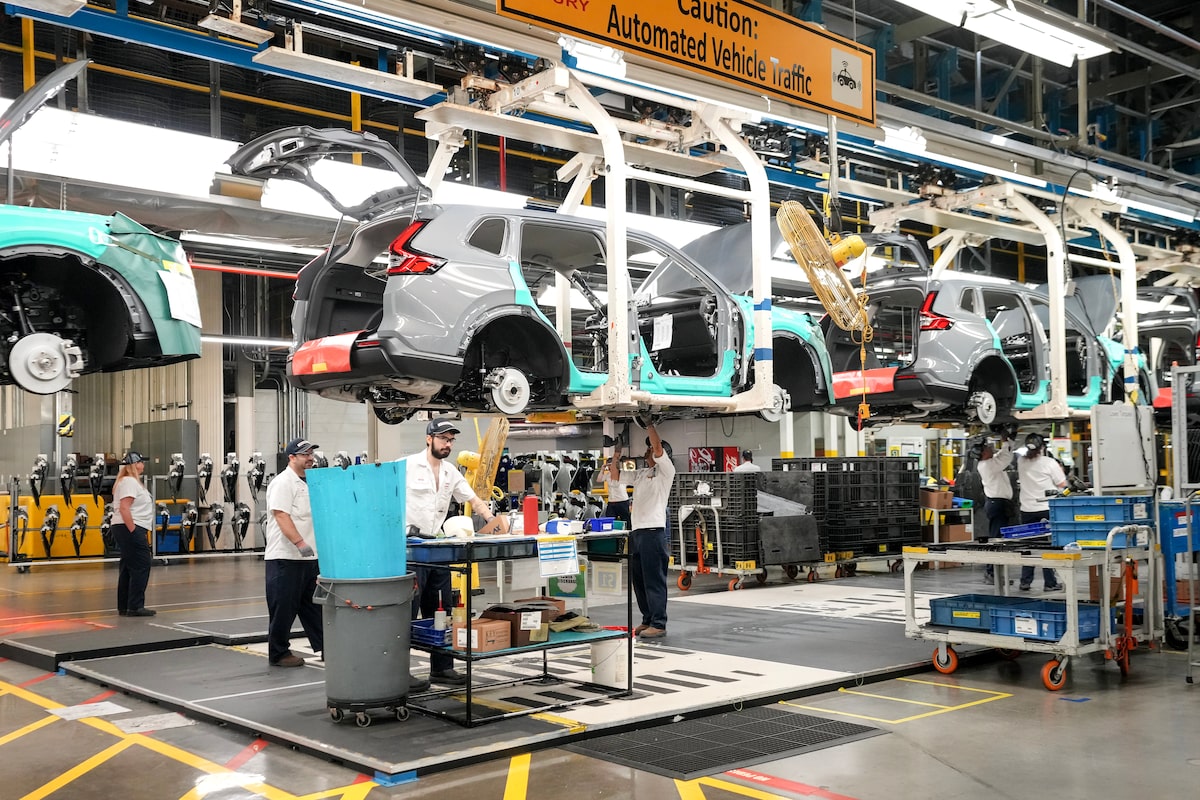
Honda employees work along the vehicle assembly line in Alliston, Ont. Production at plants owned by Honda and Toyota has remained stable even as Donald Trump imposed 25% tariffs on the non-U.S. content of Canadian-made cars.Nathan Denette/The Canadian Press
A decade of upheaval and declining production in the Canadian automaking sector has highlighted the persistent strength of Japanese manufacturers in this country, even as the Detroit Three have retreated.
Those are the findings of a new report from the Trillium Network for Advanced Manufacturing, a think tank based at Western University in London, Ont.
The report, to be released on Monday, says Ontario auto production declined to 1.2 million vehicles in 2025 from 2.3 million in 2016, driven by a plunge in output at factories owned by Ford Motor Co. F-N, General Motors Co. GM-N and Stellantis NV STLA-N.
In 2016, four manufacturers each regularly assembled more than 400,000 cars a year in Ontario; By 2025, Honda HMC-N and Toyota TM-N were the only ones to do so, accounting for 77 per cent of Canadian production, the report says.
Assembly-plant employment has also plunged, to 23,700 in 2024 from 32,700 in 2015. This does not include the tariff-related job cuts of 2025.
Ottawa, Seoul agree to work on bringing South Korean auto sector manufacturing to Canada
But production at plants owned by Honda and Toyota has remained stable – not including the slowdown during the COVID-19 pandemic – even as U.S. President Donald Trump imposed 25-per-cent tariffs on the non-U.S. content of Canadian-made cars.
Brendan Sweeney, managing director of the Trillium Network, said the Japanese carmakers have increased production and investments in Ontario recently, making higher-priced cars that contain more advanced technology. Toyota makes the RAV-4 hybrid and Lexus RX at plants in Cambridge and Woodstock. Honda makes the Civic and CR-V in Alliston.
Meanwhile, The Detroit Three have scaled back their Ontario operations, idling assembly lines and laying off thousands of people.
Ford’s Oakville factory has been closed for retooling since 2024, while Stellantis has halted retooling work at its Brampton plant, which closed in the same year. GM shut its BrightDrop electric delivery van plant in Ingersoll in October, eliminating 1,150 jobs, and last week cut 700 jobs at its Oshawa Silverado factory.
Mr. Sweeney attributes Honda and Toyota’s steady footprint to a cultural belief in looking longer term in comparison to their Detroit counterparts. The Japanese companies look at their plants in terms of how they fit in their overall network and market whereas U.S. companies see their plants more as profit centres.
GM predicts tariffs will cost it $4-billion this year
Honda and Toyota “are not as worried about quarterly results,” he said by phone. “They are not as worried about kowtowing to an American president because they are not American companies. They tend to have these long-term horizons for a return on investment compared to the U.S.-based automakers.”
Still, Toyota has said that the Trump tariffs have made manufacturing in Ontario “unsustainable.” And Honda has taken steps to shift production to avoid tariffs, targeting some Ontario-made vehicles for markets it has declined to name.
And the industry is braced for the arrival of 49,000 Chinese electric vehicles after Ottawa agreed to the annual quota in exchange for breaks on canola tariffs and other products.
Amid this uncertainty, Mr. Sweeney said the Ontario auto-sector’s future hinges on two events: the February release of the federal government’s auto strategy to protect jobs and factories; and the review of the U.S.-Mexico-Canada free-trade agreement scheduled for July. Mr. Trump’s love of using tariffs to bludgeon countries the U.S. trades with has raised doubts over the survival of a trade agreement that has allowed the North American auto industry to integrate and thrive.
Opinion: How Canada’s auto sector can survive its terrible, no-good, very bad year
Mr. Sweeney said he is hopeful the Trump administration switches tack on tariffs, given the billions in new costs that U.S. automakers are bearing. “It’s not like things are going really, really well south of the border,” he said.
The Trillium Network, in its new report, highlights its own solutions to bolster the Canadian auto sector. These include rewarding automakers that produce cars or components here or make investments to do so, using a variety of incentives: tariffs breaks or remissions; production credits; consumer rebates on Canadian-made cars; and encouraging manufacturers to make better use of Canadian technology and talent.
It’s been decades since Canada used some of these measures, he said.
“We haven’t really had an approach that says, ‘Listen, if you don’t make cars here and you want to bring them over here, it’s going to be a little harder to access our market.’
“Maybe there’s an additional cost to that, at least relative to the companies that do make cars here,” he said.