
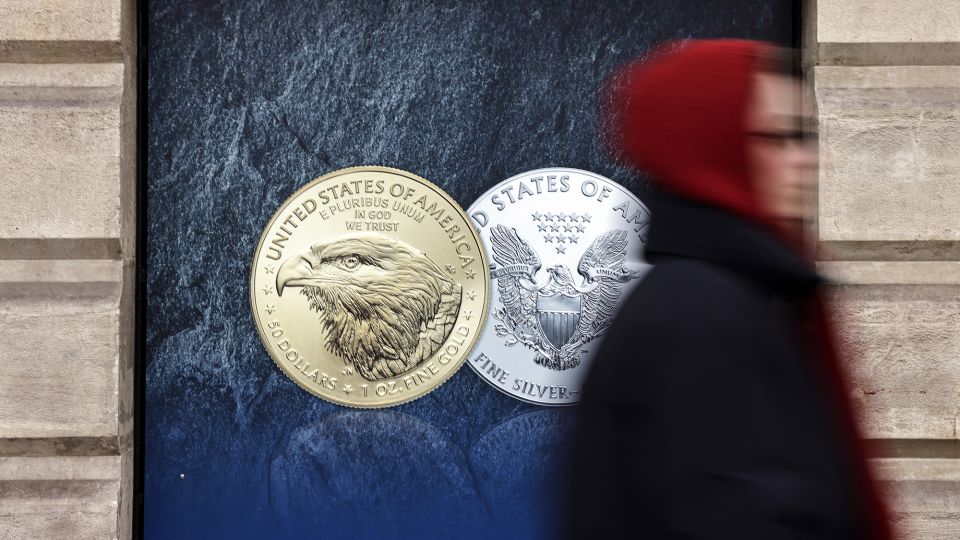
 Gold and silver, considered havens amid uncertainty, have experienced enormous volatility this year. – Oscar Del Pozo/AFP/Getty Images
Wall Street traders are grappling with sharp swings in precious metals, bitcoin is hovering at its lowest level since April and there are lingering nerves about technology stocks.
It’s been a weird few days on Wall Street. Gold and silver, considered havens amid uncertainty, have experienced enormous volatility. A ferocious rally in precious metals this year halted with a painful drop on Friday.
Meanwhile, bitcoin slumped over the weekend, tumbling from above $83,000 to as low as $74,570 and hitting its lowest level since April. Bitcoin is down sharply from a record high above $126,000 in October. And markets in Asia kicked off February on a down note: South Korea’s benchmark Kospi index sank 5.26% on Monday and had its worst day since April.
The hottest trades on Wall Street across the past year — from precious metals to South Korean tech companies — are experiencing turbulence after enormous gains.
Gold surged to a record high above $5,550 a troy ounce on Wednesday before dropping 11% on Friday. Silver plunged 31%. Gold early Monday dropped as low as $4,423 before paring losses and trading around $4,680 as of the afternoon.
Wall Street in recent years has experienced instances of so-called meme stock mania, where traders rally around a specific company to try and ride a surge in its share price. Some investors say similar themes of exuberance have developed around precious metals as they have become increasingly popular investments.
“More recently, some serious froth and leverage entered this asset class…as its continued rally got the attention of individual investors and momentum-based investors alike,” Matt Maley, chief market strategist at Miller Tabak + Co, said in a note.
“The recent run up in precious metals feels to have an enormous speculative element,” Jim Reid, global head of macro research at Deutsche Bank, said in a note.
“While a correction had been increasingly anticipated — and was arguably overdue — the speed and depth of the sell-off proved a stark wake-up call,” Ole Hansen, head of commodity strategy at Saxo Bank, said in a note.
Hansen said the rally in precious metals and particularly silver — supported by strong demand from Chinese investors — had also been “increasingly driven by FOMO and speculative excess.”
“When gold and silver turn into hot topics at dinner tables and in workplaces, it is often a sign that a particular phase of the rally is nearing exhaustion,” Hansen said.
While precious metals have seen wild swings, bitcoin — once pitched as a form of “digital gold” and considered an alternative store of value — has languished this year amid heightened geopolitical uncertainty. The world’s largest cryptocurrency by market value is down roughly 10% this year, struggling to gain traction after closing slightly in the red for 2025.
Story Continues
Bitcoin traded at around $78,050 as of Monday afternoon.
Bitcoin has languished this year amid heightened geopolitical uncertainty. – Chesnot/Getty Images
Meanwhile, in South Korea, the market had its worst day in months amid nerves about companies’ spending on artificial intelligence. The drop comes while Wall Street is in the midst of corporate earnings season, and investors are similarly assessing the health of big tech companies’ spending plans on AI.
US stocks closed higher Monday morning to kick off February trading: The Dow gained 515 points, or 1.05%. The benchmark S&P 500 rose 0.54%. The tech-heavy Nasdaq Composite gained 0.56%.
“While technically stores of value, still with strong long-term fundamentals, the total collapse in precious metals prices shows that any market can become gripped by mania, especially in the age of financialization and gamification,” Kyla Rodda, senior financial market analyst at Capital.com, said in a note.
President Donald Trump’s announcement that he tapped Kevin Warsh as his Fed chair nominee also contributed to a shift in market sentiment.
Gold futures were down 1.4% Monday. Silver futures fluctuated between gains and losses and were up 1.7% as of the afternoon. Despite the steep drop on Friday, gold is up roughly 8% this year and silver is up 13%.
South Korea’s Kospi soared 76% in 2025 and so far has been a leading stock market index this year. The country’s stock market has benefited from investor enthusiasm about AI as tech and chip companies have soared higher.
Julian Emanuel, senior managing director at Evercore ISI, said in a note that recent moves in gold, silver, copper and South Korean tech stocks can be categorized as “exuberant” or “parabolic.”
Emanuel said his outlook for stocks remains positive, and he expects the S&P 500 to rise roughly 13% this year.
“The trader behavior has gone global, where people chase hot names,” said Steve Sosnick, chief strategist at Interactive Brokers. “What we’ve seen now is a greater propensity to chase rallies.”
“It’s not the same trade, but it’s the same trader mentality,” Sosnick said.
Mohit Kumar, chief economist and strategist for Europe at Jefferies, who has been long on gold since 2022, said he thinks the sharp drop was an “unwind of crowded positions” as opposed to any “systemic risks.”
Hansen at Saxo Bank said attention will turn to China, as investors there have been key drivers of demand for precious metals in recent months. Local prices in China have traded at a premium to the benchmark London market.
Wall Street this week will get a slate of corporate earnings results including from tech stalwarts Alphabet (GOOG) and Amazon (AMZN) that could influence market moves. Investors in the coming months will also be attuned to Warsh’s remarks during his confirmation hearings for the Fed chair role.
“It’s a market to watch for vulnerabilities and extremes,” said Darrell Cronk, CIO for wealth and investment management at Wells Fargo.
The US dollar index was up 0.63% on Monday after rising 0.74% on Friday and having its best day since June, stabilizing after a recent slide.
The rebound in the dollar can also put pressure on gold, which tends to benefit in a weaker dollar environment. Still, Deutsche Bank is sticking with its call for gold to hit $6,000 a troy ounce by the end of the year.
“Significant institutional investors have signalled the probability of a gradual multi-year diversification away from dollar-denominated assets, and we are not aware that this has changed,” Michael Hsueh, research analyst at Deutsche Bank, said in a note.
For more CNN news and newsletters create an account at CNN.com