
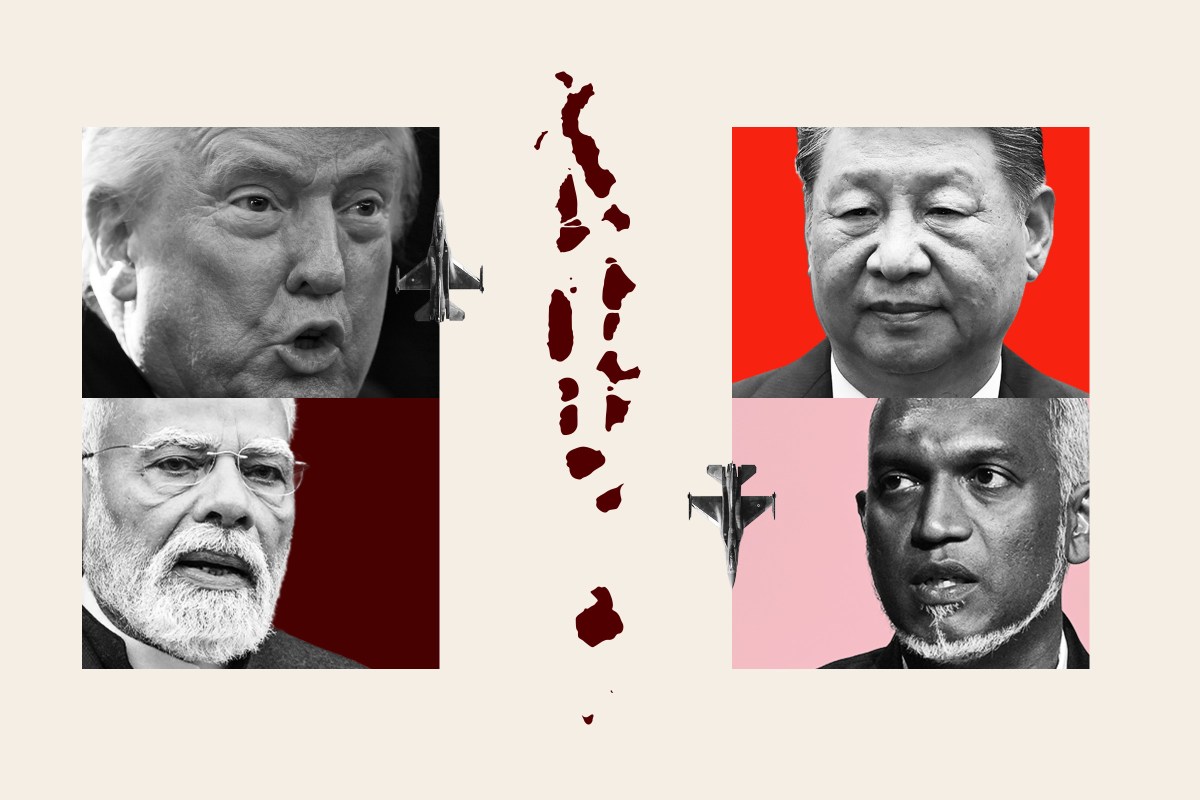
The dispute between the United States and the United Kingdom over control of islands hosting a remote yet strategically located base thousands of miles away from both countries has taken a new turn as a much closer nation throws its bid in to assume ownership.
Maldives President Mohamed Muizzu tells Newsweek he would be willing to pursue an arrangement through which the U.S. would continue its presence at Naval Support Facility Diego Garcia should the Maldives take control of the Chagos Archipelago, a U.K.-held Indian Ocean territory that London is set to instead transfer to another island nation, Mauritius, in line with an agreement reached last year.
That deal has been the subject of scathing criticism from President Donald Trump, who once supported the handover to Mauritius but has more recently voiced opposition, citing national security concerns, despite Mauritius’ vows to allow the U.S. and U.K. to maintain operations at the base.
Muizzu acknowledged the U.S. leader’s concerns, telling Newsweek that “President Trump clearly seeks to protect and secure the continuation of the use of Chagos for the U.S. Naval Support Facility Diego Garcia,” and offering to address them through a motion that would be submitted to parliament, where his People’s National Congress party enjoys a substantial majority.
“Currently, under British ownership, the UK and the US can operate from the Diego Garcia base freely according to their various security and defence alliances with each other and many other countries, including the Maldives,” Muizzu said. “Under a transfer of sovereignty to the Maldives, the government of Maldives would seek approval through our parliament as per our constitution, to facilitate the continuation of the status quo.”
The political battle plays out amid growing geopolitical rivalry in the Indian Ocean involving the U.S., China and India, all of which are vying for influence across the region, where Muizzu said the Maldives was well-equipped to ensure the lasting protection and prosperity of the Chagos Archipelago on various fronts.
“Currently the Chagos Islands are uninhabited, while the archipelago is designated a marine conservation area,” Muizzu said. “These two factors are those most cited as providing additional security for the Diego Garcia base.”
“The Maldives has the greatest experience in the world of maintaining marine conservation areas across thousands of miles of ocean, while sparingly building small island communities and beach resorts—which power our economy—within them,” he added. “We have never overpopulated, overdeveloped, or under protected marine conservation zones within our current borders —and we would not do so should those borders be expanded to include Chagos.”
 Competing Claims
The Chagos Archipelago has been under U.K. control for more than two centuries, having been won from France at the end of the Napoleonic Wars in 1815. The uninhabited islands had first caught the attention of Europeans upon being encountered by Portuguese explorers in the 16th century, though their isolated nature made them difficult to settle and it was only later under French rule that a steady population began to emerge.
The Chagossian people trace their roots to a mix of freed African slaves along with peoples of Indian and Malay descent. They lived under U.K. colonial administration based in Mauritius until 1965, when Mauritius was granted independence separately from the Chagos Archipelago, which became part of the British Indian Ocean Territory. The Maldives, having been governed by the U.K. as a separate protectorate, also gained independence that year.
But the Chagossians would be forced to leave their islands, with the U.K. beginning to expel the entirely of the local population in the 1960s to make room for a joint military base with the U.S. on the largest Chagos island of Diego Garcia, leaving most to resettle in the U.K., Mauritius and the Seychelles.
Today, Naval Support Facility Diego Garcia constitutes one of the U.S.’s most remote bases in the world, offering significant power projection capabilities with the capacity to host key sea and air assets, including long-range nuclear-capable B-2 bombers. Under the agreement reached between the U.K. and Mauritius, the island of Diego Garcia would remain under U.K. lease for 99 years.
The White House initially approved the deal as an arrangement that “secures the long-term, stable, and effective operation of the joint U.S.-UK military facility at Diego Garcia.” Earlier this month, however, Trump reversed this position in a Truth Social post that also referenced his claims to another NATO ally-held territory hosting an isolated and strategically located U.S. base, Greenland.
“Shockingly, our ‘brilliant’ NATO Ally, the United Kingdom, is currently planning to give away the Island of Diego Garcia, the site of a vital U.S. Military Base, to Mauritius, and to do so FOR NO REASON WHATSOEVER,” Trump wrote in a Truth Social post. “There is no doubt that China and Russia have noticed this act of total weakness.”
“The UK giving away extremely important land is an act of GREAT STUPIDITY, and is another in a very long line of National Security reasons why Greenland has to be acquired,” he wrote. “Denmark and its European Allies have to DO THE RIGHT THING.”
In comments shared with Newsweek, a U.K. government spokesperson stated that the “UN General Assembly and the International Court of Justice have made clear that the question of sovereignty of the Chagos Archipelago is between the UK and Mauritius.”
“The Diego Garcia military base is crucial to the security of the UK and our key allies, and to keeping British people safe,” the U.K. government spokesperson said. “The Diego Garcia treaty has robust security provisions that categorically prevent compromises to the base. The deal protects the base for generations and ensures that the UK can retain unique and vital capabilities to deal with a wide range of threats.”
Yet Trump holds significant sway in the process given the U.S.-U.K. treaty reached in 1966 on the status of Diego Garcia. The row has since prompted Washington and London to reopen discussions about the fate of the Chagos Archipelago, to which the Maldives now seeks to highlight its own links.
“The Maldives’ claim to the Chagos Islands is historic, cultural, economic, and environmental,” Muizzu said. “The Chagos Islands—known to us as Foalhavahi—lie just 310 miles from Malé, the capital of the Maldives.”
By comparison, they lie around 1,300 miles from Mauritius, which is considered politically and geographically part of Africa. Beyond proximity, Muizzu pointed to other factors backing the Maldives’ claims, including how “900-year-old gravestones on the Chagos islands found etched with words in Dhivehi—the Maldives’ official language—provide evidence of long-standing economic and population ties.”
“A 16th century patent from a Maldivian king even states his kingdom’s sovereignty over Chagos—dating from more than 100 years before Mauritius, at the time an uninhabited island, was populated by European colonists,” Muizzu said. “The Maldives, by contrast, has been populated for more than 2,500 years.”
“While historically Maldivians did not permanently settle on the Chagos Islands, alongside carbon-dated archaeological evidence, the DNA of modern-day Chagossians demonstrates evidence of Maldivian and Creole heritage,” he added. “Supporting cultural evidence from centuries-old Maldivian folk tales tells of seafarers and fishermen being stranded there as they used the Archipelago as sites for seasonally populated fishing stations and economic resources.”
A Great Power Game at Sea
Like the Chagos Archipelago it seeks to control, the Maldives has also found itself at the center of great power competition intensifying across the Indian Ocean, a vast expanse that hosts crucial trade routes from East, South and West Asia, including the Middle East, to Africa.
After gaining independence alongside Mauritius from the U.K. in 1965, the Maldives developed close ties with India, with the two sides developing cooperation in a number of sectors, including on security. Yet these relations began to sour after Muizzu took office in 2023, backed by an “India Out” campaign that called for combating Indian influence on the island and promoting stronger ties with China.
This development, which resulted in the departure of Indian troops and the signing of new agreements—including on military cooperation—with China, marked a major shift for the region. Beijing and New Delhi have long engaged in a contest for influence across countries in South Asia and islands nations of the Indian Ocean, where U.S. officials have sometimes referred to a “String of Pearls” consisting of Chinese military and commercial facilities extending from the mainland to the Horn of Africa.
Later in 2024, Muizzu began mending relations with India, meeting Prime Minister Narendra Modi in a high-profile visit to Delhi that October. The Maldives and India would go on to forge a number of new deals shoring up their partnership, along with a pending free trade agreement, and Muizzu attested to his willingness to continue building relations—so long as they did not come at the cost of national sovereignty.
“The Maldives-India partnership is one of deep-rooted connections and an enduring partnership,” Muizzu said. “We deeply respect and appreciate India’s neighbourhood first policy. We strongly believe in working together on matters such as regional security and stability.”
“We are also looking forward to completing the free trade agreement with India which, once completed, will be very beneficial for traders of both countries,” he continued. “However, the sovereignty of the Maldives is my highest priority, hence it is Maldivian foreign policy under my leadership to ensure that sovereignty and independence are never compromised.”
Muizzu has also pressed on with China relations, which were further solidified during his latest meeting with President Xi Jinping last August and have been followed up with additional bilateral engagements. In addition to their military partnership, the two nations maintain various agreements, including deals to secure Chinese funding for infrastructure works on the Maldives.
In pursuing such agreements, Muizzu has rebuffed concerns long expressed by U.S. officials of a perceived Chinese effort to cultivate global influence through deals and development projects that risk incurring substantial debt for host nations, a strategy consistently denied by Beijing. He said the Maldives under his leadership would cultivate a diverse portfolio of relationships, echoing Trump’s “America First” strategy in emphasizing a prioritization on national interests.
“Leadership in international affairs, and prosperity for one’s country are not—as some seem to believe—only achieved by ‘choosing a side.’ Not to choose is also a choice,” Muizzu said. “We have a ‘Maldives first’ foreign policy. It is possible for us to describe China, as I have done, as our ‘trusted and sincere development partner,’ India as our ‘closest neighbour’ and ‘trusted partner,’ and Britain as ‘our natural partner.’ There are no contradictions here.”
“When I was elected to office in 2023, the Maldives’ national debt was too high,” he added, “and it has been a priority of my administration not to take on new debt in some periods while repaying outstanding loans, to stabilise the financial system and build investor confidence.”
Mauritius has also been the subject of overtures from China and India, which supports the Chagos Archipelago transfer agreement and has invested in close ties with the island nation constituting one of the few fellow countries where Hinduism is the largest religion.
China, meanwhile, has expressed the importance of its ties with both Mauritius and the Maldives, as well as a willingness to expand them without taking a specific position on control of the Chagos Archipelago, only stating that any such arrangements should conform with the United Nations (U.N.) Charter.
“Mauritius and the Maldives are both important partners of China,” Chinese Embassy to the U.S. spokesperson Liu Pengyu told Newsweek. “China’s cooperation with Mauritius and the Maldives sets an example of mutual respect, equal treatment, and common development between big and small countries. China is willing to expand practical cooperation with both countries in various fields, and promote greater development of bilateral relations.”
“China has consistently advocated that all countries abide by the purposes and principles of the UN Charter, respect each other’s sovereignty and territorial integrity, and resolve differences and disputes between countries peacefully through dialogue and consultation,” Liu said.
Newsweek has reached out to the Indian Embassy to the U.S., the Mauritian Foreign Ministry and the U.S. State Department for comment.
 The Voice of the People
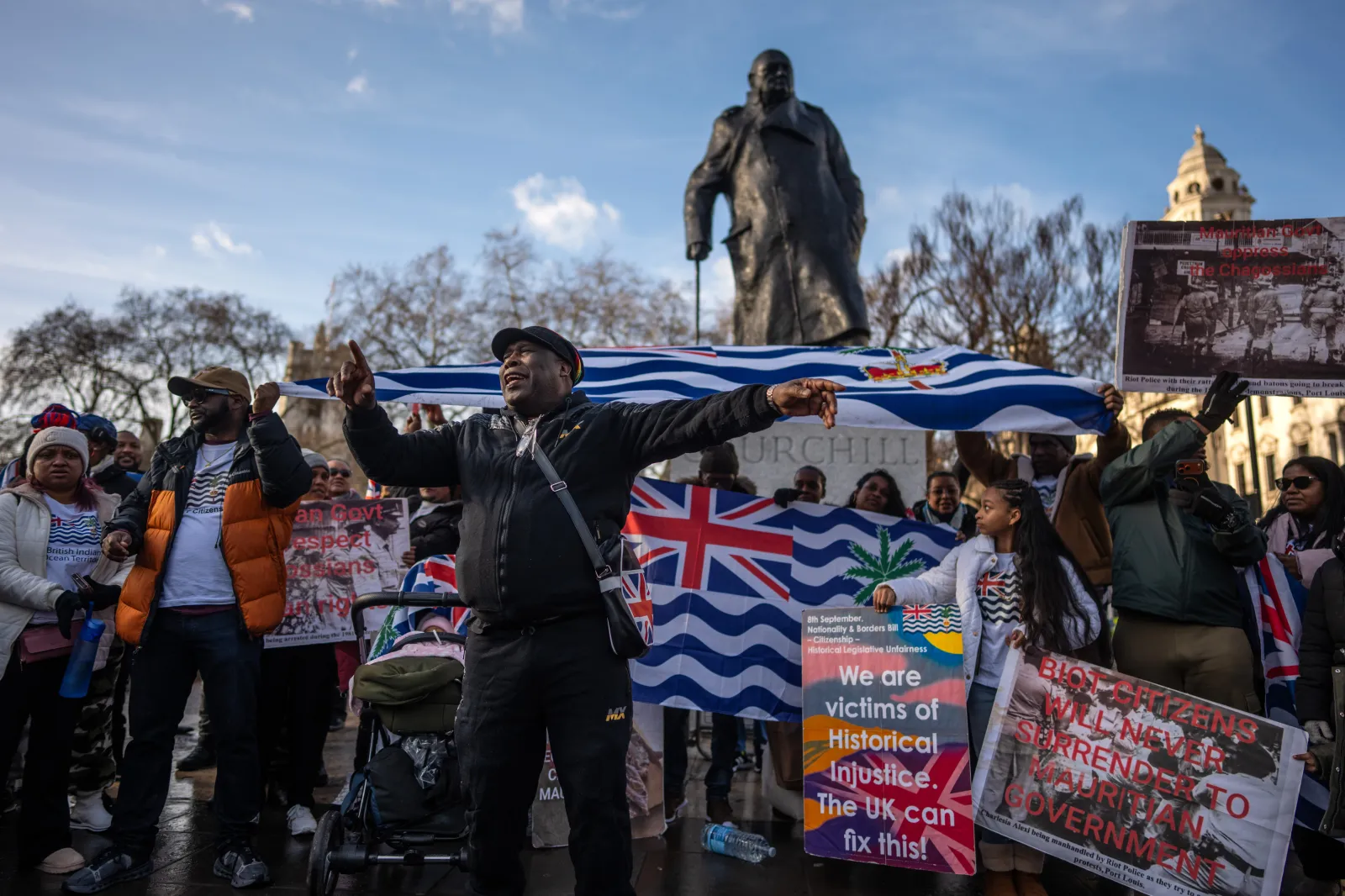
Also stakeholders in the fate of the Chagos Archipelago are the Chagossians themselves, all living abroad after the U.K.-led depopulation of the islands decades ago. The U.K. deal has been met with mixed reactions among Chagossian representatives, with many rallying against the prospect of the islands coming under the control of Mauritius.
Under the current terms of the deal, Chagossians are not permitted to resettle in Diego Garcia, which remains a restricted military zone.
Last April, as the U.K.-Mauritius deal was being finalized, Chagossian Voices advocacy group chair Frankie Bontemps told Newsweek the treaty “perpetuates a long and painful pattern of deciding the future of our homeland without our input.” He said at the time that his organization was not opposed to the U.S. military presence on Diego Garcia and the employment opportunities it offers but expressed concern “about how the Chagos Islands, especially Diego Garcia, are treated as a military asset in global conflicts that do not involve them.”
He reiterated his position in November, as the deal met significant blowback in the U.K. parliament, telling Newsweek how the Chagossians had been “sacrificed for the defense purpose of the Western world.”
Trump’s latest position on the agreement has thus been welcomed by some, such as Chagos government-in-exile head Misley Mandarin, who told Newsweek early last month that the U.S. leader “needs to veto it as soon as possible” and even pledged to rename one of the Chagos Islands after Trump.
Criticism has also emerged from bodies affiliated with the U.N. One such expert panel concluded last June that “the agreement appears to be at variance with the Chagossians’ right to return, which also hinders their ability to exercise their cultural rights in accessing their ancestral lands from which they were expelled.”
Muizzu, for his part, said he would take into account the history and interests of the Chagossians should the Maldives’ own bid for the islands prove successful.
“The Chagossians must have a voice and a say in this debate,” he said. “A number of those alive today include those who were born of the islands when they were inhabited and before they were depopulated. They are in part related to Maldivians, a fact we seek to acknowledge and celebrate.”