
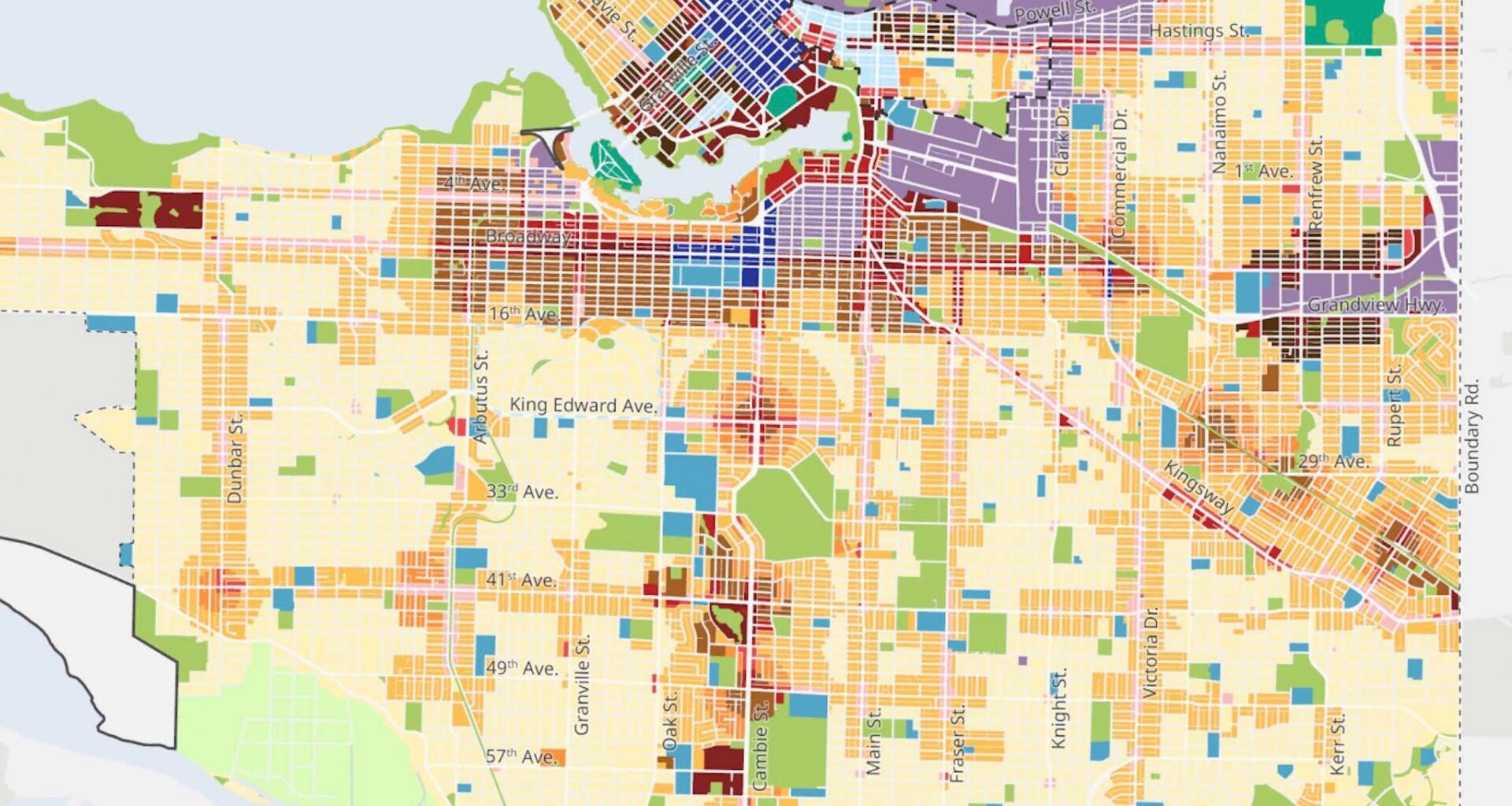
Vancouver City Council is poised to make one of the most consequential planning decisions in the city’s history: the adoption of the City of Vancouver’s first-ever citywide Official Development Plan (ODP) — a legally binding land use framework that will guide growth, development, and infrastructure investment for the next 30 years and beyond.
The push for a citywide ODP was triggered by the provincial government’s legislation in 2024, which amended the Vancouver Charter to require Vancouver’s municipal government to adopt an interim citywide ODP by June 30, 2026, aligning the City with planning standards already applied to all other municipal governments separately governed by the Local Government Act.
The legislation also stipulates that the City must meet the second deadline by the end of June 2030 to turn this interim ODP into the new permanent ODP, including repealing local area-specific ODPs. City staff state this ODP is a “living document,” with the provincial government requiring a review every five years, starting in 2030, which will help ensure the ODP will “continue to reflect the latest demographic and housing projections and needs, regional planning directions, and capital planning.”
In the first week of February 2026, City Council is expected to approve City staff’s recommendation to refer the draft interim ODP to a public hearing, where public speakers will be heard and a final decision made. The public hearing is expected to be scheduled later this winter or early spring, with City Council ultimately expected to approve the interim ODP due to its legally obligated deadline this June.
The ODP does not replace the City’s Grandview-Woodland Plan, West End Plan, Cambie Corridor Plan, Broadway Plan, and the newly approved Rupert and Renfrew Station Area Plan, which are area plans and not local area-specific ODPs. It would eventually replace local area-specific ODPs such as the 2005-approved Southeast False Creek ODP, which was triggered by the Vancouver Olympic Village project, and the 2006-approved East Fraser Lands ODP, which has guided the River District development.
Other municipal governments in Metro Vancouver are also working on or have recently approved updated long-term statutory land-use plans, although they use the provincial government’s similar Official Community Plan (OCP) framework under the Local Government Act rather than Vancouver’s ODP under the Vancouver Charter. However, the ODP provides Vancouver’s municipal government with more power and authority than all other cities under the OCP. Notably, the City of Vancouver’s major border neighbour, the City of Burnaby, approved the new Burnaby 2050 OCP in December 2025.
Vancouver’s ODP represents a major shift in how land use decisions are made by the City.
But there are no surprises in the ODP, which went through extensive public consultation last year and is built on the very same policies, principles, and strategies of the Vancouver Plan — approved by the previous makeup of City Council in July 2022 after years of major public consultation.
Unlike the Vancouver Plan and previous planning documents, the ODP carries legal weight. Zoning by-laws, rezoning applications, and development decisions must now be evaluated for consistency with the ODP, fundamentally changing how building development proposals move through the municipal government.
Public hearing requirement removed for some types of residential projects
By using the Vancouver Plan as its foundation, the ODP adds new layers of policy detail, mapping, and statutory clarity to meet provincial requirements and reflect recently approved City Council priorities and policies and the provincial government’s housing-related legislation.
It also incorporates the components of Metro Vancouver Regional District’s 2023-approved Metro 2050 Regional Growth Strategy and TransLink’s 2022-approved Transport 2050 Plan.
For example, following the regional district’s plan, the ODP reinforces protections for existing industrial land uses and identifies potential residential uses on employment lands within 200 metres of a SkyTrain station. It also reinforces higher-density, transit-oriented development growth under provincial legislation and TransLink priorities, and identifies corridors for long-term public transit improvements, including new rapid transit.
One of the most debated Vancouver ODP implications is procedural: under the new rules, rezoning applications that align with the ODP and include at least 50 per cent residential floor area will no longer require a public hearing. In some cases, public hearings may be prohibited altogether, shifting final decisions to regular City Council meetings. This change in removing the need for some public hearings for residential projects also follows the provincial government’s legislated requirements to the City.
This shift is intended to streamline housing approvals, reduce delays, and accelerate the delivery of new homes. The general idea is that the public hearings performed during the planning processes for the ODP, Vancouver Plan, and previously approved area plans reduce some of the need for future re-deliberations, especially if the rezoning application aligns with the ODP, with housing put on a pedestal, given that it is a priority for affordability and supply considerations.
Critics, however, argue that removing public hearings weakens meaningful public oversight, with the City’s formal public consultation periods for rezoning applications and written submissions becoming the key avenues for residents to influence decisions on certain types of residential projects.
Urban Structure Strategy and Generalized Land Use
Central to the ODP is a new “Future Growth” section that introduces two major planning tools: the Urban Structure Strategy and the Generalized Land Use (GLU) designations.
The Urban Structure Strategy outlines how Vancouver is expected to evolve over the next 50 to 100 years, identifying neighbourhood types, employment centres, transportation networks, and ecological systems that underpin long-term growth. It is intended to guide future area planning rather than evaluate individual rezoning applications.
The GLU designations, by contrast, are immediately consequential. Mapped at the parcel level, they summarize the maximum development potential of each site based on existing zoning, policies, and approved plans. City staff describe the GLU as a first filter for rezoning applications — if a proposal exceeds or conflicts with its GLU designation, an ODP amendment would be required.
While GLU designations do not grant automatic development rights, they significantly shape expectations for height, density, and land use across the city.
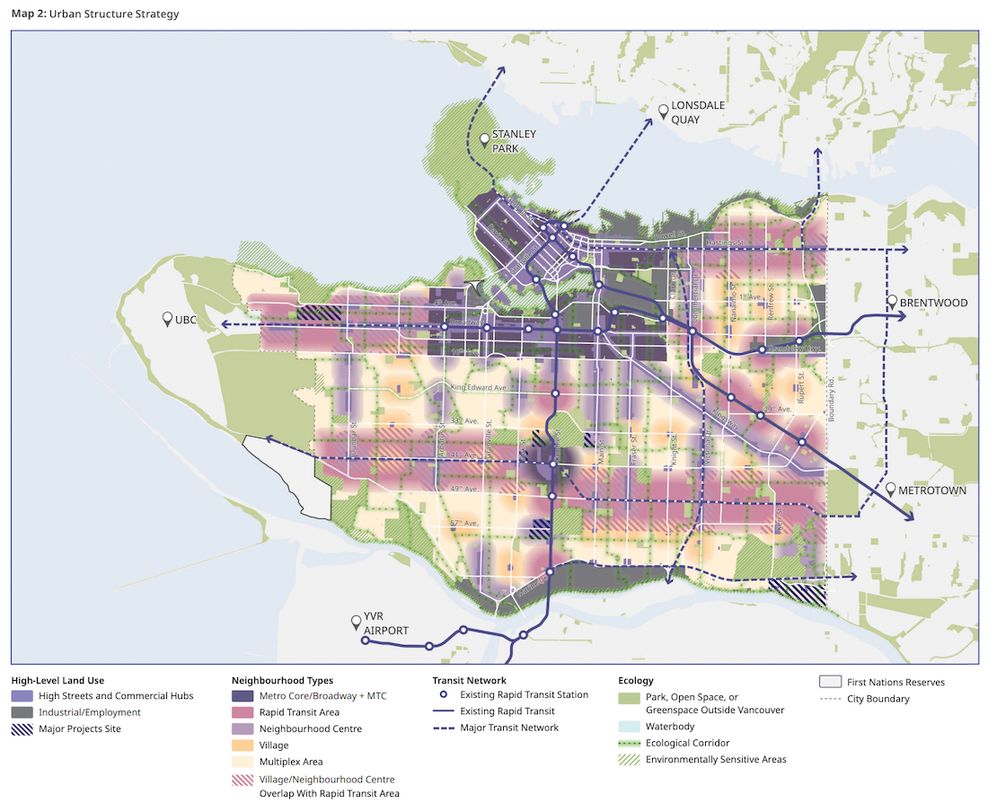
Urban Structure Strategy, Vancouver ODP. (City of Vancouver)
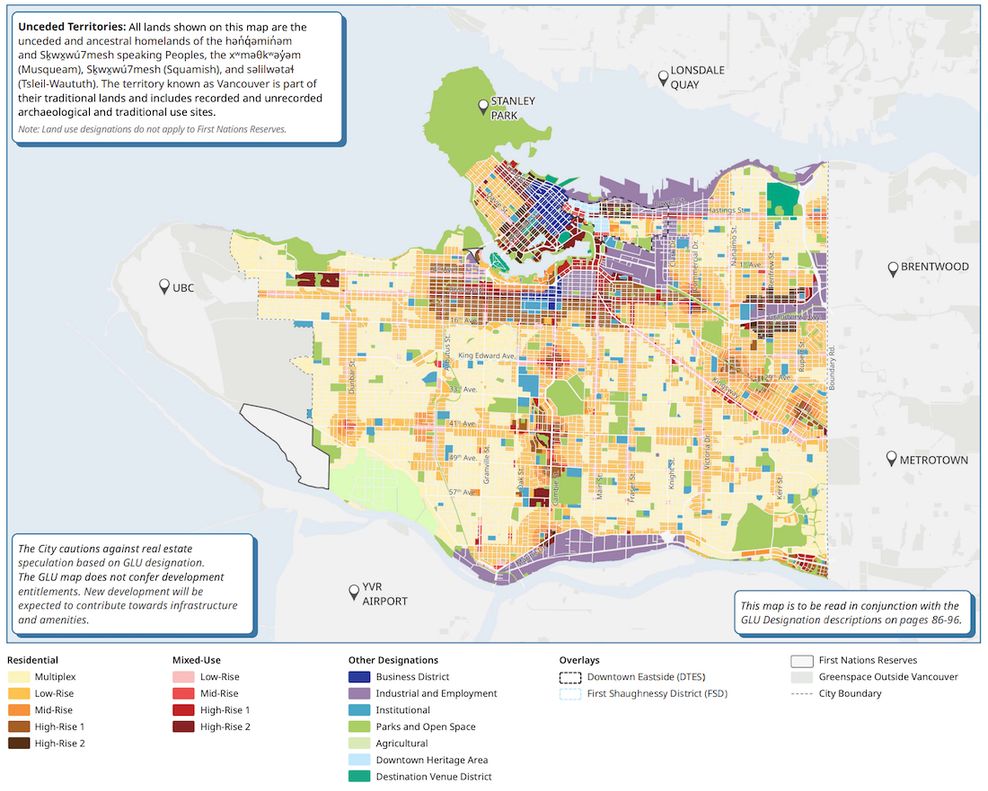
Generalized Land Uses, Vancouver ODP. (City of Vancouver)
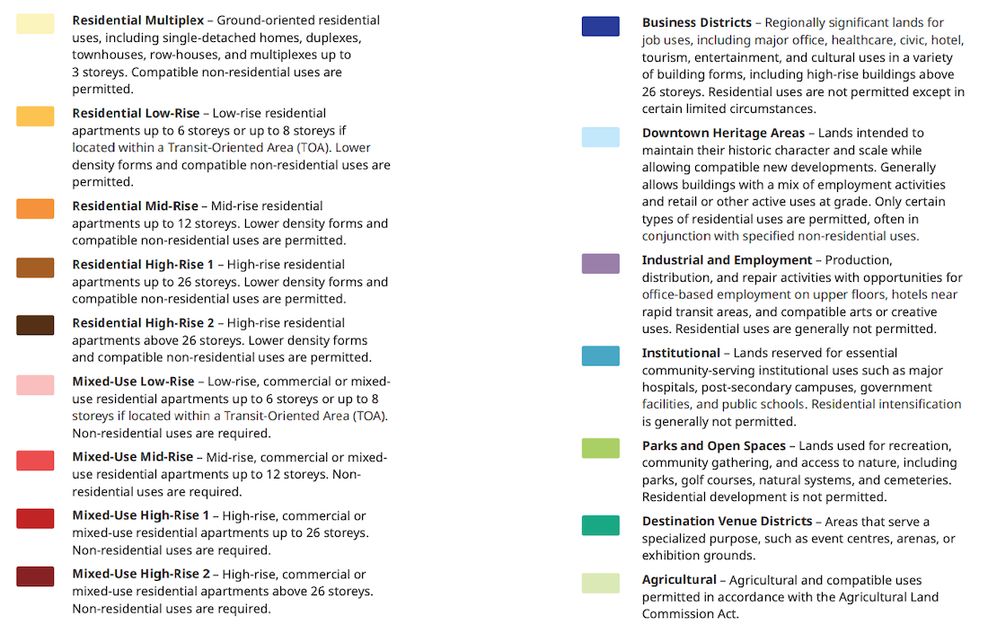
General Land Uses, Vancouver ODP. (City of Vancouver)
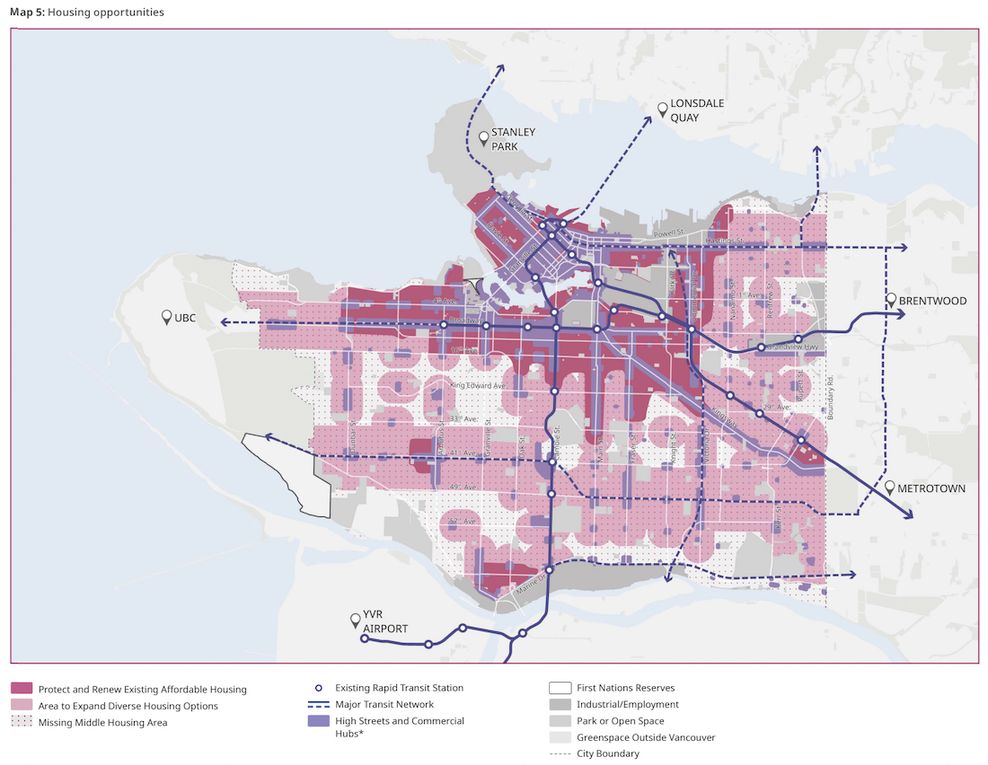
Housing opportunities, Vancouver ODP. (City of Vancouver)
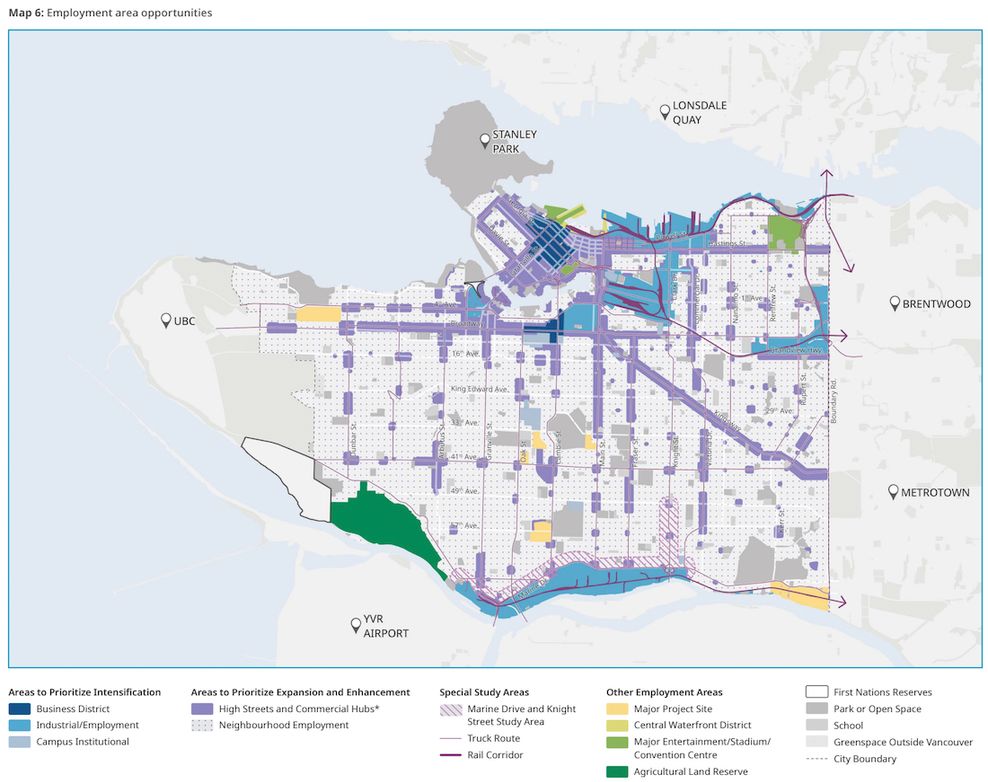
Employment area opportunities, Vancouver ODP. (City of Vancouver)
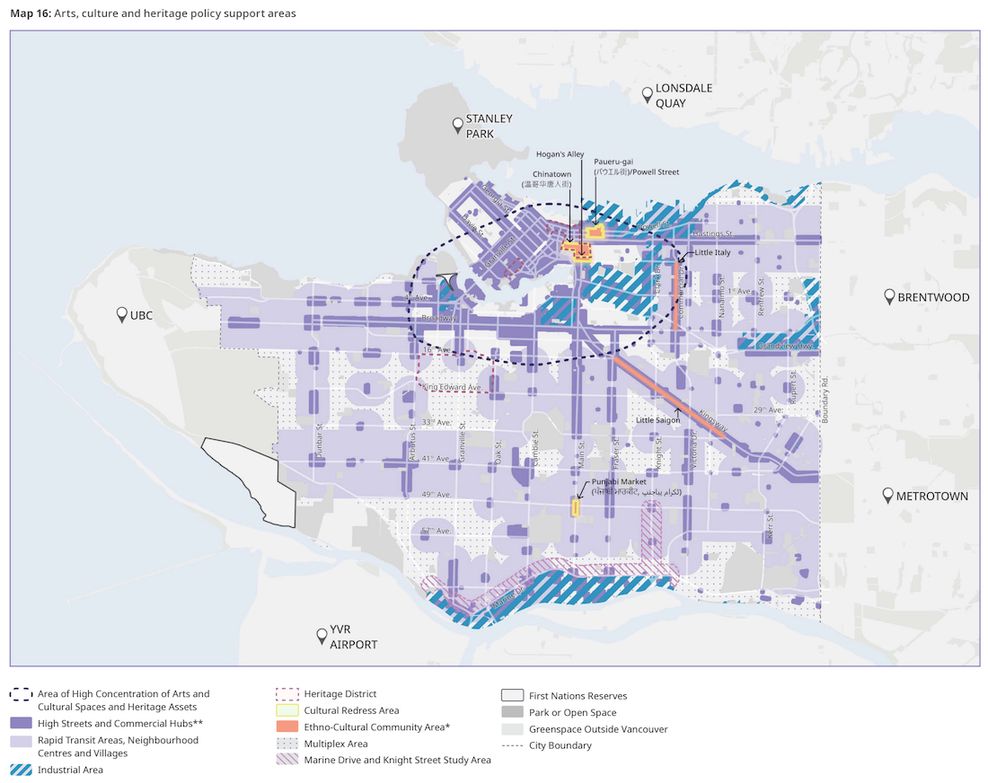
Arts, culture, and heritage policy support areas, Vancouver ODP. (City of Vancouver)
Another central legal requirement of the ODP is demonstrating sufficient land capacity to meet Vancouver’s projected housing needs over the next 20 years. The City’s Housing Needs Reports, updated most recently in 2025, indicate that Vancouver must dramatically increase housing supply to address affordability, population growth, and homelessness. The ODP’s land use framework provides enough theoretical capacity to exceed those provincial housing targets.
The ODP also emphasizes expanding rental housing, social housing, and other non-market housing options, while maintaining tenant protections and discouraging displacement.
Public feedback reveals deep concern about whether those protections will be sufficient. During the public consultation last fall, many residents expressed anxiety about redevelopment pressure, rising rents, and the loss of existing affordable housing stock — concerns City staff note will be addressed during implementation rather than through the ODP itself.
There were also mixed views on growth, with concerns about high-rise towers and the potential of “over-development,” while others call for more density in some areas.
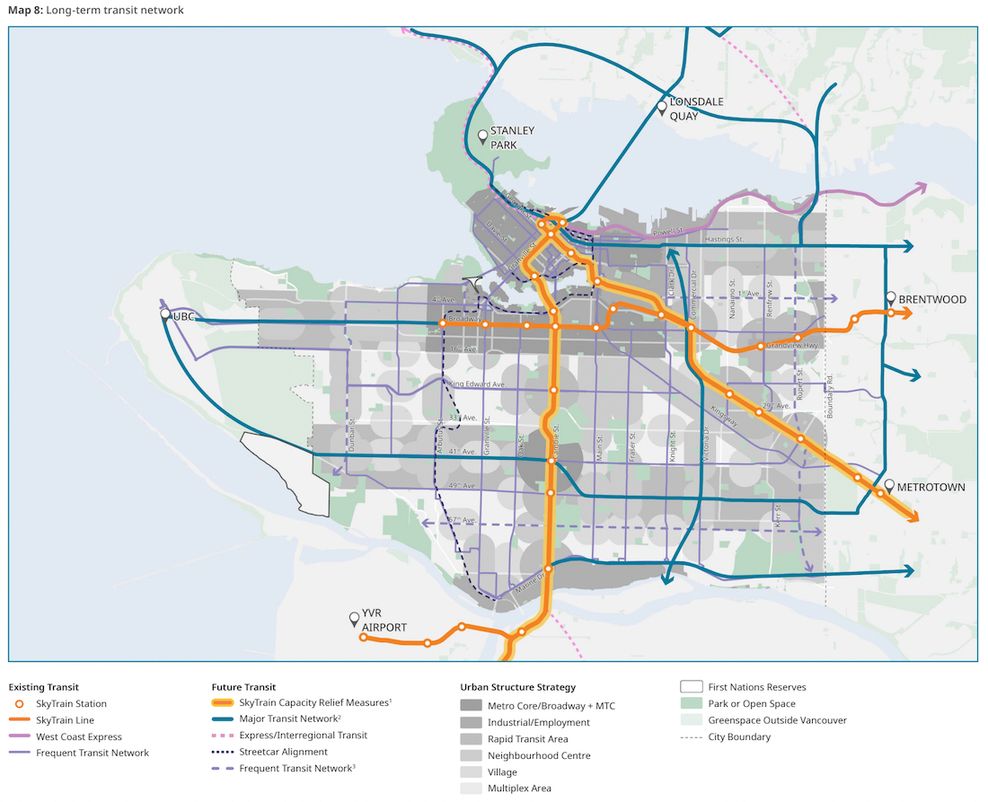
Long-term public transit network, Vancouver ODP. (City of Vancouver)
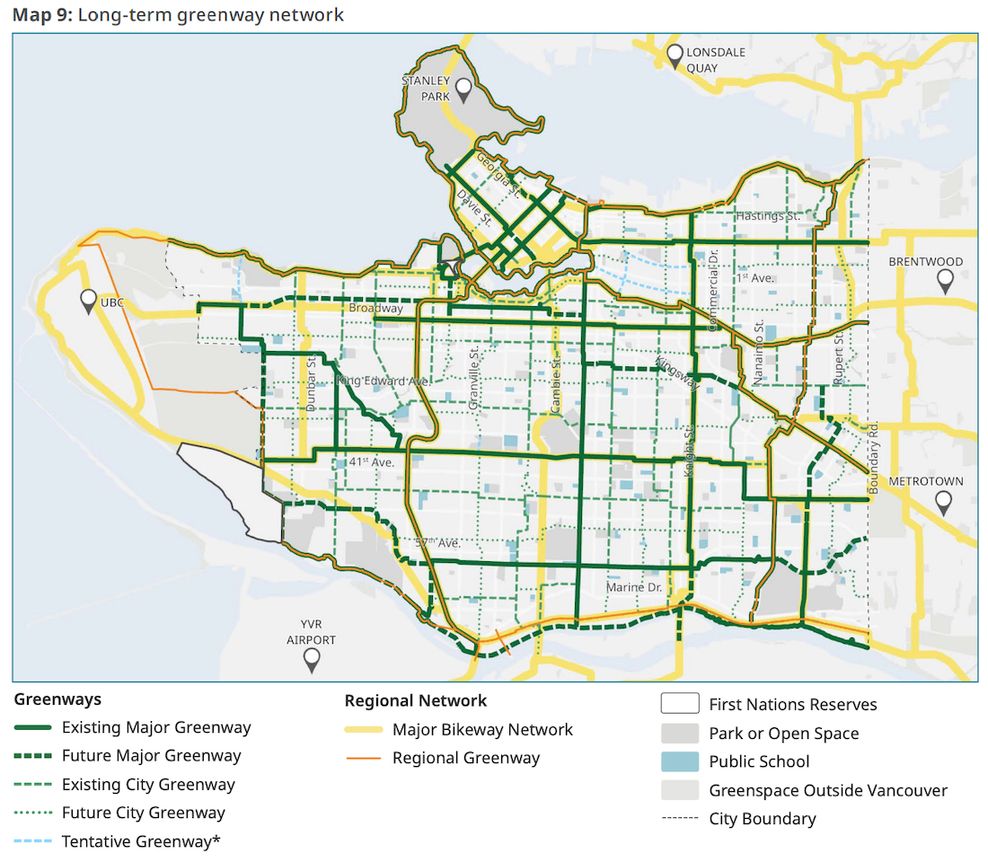
Long-term greenway network, Vancouver ODP. (City of Vancouver)
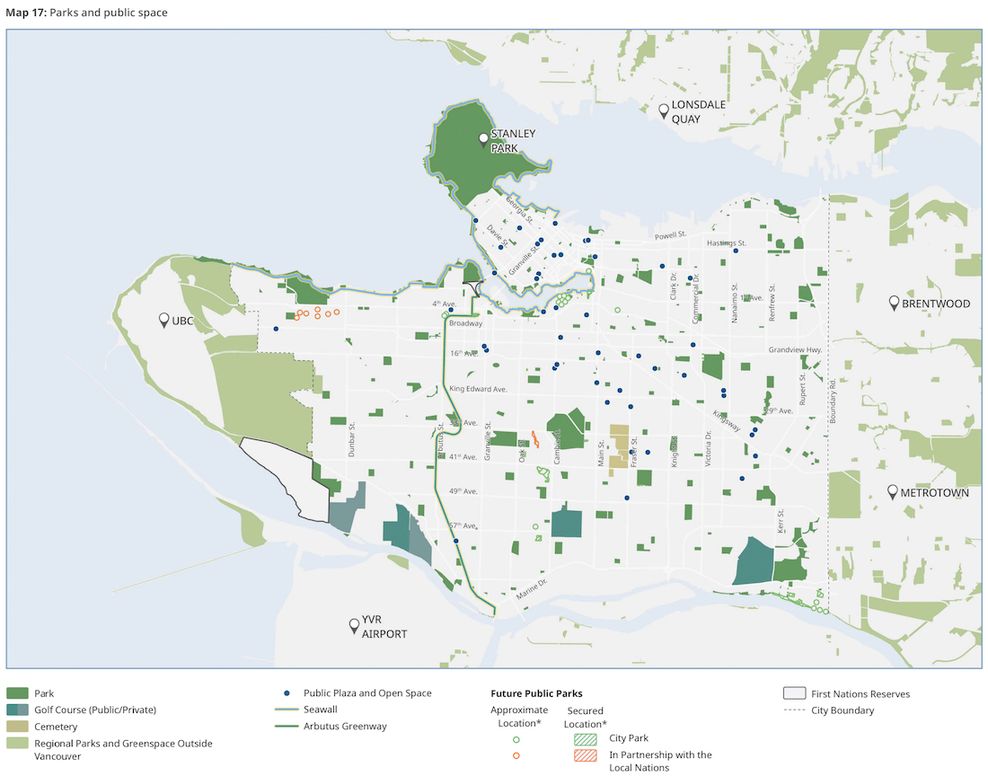
Parks and public space, Vancouver ODP. (City of Vancouver)
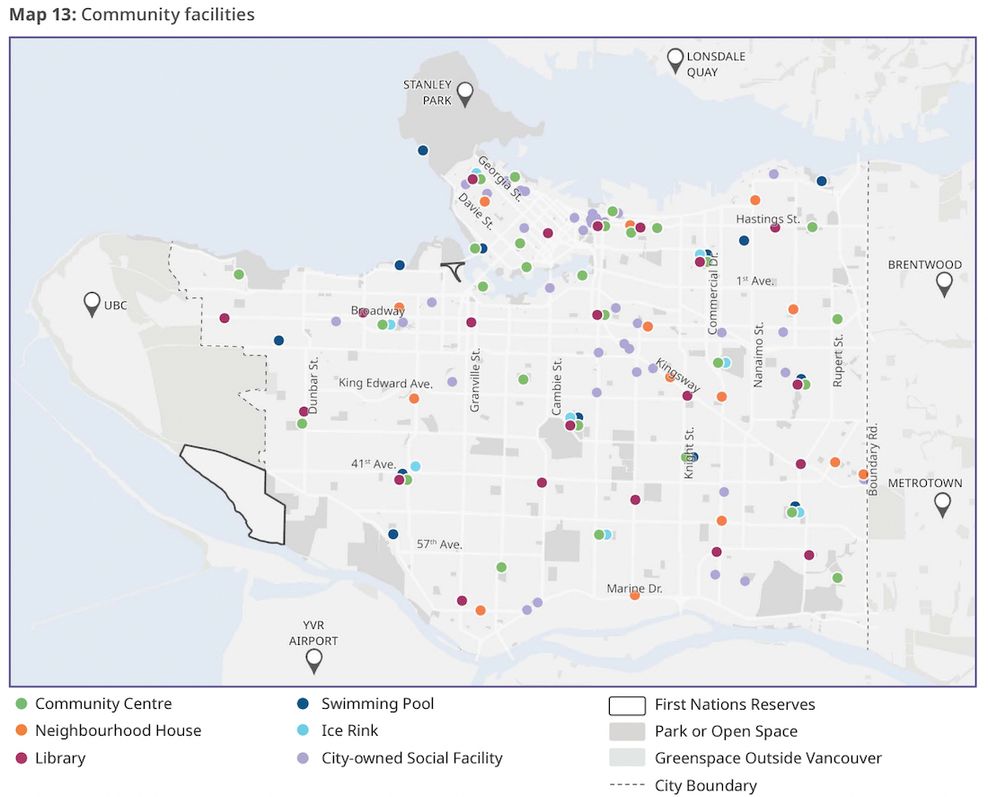
Community and recreational facilities, Vancouver ODP. (City of Vancouver)
Beyond land use, the ODP addresses the infrastructure required to support growth — schools, childcare, public parks, utilities, and community and recreational facilities. Generally, the ODP indicates the Vancouver Eastside neighbourhoods are in need of more attention, as they are underserved compared to the Vancouver Westside.
However, City staff are candid about the municipal government’s financial constraints. The City faces a significant infrastructure renewal funding gap, compounded by limited municipal revenue tools. While the ODP outlines what is needed to support future residents, it does not guarantee funding, relying instead on capital plans, development cost levies, and continued pushes for funding from the provincial and federal governments.
Mapping out seismic risks and flood hazards
The ODP embeds climate action and resilience as foundational principles, with policies addressing heat waves, flooding, and seismic risk. The City has mapped hazardous lands and climate risks, including floodplains, extreme heat zones, and seismic vulnerability areas. City staff note these maps will guide future zoning updates, infrastructure investment, and building regulations.
The ODP highlights protections for environmentally sensitive areas, existing and new “ecological corridors,” and urban forests, and incorporates the City’s target of achieving 30 per cent tree canopy coverage citywide, which is also one of the identified strategies to mitigate heat.
Fundamentally, the ODP serves to help the City manage its growth. By 2050, Vancouver is expected to reach a total population of about one million people — an increase of about 240,000 compared to today. As well, the city will be home to about 127,000 more jobs for a total of about 619,000 jobs.
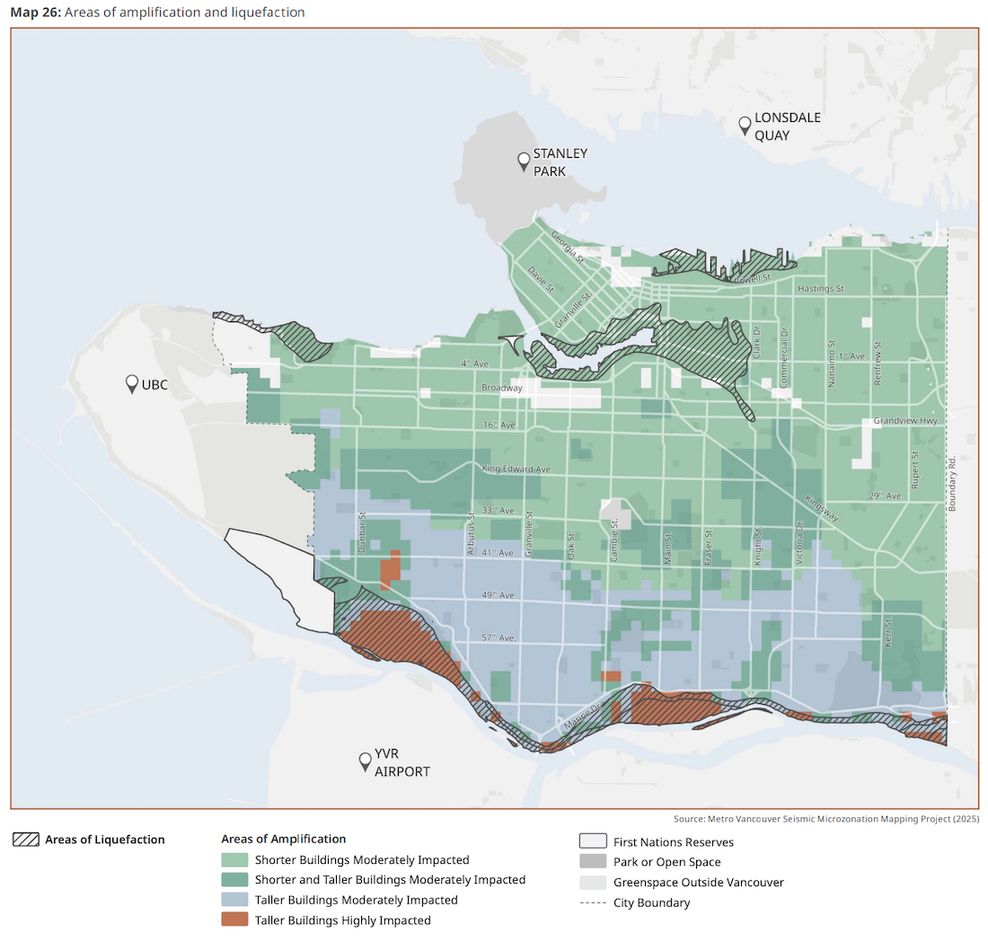
Areas of amplification and liquefaction during an earthquake, Vancouver ODP. (City of Vancouver)
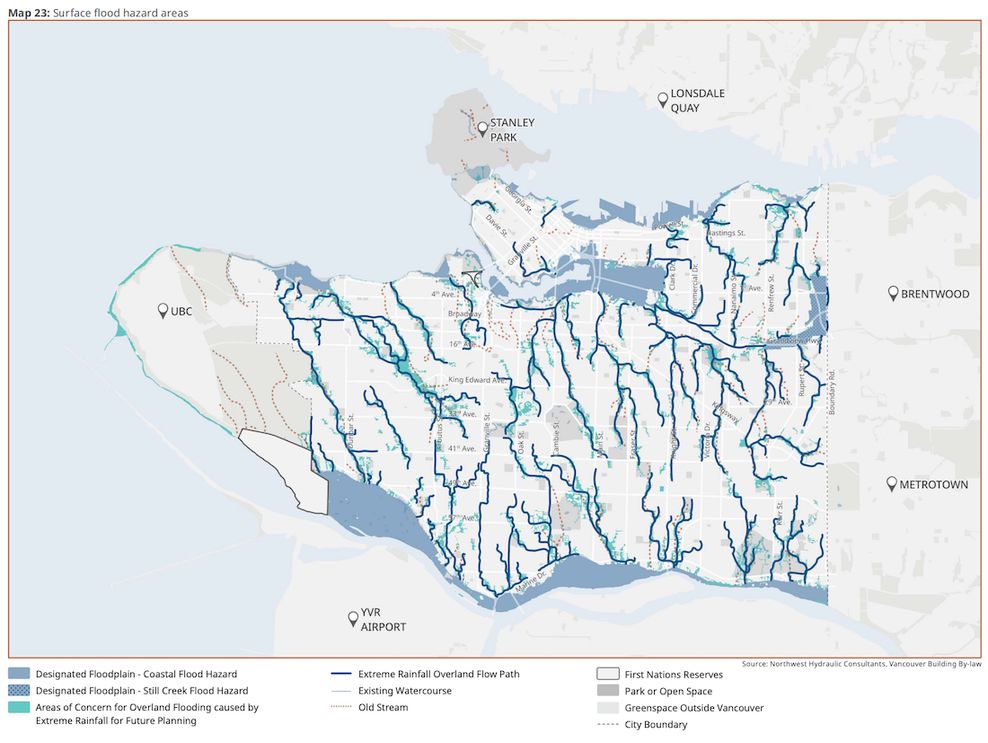
Surface flood hazard areas, Vancouver ODP. (City of Vancouver)
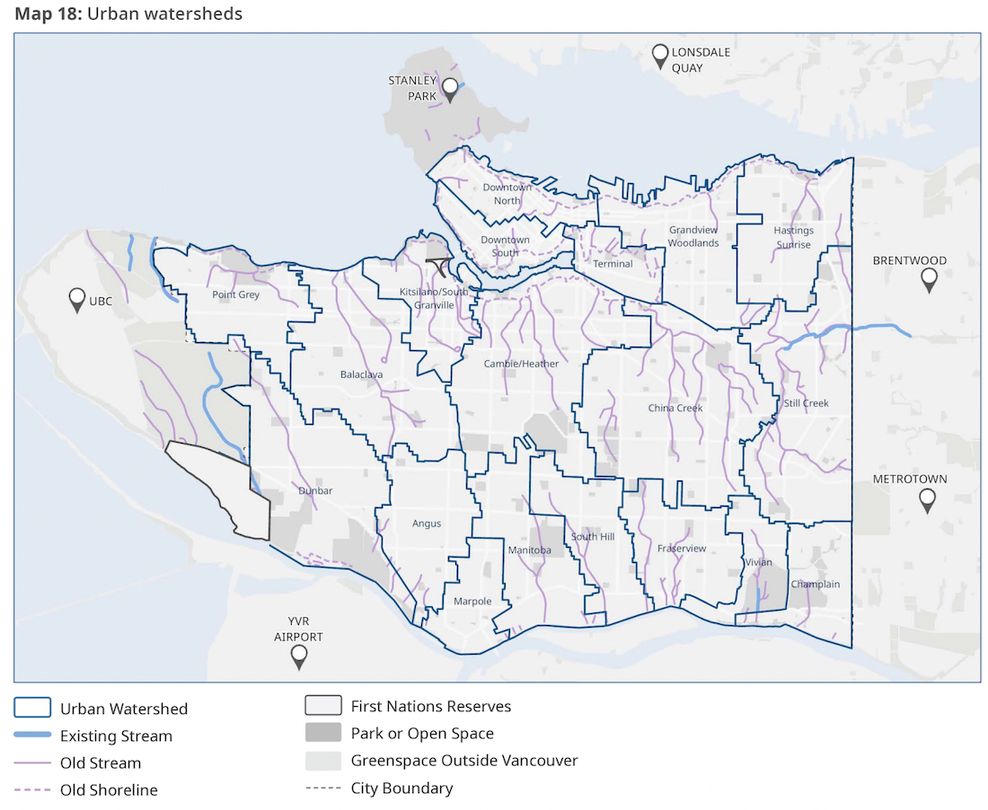
Urban watersheds, Vancouver ODP. (City of Vancouver)
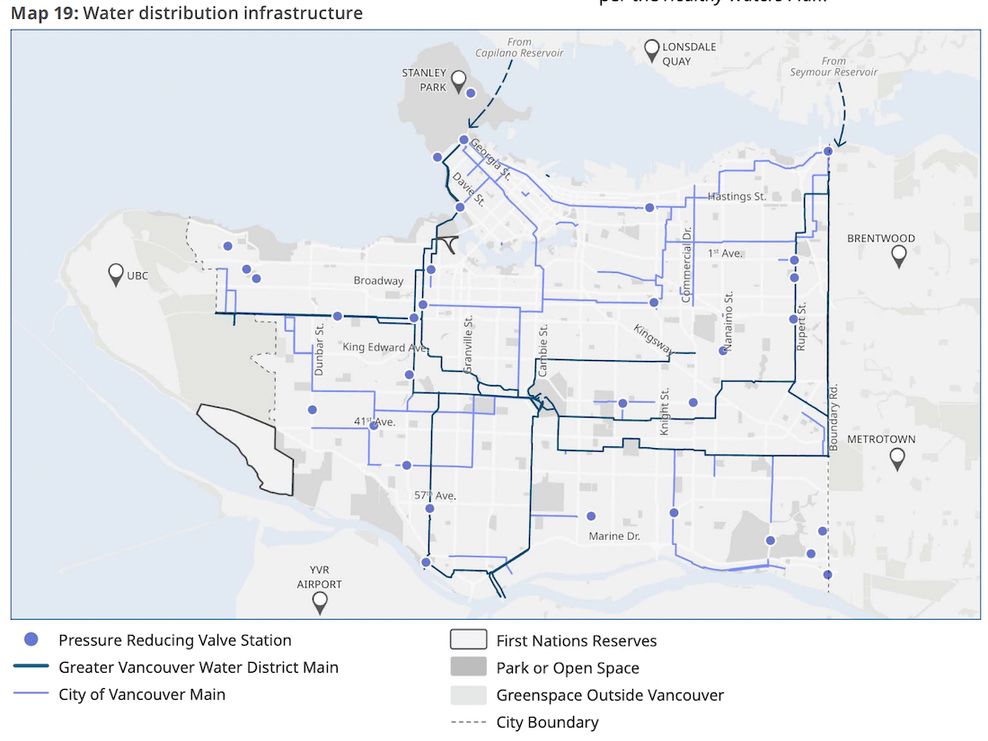
Water distribution infrastructure, Vancouver ODP. (City of Vancouver)
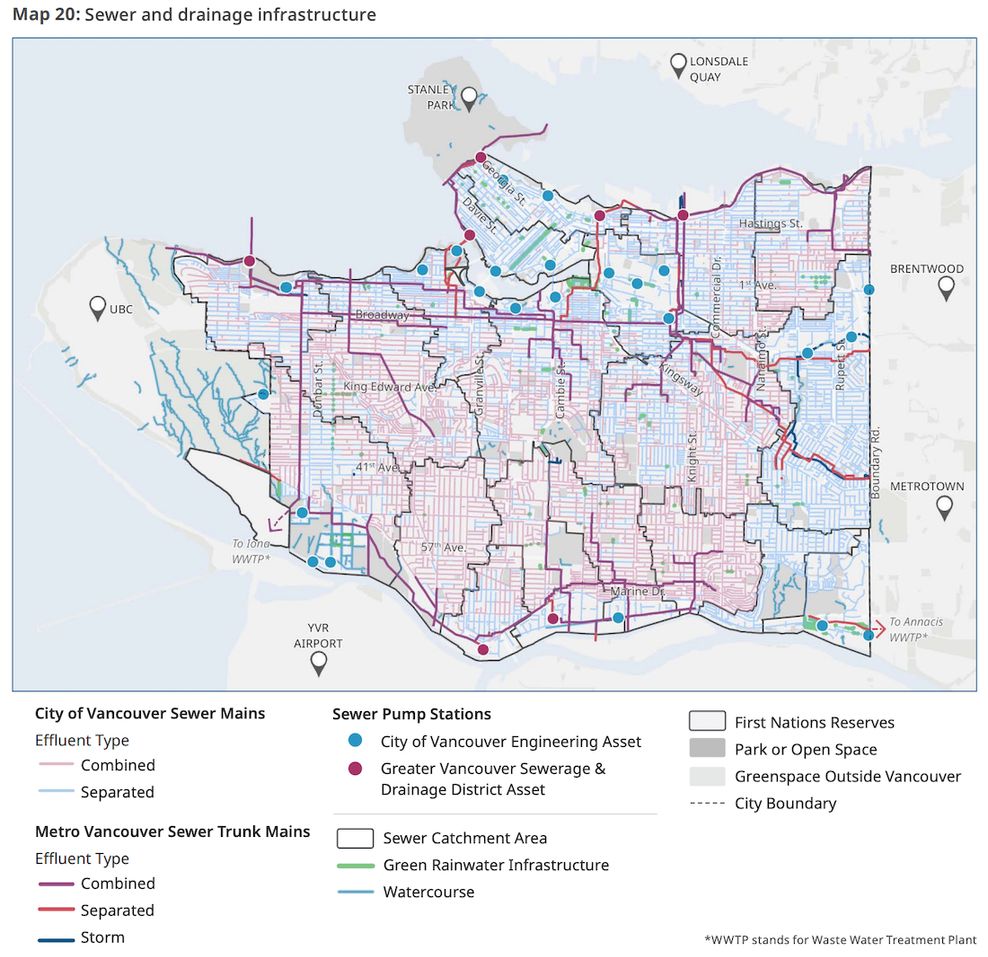
Sewer and drainage infrastructure, Vancouver ODP. (City of Vancouver)