
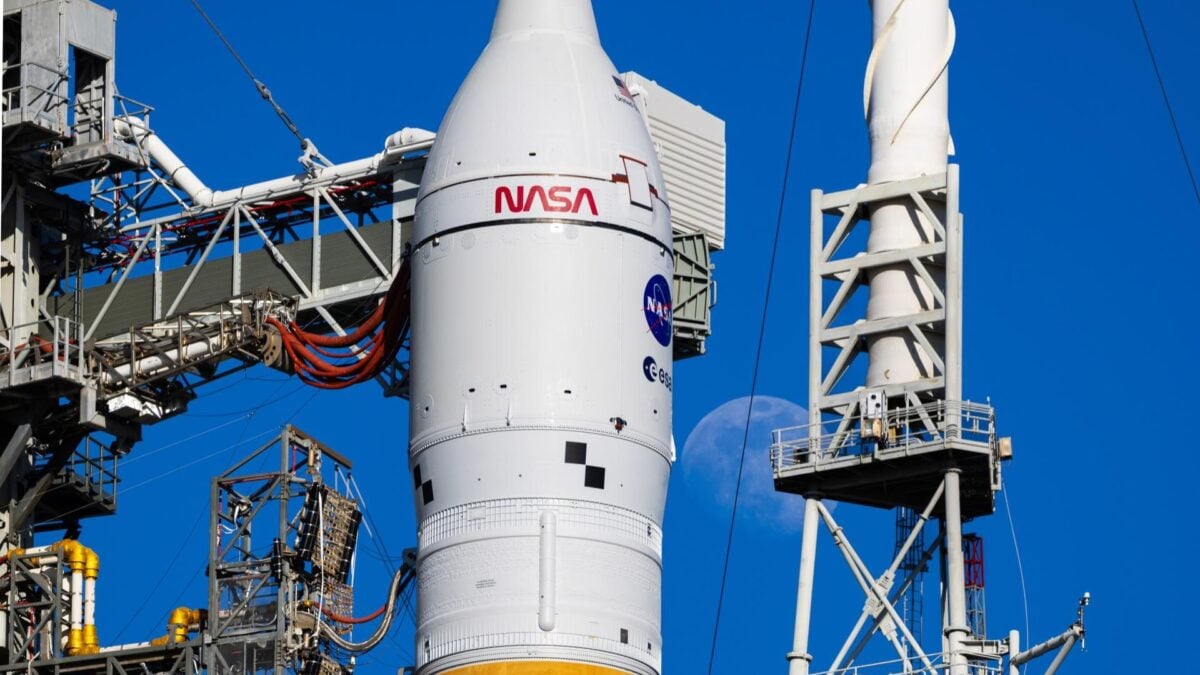
For a minute there, it was looking like NASA’s Artemis 2 mission could launch as soon as Sunday, February 8, but a technical issue that arose during the final fueling test has put the brakes on pre-launch preparations.
In a statement released early Tuesday morning, NASA said it terminated the wet dress rehearsal countdown at the T-5:15 minute mark due to a liquid hydrogen leak at the interface where hydrogen flows into the core stage of the Space Launch System (SLS) rocket. In a separate statement, the agency said the mission would no longer be able to launch during the February window, which closes February 11. Instead, NASA will now work toward the March window as the earliest possible launch opportunity for Artemis 2.
“With more than three years between SLS launches, we fully anticipated encountering challenges,” NASA Administrator Jared Isaacman said in an X post. “That is precisely why we conduct a wet dress rehearsal. These tests are designed to surface issues before flight and set up launch day with the highest probability of success.”
What went wrong?
NASA said engineers “pushed through several challenges” during the two-day wet dress rehearsal, which involves loading the SLS’s core and upper stages with cryogenic propellant (liquid hydrogen and liquid oxygen) and proceeding through a countdown that concludes at T-29 seconds. Engineers do not fire the rocket’s boosters during this test. Its purpose is to allow teams to practice fueling and countdown protocols, verify that all integrated ground systems are working properly, and identify any technical issues (such as propellant leaks) prior to launch.
So, the Artemis 2 wet dress rehearsal did exactly what it was supposed to do. According to NASA, teams began the approximately 49-hour countdown at 8:13 p.m. ET on Saturday, all the while monitoring unusually cold weather at Kennedy Space Center in Cape Canaveral, Florida. The cold forced them to slightly delay tanking operations, as low ambient temperatures can interfere with this process, but engineers ultimately determined that it was safe to proceed.
During fueling operations on February 2, they spent “several hours” troubleshooting a liquid hydrogen leak inside an interface that feeds propellant into the rocket’s core stage, putting them behind in the countdown. While teams did manage to fill all the rocket’s tanks and run the countdown to about five minutes before launch, the test was ultimately halted when sensors detected the leak getting worse.
Hydrogen leaks are common during SLS wet dress rehearsals and plagued the Artemis 1 mission as well, delaying the launch twice.
On top of this, a recently replaced valve that controls hatch pressurization for the Orion spacecraft required retorquing, which caused wet dress rehearsal closeout operations to take longer than planned. Audio communication channels across ground teams also dropped out several times—an issue engineers have been dealing with for the past few weeks.
Now what?
The next launch window for Artemis 2 opens on March 6, with subsequent opportunities on March 7, 8, 9, and 11. Now that NASA is working towards these dates, it has a few weeks to address the hydrogen leaks and other technical issues that arose during the wet dress rehearsal.
Teams will fully review all data from the test, fix these problems, and conduct another wet dress rehearsal before setting an official target launch date.
The Artemis 2 astronauts—NASA’s Reid Wiseman, Victor Glover, and Christina Koch, and the Canadian Space Agency’s Jeremy Hansen—have been in preflight quarantine since January 23 to prevent them from getting sick before or during the mission, but they will exit now that NASA is working toward a March launch. They will reenter two weeks before the next launch attempt.
Crew safety is NASA’s number one priority. Artemis 2 will send these astronauts on a 10-day trip around the Moon, taking them farther from Earth than any human has traveled before. Though we were all hoping to see this historic mission get off the ground this month, we’ve waited more than 50 years to return to the Moon and can certainly wait a few weeks longer.