
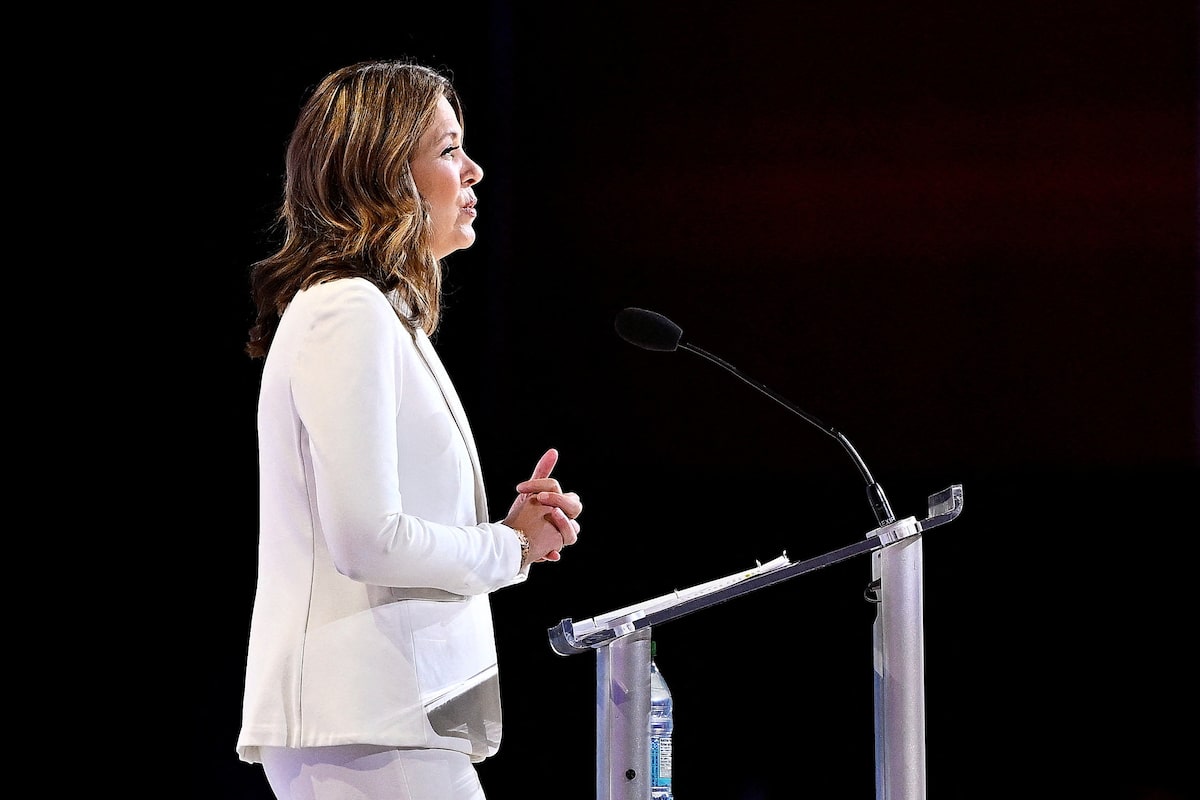
In late January, on a radio show, in response to a caller’s question about federal bail laws, Premier Danielle Smith said, ‘I wish I could direct the judges.’ Critics saw the remark as potential political interference in the courts.Adrian Wyld/The Canadian Press
Alberta Premier Danielle Smith is calling on Prime Minister Mark Carney to give her United Conservative Party government more say over judicial appointments, citing what she described as the province’s distinct legal traditions.
In a letter to the Prime Minister published on Tuesday alongside a news release, Ms. Smith said she also wants the province to have an increased say in appointments to the Supreme Court of Canada, and for Ottawa to reduce bilingualism requirements for judges on the top court.
Ms. Smith said she would withhold some judicial funding if Ottawa did not agree to her demands. It was the latest in a series of moves from the Premier through which she has sought to impose more provincial political power in the realm of the courts.
“We are simply asking for a formal and meaningful role in the judicial appointment process,” Ms. Smith said in the news release, adding that such changes would support national unity – an allusion to the separatist movement in her province.
According to Canada’s Constitution, Ottawa is in charge of appointing judges to higher levels of courts across the country, including the Supreme Court and the federal courts, as well as the appeal and superior courts in each province.
Alberta justices emphasize independence in rare statement after remarks by Danielle Smith
Justice Minister Sean Fraser’s spokeswoman, Lola Dandybaeva, said in a statement on Tuesday that the federal government “values engagement with Alberta” and will continue to work within Canada’s constitutional framework.
“Respecting that framework is essential to protecting Canada’s sovereignty and democratic system,” Ms. Dandybaeva said.
Tuesday’s demands represent another foray from Ms. Smith into the justice system, after other decisions and declarations in recent months.
In late January, on a radio show, in response to a caller’s question about federal bail laws, Ms. Smith said, “I wish I could direct the judges.” Critics saw the remark as potential political interference in the courts. Several days later, top judges in Alberta, led by the province’s acting Chief Justice Dawn Pentelechuk, issued a rare statement that underlined the importance of independent courts in a healthy democracy.
Ms. Smith last fall shielded four different laws from court challenges by invoking the notwithstanding clause in the Charter of Rights and Freedoms.
Alberta invokes notwithstanding clause on three bills affecting trans and gender-diverse youth
The current system through which the federal government names judges to the Court of King’s Bench of Alberta and the Alberta Court of Appeal, as well as the same courts in all provinces, was established by Ottawa in the late 1980s. There are 17 judicial advisory committees across Canada, including one for Alberta, that assess applicants and make recommendations to the federal government.
Each committee has seven members: Ottawa names three; the provincial government names one; the province’s chief justice names one; and two lawyers’ groups – one national and one provincial – each get one pick.
Ms. Smith on Tuesday proposed a four-person committee, with two picks from Alberta and two from Ottawa. The quartet would produce a list of names. The provincial and federal justice ministers would then collaborate to choose the new judges.
Legal experts on Tuesday questioned some of Ms. Smith’s demands. In the Premier’s letter to Mr. Carney, released Tuesday and dated Jan. 23, she said she would withhold funding for three open positions on the Court of King’s Bench if Mr. Carney didn’t agree to her proposed changes. Ottawa filled two of those jobs on Jan. 27 and in any case pays the vast majority of costs for such judges.
There were also questions about what Ms. Smith called Alberta’s distinct legal traditions. The justice system in Alberta, like elsewhere in Canada outside Quebec, is rooted in the same common law that stretches back centuries to England.
Ms. Smith said she would withhold some judicial funding if Ottawa did not agree to her demands.Jennifer Gauthier/Reuters
On judicial appointments, Alberta also wants its proposed system in place for Supreme Court openings for candidates from Western Canada.
Such a proposal for the top court might not be workable, said lawyer Andrew Bernstein at Torys LLP in Toronto, a veteran of Supreme Court cases.
“It’s very difficult to see how provincial representation would work for the Supreme Court,” Mr. Bernstein said.
The current system for Supreme Court appointments starts with an independent advisory board that reviews and interviews applicants. The board presents a short list to the Prime Minister, who makes the final choice.
The board previously has had eight members, with three named by Ottawa and five named by different law groups. The board consults widely and Ottawa also consults directly with provincial governments.
There are two positions among nine judges on the top court that by convention are appointed from Western Canada. Alberta has had both Western seats since late 2017.
In mid-January, Supreme Court Justice Sheilah Martin, from Alberta, said she will retire at the end of May. Justice Mary Moreau from Alberta remains on the top court.
Robyn Urback: If nothing else, Danielle Smith is a disruptor
Legal experts believe that a fourth consecutive Albertan for one of the two Western spots is unlikely. Albertans have been named to the top court in five of the past seven openings for Western Canada.
Among Ms. Smith’s other demands on Tuesday was relaxing the law on bilingualism for judges of the Supreme Court.
In 2023, the federal Liberals amended the Official Languages Act, requiring Supreme Court judges to be able to understand legal proceedings in French and English without the assistance of an interpreter.
In Ms. Smith’s letter to Mr. Carney, she said the bilingualism requirement for the Supreme Court “entrenches systemic barriers and alienation for Western Canadians.”
In 2023, the last time there was an open spot from Western Canada, the advisory board put forth only two names. It is supposed to submit three to five names. The bilingualism requirement was seen as a challenge.
Allan Hutchinson, a law professor at Osgoode Hall at York University, said Ms. Smith’s demands are typical of her efforts to put pressure on Ottawa on various fronts. He said significant change to the appointments process is unlikely. On bilingualism, he said it makes sense if the requirement isn’t overly strict.
“It sends a message that people who fancy their chances as a judge should start boning up on their French,” Prof. Hutchinson said.