
It started off just like any other Pep Guardiola press conference. Five minutes late, he bundled through the door and let out a sigh as he sank into his swivel chair and rocked back and forth until he was comfortable.
Guardiola likes a lot of things about being a Premier League manager, but speaking to the media is not at the top of the list.
Partly because he has an axe to grind with Sky Sports over comments from certain pundits, the Manchester City manager’s answers to TV reporters in the first section of the press conference are often stunted — one of them this season lasted only three minutes — but his responses in the second section to the written press are more expansive.
“The first part was a bit boring,” Guardiola joked halfway through Tuesday’s press conference to preview the second leg of City’s Carabao Cup semi-final against Newcastle United on Wednesday. “Now it gets interesting. Now we start the good [questions].”
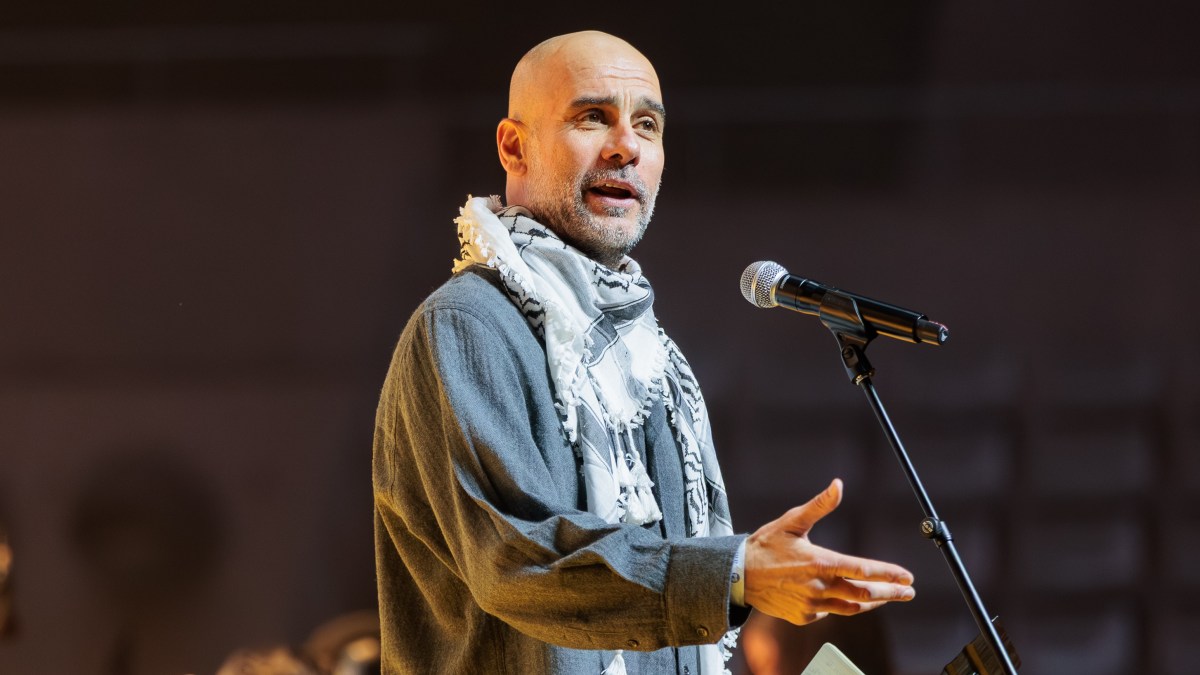
It took just one of those questions — about his appearance last week at a Palestinian charity concert in Barcelona — to spark the Catalan into life and off he went, delivering a 16-minute address that was more suited to the UN general assembly than a sterile press conference room in east Manchester.
Guardiola, 55, spoke eloquently about the “genocide in Palestine”, the wars in Ukraine and Sudan, and the killings perpetrated by members of the United States Immigration and Customs Enforcement department (ICE).
Oh, and he was on the warpath with referees and the critics who claim he has only bought his way to success at City. “We will always live with that [claim],” he said, leaning forward into the microphone to make sure his words were heard clearly.

Guardiola said he is “hurt” by images of suffering and that is why he speaks up for a “better society”
DENNIS AGYEMAN/GETTY IMAGES
Guardiola was at his most animated and passionate when talking about world affairs, however.
“With the technologies and advances that we have, humanity is better than ever in terms of possibilities” he said forcefully. “We can reach the moon, we can do anything, but still right now, we kill each other.
“For what? When I see the images, I am sorry, it hurts me, that is why in every position I can help by speaking up for a better society, I will try and will be there. This is for my kids, my family, for you and your families, for the players, the staff.
“Never, ever in the history of humanity — never ever have we had the info in front of our eyes more clearly than now: genocide in Palestine, what happened in Ukraine, what happened in Russia, what happened all around the world — in Sudan, everywhere.”
“Do you want to see it?” he asked, staring directly at reporters. “It’s our problem as human beings.”
Nobody knows what caused Guardiola to open his heart and speak so passionately, but he has been politically active in the past. He campaigned for an independence referendum for Catalonia and is a supporter of Open Arms, the Spanish NGO which rescues refugees in the Mediterranean Sea.
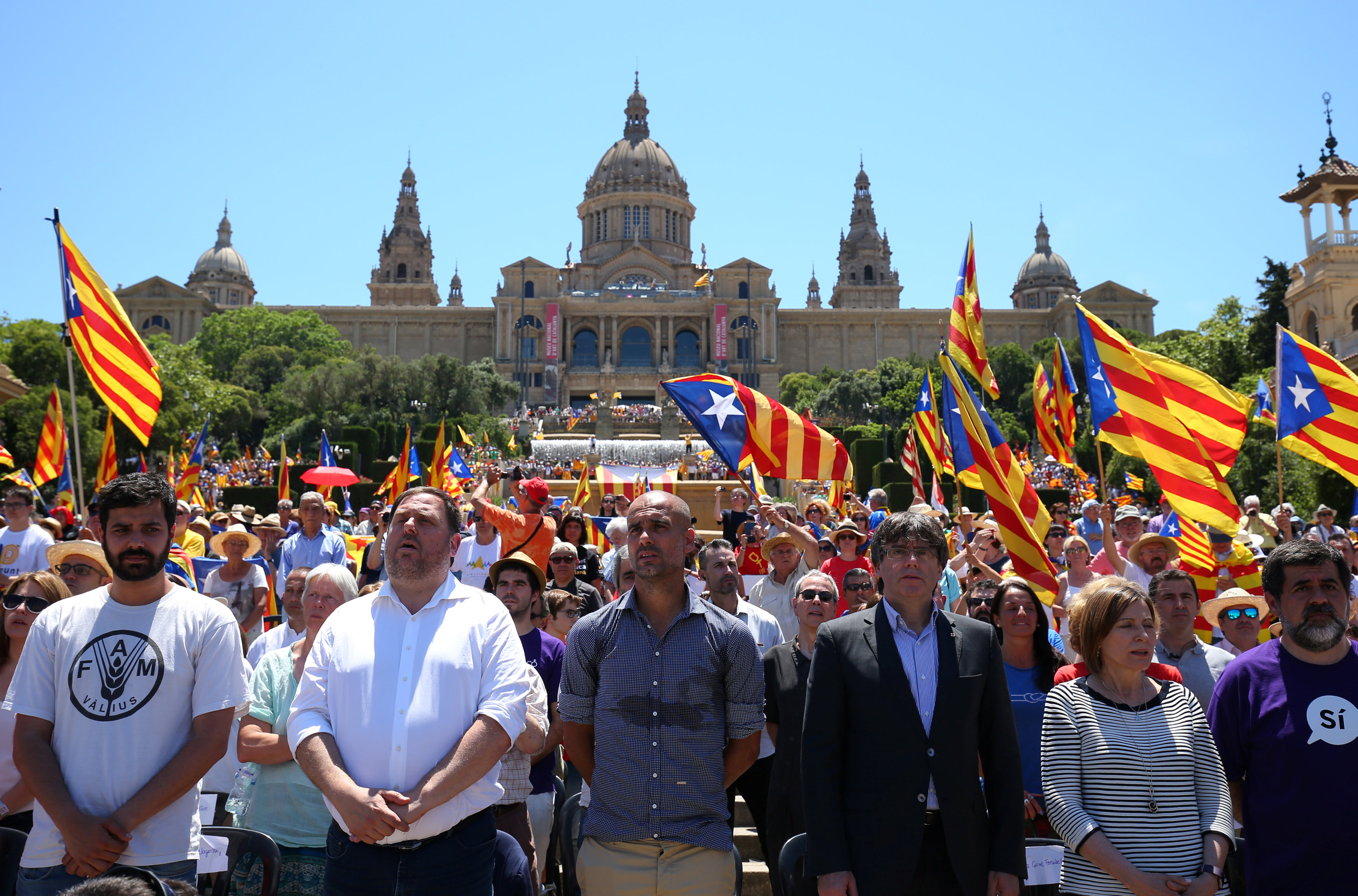
The City manager, centre, has campaigned for an independence referendum for Catalonia, his native region in Spain
ALBERT GEA/REUTERS
That said, Guardiola is not entirely on solid ground. Sheikh Mansour, the City chairman, is also vice-president of the United Arab Emirates, which “arbitrarily restricts the rights to freedom of expression”, according to an Amnesty International report.
“Every country decided the way they want to live for themselves,” Guardiola said hesitantly when asked about freedoms in the UAE in 2018. “If he decides to live in that [country], it is what it is.”
Meanwhile, Sudan is taking the UAE to the International Court of Justice, accusing it of supporting the paramilitary Rapid Support Forces in the Sudanese civil war.
Still, at a time when many others in his position refuse to even speak about anything other than headers, volleys and hamstrings, it was somewhat refreshing to hear Guardiola talk so openly and passionately of his concerns about the state of the planet.
“The people who have to [flee] their countries and get rescued in the sea — don’t ask if that is right or wrong, just rescue them,” Guardiola said on the topic of migration.
The heavy-handed tactics used by ICE have struck a nerve too, particularly the killings of Renée Good and nurse Alex Pretti in Minneapolis.
“Look what happened in the United States of America,” Guardiola said, gesturing throughout. “Renée Good and Alex Pretti have been killed. Imagine if he worked for the NHS and five, six [ICE agents] threw him on the grass and fired ten shots at him. Tell me, how can you defend that?”
After such an impassioned speech on global affairs, it seemed somewhat trivial to turn back to the topic of transfer spending, but Guardiola himself brought it up earlier in the press conference.
“I’m a little bit sad and upset because in [terms of] net spend in the last five years we are seventh in the Premier League,” he said sarcastically. “I want to be the first, I don’t understand why the club don’t spend more money. I am a little bit grumpy with them.”

City’s signing of Semenyo in January was the biggest of the transfer window in terms of price, at £62.5million
ROB NEWELL/GETTY IMAGES
City have spent almost £2billion since Guardiola took over, but the club have managed to counteract that spending to a certain extent — particularly over the past few years — by making huge profits on players, particularly academy graduates such as Cole Palmer, Oscar Bobb and Jadon Sancho.
It clearly irks Guardiola that he is still labelled a chequebook manager by his critics despite being two victories away from his 19th trophy at City.
“Every time we won something, it was exactly the same,” Guardiola said when asked about City’s “big-spenders” tag. But the numbers are the reality. Good luck to the six teams who are in front of us in terms of net spend. Let’s go. I’m waiting. That’s a nice quote, eh?”
After 16 breathless minutes, Guardiola got up from his seat before spotting that a reporter in the front row had not been allocated a question by the press officer on the top table.
The reporter in question gave Guardiola a grilling on Rodri’s insinuation, after the 2-2 draw against Tottenham Hotspur, that referees are not “neutral” in some City games.
Please enable cookies and other technologies to view this content. You can update your cookies preferences any time using privacy manager.
Enable cookiesAllow cookies once
Guardiola said that the adrenaline was probably still pumping around Rodri’s veins when he had a microphone shoved in front of his face.
“In that moment you can feel the situations, when you finish the game and go [to the interviews], but Rodri knows we have to play better,” he said.
In Guardiola’s opinion, are referees conspiring against City?
“No, no — absolutely not,” he said, overlooking the fact that earlier in the press conference he said that City were repeatedly on the receiving end of bad refereeing calls. “I am sorry, it’s not [just] once,” he said. “I’m so nice with the referees but they don’t believe me.”
And with a jovial farewell — “It’s always a pleasure, guys” — Guardiola was on his way out of the door, free to spend the rest of his afternoon studying Newcastle’s patterns of play, looking at this weekend’s refereeing appointments, or reading the latest news reports from the Middle East.
Man City v Newcastle United
Carabao Cup semi-final, second leg
Wednesday, 8pm
TV: Live on Sky Sports