
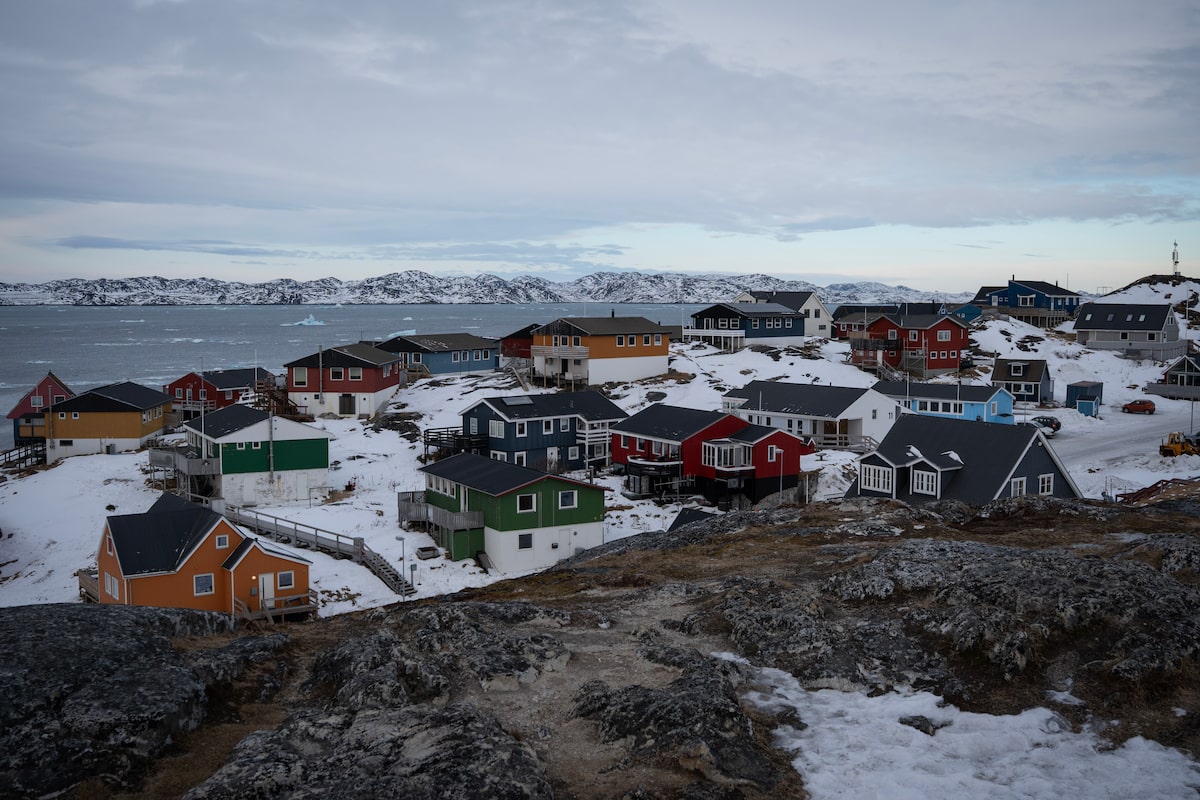
Only Iceland and the U.S. currently have diplomatic consulates in Nuuk. Canada and France are set to join them this week.Siegfried Modola/The Globe and Mail
Greenlanders are about to receive some crucial diplomatic support from Canada and France in the island’s continuing battle with Donald Trump.
Governor-General Mary Simon will be in Nuuk on Friday to open a consulate in the capital. A Canadian Coast Guard ship, the Jean Goodwill, will be on hand for the ceremony. And French officials are expected to open a consulate on Thursday.
Canada and France are among the first countries to establish diplomatic missions in Greenland in the wake of the U.S. President’s threats to acquire the Arctic island, which is a self-governing part of Denmark. Canada’s pledge to set up a consulate was made in late 2024 as part of a review of Arctic foreign policy, but the proposal took on added importance in recent months as Mr. Trump ratcheted up his rhetoric.
Currently only Iceland and the U.S. have diplomatic consulates in Nuuk although several countries have honorary consuls, who are typically local citizens and provide limited services.
The new consulates are part of a growing effort by European and NATO countries to show support for Greenland and its 57,000 residents.
“Let me be clear: Canada stands firmly in support of the people of Greenland who will determine their own future,” Ms. Simon said during a speech at the Arctic Frontiers conference in Norway on Tuesday. “Another country should not interfere in a sovereign state,” she added in an interview with the CBC.
French Foreign Minister Jean-Noël Barrot has made it clear that his country’s new consulate is also a clear statement of support for Greenland and Denmark.
“It’s firstly to signal our desire to deepen our presence in every dimension on that territory belonging to the Kingdom of Denmark,” he said in an interview with France’s LCI television last month. “It’s sending a political signal, but one that’s combined with a desire to play a more active role in Greenland.”
Opinion: Canada must stand with Europe in its defence of Greenland if we know what’s good for us
The North Atlantic Treaty Organization is also paying renewed attention to Arctic security, in part to address concerns expressed by Mr. Trump about growing threats from Russia and China off the coast of Greenland. NATO has begun preparations for a mission called Arctic Sentry, to bolster security across the Far North.
The NATO support and the new consulates “are very important,” said Birger Poppel, a professor of Arctic affairs at the University of Greenland. “You could see the opening of the consulates as part of the support that Greenland has seen over the last weeks from all over,” he said.
The connection between Canada and Greenland is particularly important because of the close cultural ties between the Inuit populations in both places, Prof. Poppel added.
“It’s obvious that the United States is a close neighbour, and when a close neighbour during the period of the Trump administration becomes hostile, it’s nice to know that you have another close neighbour that is much more friendly, and respecting of international borders and agreements.”
Trump talks about Greenland as a strategic asset that could be bought by Washington, while Denmark asserts its legal sovereignty over the island. For the Inuit people, who have lived here for centuries, no one owns the Arctic land.
Reuters
Ms. Simon, who grew up in Nunavik in northern Quebec, has made broadening ties between Inuit in Canada and in Greenland a focus of her trip, which also includes a stop in Copenhagen to meet King Frederik X and Danish Prime Minister Mette Frederiksen. She is travelling to Greenland with a group of Inuit leaders from Canada.
One of them is Natan Obed.
“For many in the Arctic, it was hard not to see the threats looming over Greenland as a sign of what was to come,” said Mr. Obed, president of Inuit Tapiriit Kanatami, which represents Inuit in Canada. “We understand that we are increasingly in the centre of a geopolitical fight that is not necessarily around our culture or our society, but is in our homeland, in our back yards.”
Mr. Trump has backed off his threat to use the U.S. military to invade Greenland. But he has indicated that a deal is being negotiated with Denmark that could grant the U.S. sovereignty over land used for military bases on the island and give American companies greater access to the territory’s mineral riches. However, leaders in Denmark and Greenland have insisted that sovereignty is not up for discussion.
People walk in front of Greenland’s parliament, called the Inatsisartut, in Nuuk. It held a special session on Monday to debate the crisis facing Greenlanders.Marko Djurica/Reuters
Greenland’s parliament, called the Inatsisartut, held a special session on Monday to debate the crisis facing Greenlanders.
“In the past 14 months, our country has found itself in a particularly difficult situation,” Greenland’s Prime Minister Jens-Frederik Nielsen told MPs. He added that even though Mr. Trump has ruled out using military force, his objective has not changed — Greenland must be linked to the United States and governed from there.
“We remain in a serious situation,” Mr. Nielsen said. “We must stand together to protect the Greenland we know.”
The debate ended with MPs passing a motion committing the government of Greenland to “stand on guard over our right to self-determination as a people” and “with all available means to secure and defend our right to self-determination.”
A recent poll of 610 Greenlanders published in The Copenhagen Post found that 76 per cent of those surveyed replied “No” when asked if joining the U.S. would be an advantage for Greenland. Only 8 per cent said “Yes” and 17 per cent were not sure.
Nearly two-thirds of respondents said Greenland should strengthen its ties to the European Union compared to just 5 per cent who said the island should collaborate more with the U.S.
When asked if Greenland should leave the Kingdom of Denmark and become independent now, 62 per cent said “No” and 25 per cent said “Yes.” However, a slim majority — 52 per cent — said that in the long term they believed Greenland could become independent.
A woman walks past a banner on a building facade featuring the Greenland flag in Nuuk. A recent poll of 610 Greenlanders published in The Copenhagen Post found that 76 per cent of those surveyed replied ‘No’ when asked if joining the U.S. would be an advantage for the island.Siegfried Modola/The Globe and Mail