
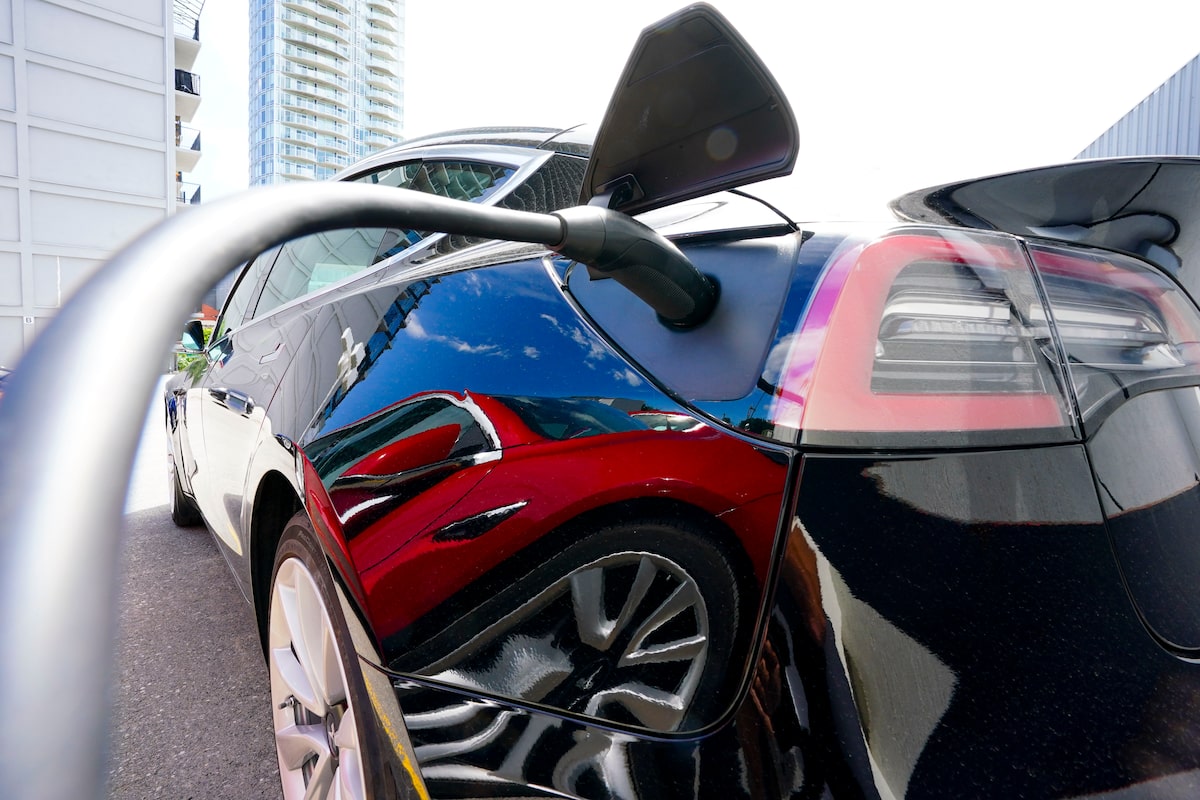
Previous rebates on electric vehicles covered up to $5,000 of new EV purchases, regardless of where the cars were made.Sean Kilpatrick/The Canadian Press
The federal government is set to scrap its policy requiring electric vehicles to make up a growing share of passenger-vehicle sales, as part of a new national automotive strategy to be released on Thursday.
A federal source and three industry sources told The Globe and Mail that the plan is for the controversial Electric Vehicle Availability Standard – also commonly known as the zero-emissions vehicle (ZEV) mandate – to be replaced by a return to tailpipe-emissions regulations.
The industry sources also said that Ottawa will bring back EV-purchase rebates for consumers and promise new investments in charging infrastructure.
Gus Carlson: What’s the future of EVs when even Elon Musk wants out?
The Globe and Mail is not identifying the sources because they were not authorized to speak publicly on the matter.
The apparent decision to scrap the ZEV mandate, which was first reported by the CBC, follows a decision by Prime Minister Mark Carney last September to suspend the policy pending a 60-day review. There have been no updates since.
The mandate’s elimination would bring an end to a key environmental initiative of former prime minister Justin Trudeau’s government, first announced in draft form in 2022. It was intended to ensure an array of EV options to Canadian consumers while providing demand certainty around charging infrastructure and power needs.
It joins a list of climate-related policies eliminated or scaled back by Mr. Carney, including a cap on oil and gas sector emissions and the consumer carbon price.
Analysis: With Chinese vehicles incoming, Ottawa faces thorny questions about how to spur EV sales
But the mandate’s demise will be welcomed by the domestic auto sector, which has long lobbied against the policy, arguing that there is neither sufficient consumer demand nor adequate charging capacity to meet the mandate’s targets of battery, fuel-cell or plug-in hybrid vehicles making up 60 per cent of national vehicle sales by 2030 and 100 per cent by 2035.
Those complaints grew even louder with last month’s deal between Ottawa and Beijing to begin allowing Chinese-made EVs into the country. Industry representatives warned that the ZEV mandate’s credit-trading mechanism, in which automakers exceeding their EV sales requirements could sell credits to those failing to meet theirs, would effectively serve as a subsidy for Chinese imports.
The repeal will bring “immediate relief” to an industry under “extreme pressure” from tariffs imposed by U.S. President Donald Trump, Canadian Vehicle Manufacturers’ Association president Brian Kingston said on Wednesday.
Prime Minister Mark Carney on Parliament Hill in Ottawa on Wednesday.Adrian Wyld/The Canadian Press
“The challenge that we’ve had in Canada has not been with EV supply – there’s over 115 models in this market and more coming into the market every single month,” said Mr. Kingston, whose association represents Ford Motor Co., General Motors Co. and Stellantis NV.
“The issue is the demand hasn’t been there because the key barriers to adoption have not been adequately addressed,” he said.
Tailpipe standards are generally preferred by the industry, because they set industrywide requirements for reducing average emissions per vehicle and involve more flexible compliance options than just transitioning to EVs. But it remains to be seen how stringent those rules will be – and how they will fit into the strategy’s broader aim of attracting new automotive investment.
Although Canada long used tailpipe rules as the primary way of reducing road pollution, it did so by adopting the standards used in the United States. With Mr. Trump having gutted the policy stateside, observers say that Ottawa is now likely to signal that it will design its own version. That’s a process with which it has little experience, and which it will be under pressure to achieve quickly both to avoid industrial uncertainty and to minimize the setbacks for national climate targets.
Yes, Chinese EVs could turn into ‘spy cars.’ So could Teslas and any modern vehicles
It is also unclear what form the new consumer incentives will take. Previous rebates, which expired last year, covered up to $5,000 of new EV purchases, regardless of where the cars were made. Ottawa has been considering including either requiring or providing an additional reward for domestic content in the new version, but the sources said they did not know if that would be part of Thursday’s announcement or whether the subsidies would be as generous this time around.
As for other measures that could be aimed at supporting or attracting domestic manufacturing, which has been upended by the U.S. tariffs, one source suggested that the strategy is likely to include a nod toward duty remissions. This is a mechanism in which overseas automakers face tariffs on exports to Canada, but those levies are removed in correlation with automaking investments here.
But there were no expectations among the sources that the announcement would include a fully fleshed-out policy on that front.