
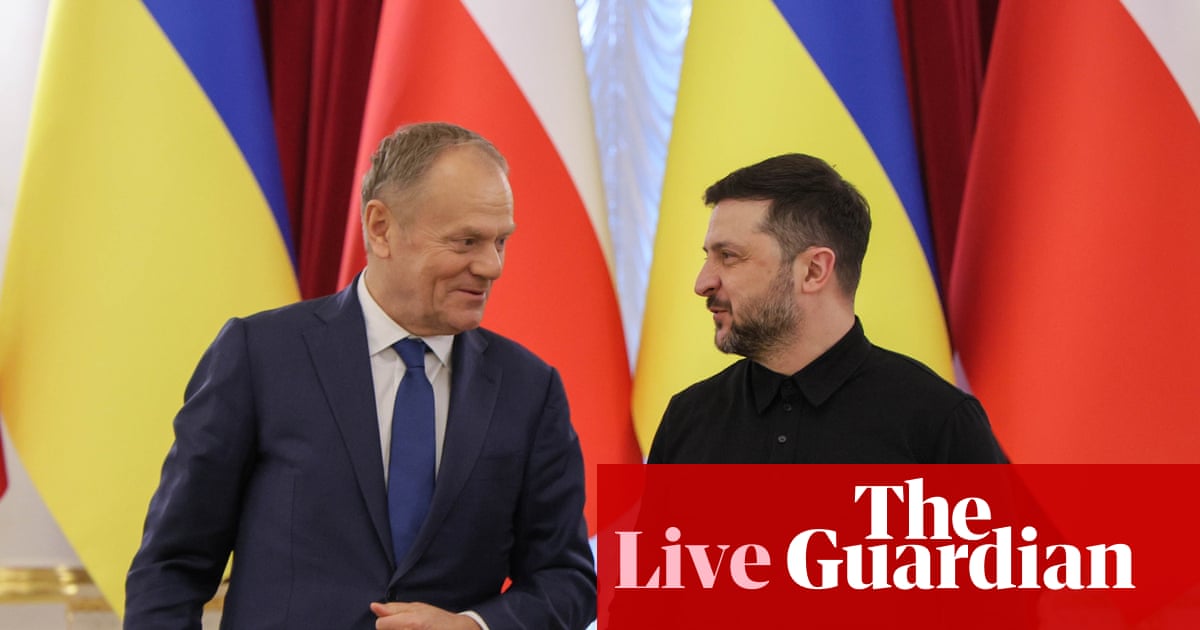
Abu Dhabi talks ‘not easy’ but Ukraine remains constructive, Zelenskyy says after Kyiv talks with Poland’s Tusk
Speaking alongiside Tusk, Zelenskyy said the discussions in Abu Dhabi were “not easy,” but insisted that Ukraine would remain to be constructive and seek a fair deal to end to the Russian aggression.
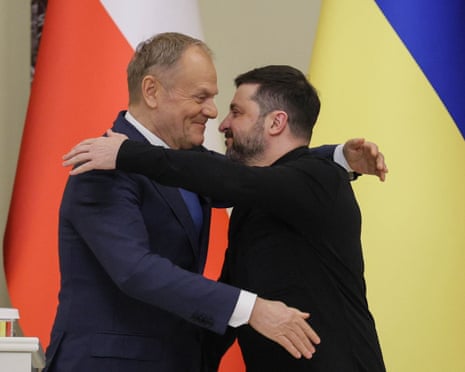 Ukrainian president Volodymyr Zelenskyy and Polish prime minister Donald Tusk attend a press conference after their meeting at the Mariinskyi Palace in Kyiv, Ukraine. Photograph: Paweł Supernak/EPA
He said that all security guarantees given to Ukraine would strengthen the security of this part of Europe, and insisted there should be no reward for the Russian aggression.
Zelenskyy said that Kyiv was ready to swap its drones for air defence missiles and Polish MiG-29 fighter jets, Reuters reported, and that the two countries also discussed the development of power grid connectivity between them.
Responding, Poland’s Tusk said he wanted to be in Kyiv, “because this is the place on the world map where all people see very clearly, as if through a magnifying glass, what is good and what is evil.”
He said:
“All decent people in the world cannot have the slightest doubt about whose side to stand on and whom to support, because by supporting Ukraine in its heroic resistance against senseless Russian aggression, we support everything that is good, right and true in the world.”
Tusk said that Poland was preparing a new €47m aid package for Ukraine, mainly on armoured equipment, to help it fight the Russian aggression, and pledged Poland’s support in Ukraine’s relations with the EU.
He also repeated that the EU should throw its weight behind the negotiation process to make sure the ultimate peace deal on the table is acceptable to Kyiv, and insisted Poland would block any attempts to pressurise Kyiv into agreeing to a bad deal.
Nothing about Ukraine without Ukraine.
He also said that Poland will host the next Ukraine reconstruction conference in Gdańsk in June this year.
Updated at 10.16 EST
Key events
3m ago
Russia willing to engage with ‘serious’ attempts to talk, Lavrov says, but blasts ‘pathetic’ comments on reopening diplomatic channels
26m ago
Ukraine-Russia talks end without breakthrough, but mark ‘most substantive engagement’ in months – snap analysis
37m ago
US blacklists Polish parliament speaker after refusal to back Trump for Nobel peace prize
2h ago
EU deal on Ukraine loan could boost UK if it agrees to help pay costs
2h ago
Abu Dhabi talks ‘not easy’ but Ukraine remains constructive, Zelenskyy says after Kyiv talks with Poland’s Tusk
2h ago
Ukraine’s Zelenskyy confirms prisoners swap, says Ukraine ‘bringing our people home’
3h ago
US vice-president meets with US athletes ahead of Winter Olympics as US says no ICE agents involved in delegation
3h ago
Russia expels German diplomat in tit-for-tat move
3h ago
Ukraine-Russian talks in Abu Dhabi end, spokesperson says
4h ago
Turning Russian Starlinks off resulting in ‘disastrous’ impact on Russian troops in Ukraine, Ukrainian ministry adviser claims
4h ago
‘I wondered if I would be a coward or not’: five Ukrainian men on how war has changed them
5h ago
US, Ukraine, Russia agree to exchange 314 prisoners after ‘productive’ talks, US envoy Witkoff says
5h ago
Sanctions having ‘significant impact’ on Russian economy, says EU special envoy
5h ago
JD Vance arrives in Milan for 2026 Winter Olympic Games
5h ago
Major power outage reported in German city of Stuttgart
6h ago
Russian Starlinks terminals inside Ukraine have been deactivated, Ukraine’s defence minister says
6h ago
Kremlin declines to comment on reported Moscow visit by Macron’s top French diplomat
6h ago
How close are the sides to a peace deal on Ukraine? – analysis
7h ago
JD Vance about to land in Italy for 2026 Milano Cortina Olympic Games
7h ago
55,000 Ukrainians killed in war against Russia, Zelenskyy says
7h ago
Morning opening: Trilateral talks on Ukraine war in Abu Dhabi get back under way
Show key events only
Please turn on JavaScript to use this feature
Russia willing to engage with ‘serious’ attempts to talk, Lavrov says, but blasts ‘pathetic’ comments on reopening diplomatic channels
Russian foreign minister Sergei Lavrov said Russia was always willing to engage with “serious” attempts to restablish diplomatic channels, as he blasted “pathetic” comments from European leaders suggesting they may call Russia’s Vladimir Putin one day.
His comments come after French president Emmanuel Macron appeared to suggest that France was looking to re-establish diplomatic contacts with Russia, with preparatory talks at the technical level, as reported by the French press (10:41).
According to the English language transcript of his interview for Russian state RT television, he said:
“A few weeks ago, French president Emmanuel Macron stated once again that he would call President Putin ‘someday.’
This is not serious diplomacy; it is pathetic. If you wish to call and discuss something seriously, then call. The Russian President will always answer, will listen to any proposal, and if it is serious, I can assure you it will receive a serious, concrete, and practical response.”
Lavrov claimed that Russia continued to maintain contact with “some European leaders,” who “call and ask us not to publicise the conversations.”
He argued:
“Yet nothing they tell us in these closed, confidential meetings differs from their public statements. It is the same old refrain: ‘let’s end this,’ ‘we need to do something.’ I see no coherent position from Europe.
They are trapped by their own rhetoric, locked into an uncompromising stance: ‘Russia’s strategic defeat,’ ‘Ukraine cannot lose, and Russia cannot win, otherwise Europe loses face.’ Everything they do now is designed to prevent and disrupt the negotiations that have been taking shape between us and the Americans, and which Ukrainian representatives are now joining.”
ShareUkraine-Russia talks end without breakthrough, but mark ‘most substantive engagement’ in months – snap analysis Pjotr Sauer
Russian affairs reporter
Ukraine and Russia concluded a second day of US-led talks in Abu Dhabi on Thursday without a breakthrough towards ending Europe’s most deadly conflict since the second world war.
Members of the US, Russian and Ukrainian delegations attend the second round of trilateral talks in Abu Dhabi, the United Arab Emirates. Photograph: Uae Ministry Of Foreign Affairs/Reuters
The two sides agreed to a reciprocal exchange of 157 prisoners of war each, offering a rare concrete outcome from the discussions.
But Steve Witkoff, Donald Trump’s special envoy involved in the talks, cautioned that “significant work remains” in the weeks ahead, dampening expectations of any swift move towards peace.
Even so, the meetings marked the most substantive engagement between senior delegations from Kyiv and Moscow in months, pointing to a tentative, if uncertain, revival of diplomatic efforts nearly four years into the war.
Thursday’s meeting, which lasted three hours, followed a round of trilateral negotiations on Wednesday that ran for about five and a half hours.
Kyrylo Budanov, the head of Ukraine’s presidential office, said the trilateral negotiations had been “genuinely constructive”, thanking the US and the United Arab Emirates for their role in mediating the talks.
Russia’s representative, Kirill Dmitriev, similarly struck a positive note, saying there had been progress and “forward movement” in discussions on ending the war.
Ukraine’s president, Volodymyr Zelenskyy, later said the peace talks would continue in the near future.
Updated at 10.07 EST
US blacklists Polish parliament speaker after refusal to back Trump for Nobel peace prize Jakub Krupa
The US ambassador to Poland has blacklisted Polish parliamentary speaker Włodzimierz Czarzasty from all “further dealings, contact, and communications” with the US administration, after he refused to back a call for US president Donald Trump to be awarded the Nobel peace prize.
The conflict follows a widely reported request from the US House speaker, Mike Johnson, and the Israeli Knesser speaker, Amir Ohana, asking Czarzasty and other European parliamentary speakers to support Trump’s candidacy and sign a drafted letter of support.
But on Monday, Czarzasty said he would not support the motion because in his view the US president “does not deserve” the award.
He said that Trump was “destabilising” international organisations by promoting his own initiatives such as the Board of Peace, and pursued “the politics of power” based on “transactional politics.” He also criticised the US policy on Greenland, amid Trump’s continuing interest in controlling the Danish territory.
Responding to his comments, US ambassador to Poland Tom Rose said today that his “outrageous and unprovoked insults” made Czarzasty “a serious impediment to our excellent relations” with the Polish government, and announced that “effective immediately, [the embassy] will have no further dealings, contact, and communications” with him.
“We will not permit anyone to harm U.S.–Polish relations, nor disrespect @realDonaldTrump, who has done so much for Poland and the Polish people,” he said.
Czarzasty is the speaker of the Polish Sejm, the lower chamber of the Polish parliament. A former Communist party member before 1989, he also leads the New Left party, a junior partner in the pro-European coalition government of prime minister Donald Tusk.
ShareEU deal on Ukraine loan could boost UK if it agrees to help pay costs Jennifer Rankin
in Brussels
Meanwhile, it emerged that the UK could reap greater benefits from a €90bn (£78bn) EU loan for Ukraine, if it agrees to help pay the cost of borrowing, after European countries signed off long-awaited financial aid for Kyiv.
British firms could have greater opportunities to supply defence equipment to Ukraine funded by the loan if the government agrees a “fair” contribution towards EU borrowing costs.
Senior EU diplomats meeting on Wednesday approved a long-awaited loan for Ukraine, which includes the new element of a more open door towards the UK.
The UK clause, including the requirement for British financial contribution, had been approved by Monday, according to three diplomatic sources. EU member states, however, will need to hold further talks on how to include the UK, including agreeing a list of products that could be procured from British suppliers.
The decision comes after the UK prime minister, Keir Starmer, signalled he would like to reopen talks with the EU on a defence pact. Negotiations to join the EU’s €150bn Security Action for Europe (Safe) programme collapsed last year.
As the current Safe scheme progresses without the UK, the loan for Kyiv offers a more immediate way for the EU and UK to find rapprochement on defence.
The loan is a crucial lifeline for Ukraine, which has been enduring months of brutal Russian attacks damaging its energy and heating systems, leaving people in the cold and dark, while the country is in the grip of a bitterly cold winter.
EU leaders last year agreed to lend Ukraine the money to fill a critical funding gap in 2026 and 2027, as Kyiv risks running out of money to fund its defence, pay public servants and pensions.
The loan will be funded by borrowing on capital markets, secured against unused spending in the EU budget. EU leaders alighted on this solution, after disagreeing over the alternative of securing the loan against Russia’s frozen assets.
Under the plan, €60bn is earmarked for Ukraine’s defence and €30bn for general budget support.
ShareAbu Dhabi talks ‘not easy’ but Ukraine remains constructive, Zelenskyy says after Kyiv talks with Poland’s Tusk
Speaking alongiside Tusk, Zelenskyy said the discussions in Abu Dhabi were “not easy,” but insisted that Ukraine would remain to be constructive and seek a fair deal to end to the Russian aggression.
Ukrainian president Volodymyr Zelenskyy and Polish prime minister Donald Tusk attend a press conference after their meeting at the Mariinskyi Palace in Kyiv, Ukraine. Photograph: Paweł Supernak/EPA
He said that all security guarantees given to Ukraine would strengthen the security of this part of Europe, and insisted there should be no reward for the Russian aggression.
Zelenskyy said that Kyiv was ready to swap its drones for air defence missiles and Polish MiG-29 fighter jets, Reuters reported, and that the two countries also discussed the development of power grid connectivity between them.
Responding, Poland’s Tusk said he wanted to be in Kyiv, “because this is the place on the world map where all people see very clearly, as if through a magnifying glass, what is good and what is evil.”
He said:
“All decent people in the world cannot have the slightest doubt about whose side to stand on and whom to support, because by supporting Ukraine in its heroic resistance against senseless Russian aggression, we support everything that is good, right and true in the world.”
Tusk said that Poland was preparing a new €47m aid package for Ukraine, mainly on armoured equipment, to help it fight the Russian aggression, and pledged Poland’s support in Ukraine’s relations with the EU.
He also repeated that the EU should throw its weight behind the negotiation process to make sure the ultimate peace deal on the table is acceptable to Kyiv, and insisted Poland would block any attempts to pressurise Kyiv into agreeing to a bad deal.
Nothing about Ukraine without Ukraine.
He also said that Poland will host the next Ukraine reconstruction conference in Gdańsk in June this year.
Updated at 10.16 EST
Ukraine’s Zelenskyy has also been speaking alongside Poland’s prime minister Donald Tusk in the last few minutes as part of Tusk’s visit to Kyiv.
I will bring you the key lines here shortly.
Ukrainian President Volodymyr Zelenskyy (R) and Polish prime minister Donald Tusk (L) attend a meeting at the Mariinskyi Palace in Kyiv, Ukraine. Photograph: Paweł Supernak/EPAShare
Updated at 08.08 EST
Ukraine’s Zelenskyy confirms prisoners swap, says Ukraine ‘bringing our people home’
Ukraine’s Volodymyr Zelenskyy has just commented on the prisoners swap announced by US presidential envoy Steve Witkoff earlier (11:29).
In a post on X, he said Ukraine was “bringing our people home,” confirming 157 Ukrainians are part of the exchange.
“Warriors from the Armed Forces, National Guard, and the State Border Guard Service. Soldiers, sergeants, and officers. Along with our defenders, civilians are also returning. Most of them had been in captivity since 2022,” he said.
Zelenskyy added that “today’s exchange came after a long pause, and it is critical that we were able to make it happen.”
“We will continue to work to release our people from captivity. We must bring everyone back – and we certainly will. We are working on every name so that each family can finally welcome their loved ones home,” hew said.
Updated at 08.08 EST
US vice-president meets with US athletes ahead of Winter Olympics as US says no ICE agents involved in delegation
Back to Italy, US vice-president JD Vance and US secretary of state Marco Rubio have met with some US athletes competing in the Olympic Games, starting officially tomorrow (although the first few competitions are already under way, don’t tell me you didn’t watch curling last night).
“The whole country – Democrat, Republican, Independent – we’re all rooting for you, we’re cheering for you, and we know you’re going to make us proud,” Vance told the athletes.
He added that the competition “is one of the few things that unites the entire country,” and is expected to watch the US women’s hockey team take on the Czech Republic later today, AP reported.
OLY-2026-MILANO CORTINA-DIPLOMACY-US
US vice-president JD Vance, second lady Usha Vance, US secretary of state Marco Rubio, his wife, Jeanette Dousdebes Rubio, and US Ambassador to Italy and San Marino Tilman Fertitta pose for a photo with Team USA athletes in Milan, Italy. Photograph: Kevin Lamarque/AFP/Getty ImagesUS vice-president JD Vance (V) and Second Lady Usha Vance (R) stand by Team USA jackets, as they attend the Team USA Welcome Experience ahead of the Milano Cortina 2026 Winter Olympic Games in Milan. Photograph: Kevin Lamarque/AFP/Getty Images
But as I mentioned earlier (9:55), there is still an on-going backlash over the security arrangements around Vance and Rubio, including media reports about expected inclusion of US Immigration and Customers Enforcement, or ICE, officials in the delegation, supporting the US state department’s Diplomatic Security Service.
The Italian press reported that overall some 300 US agents were expected to come to Italy to protect the vice-president from all US agencies.
Arrival of the American delegation at the Hotel Gallia in Piazza Duca D’Aosta for the Milan Winter Olympics. Photograph: Stefano Porta/LaPresse/Shutterstock
Italy’s interior minister Matteo Piantedosi said earlier this week that ICE officials will not conduct any policing on Italian streets, dismissing political outrage over their presence as baseless, Reuters reported.
And in the latest plot twist, a top security official for the US Olympic and Paralympic Committee said on Thursday that no agents from US ICE were part of the delegation at all – despite US officials previously suggesting the opposite.
“I can tell you unequivocally that there are no ICE agents that are part of the Team USA delegation on the ground here in Milan,” Nicole Deal, Chief of Security and Athlete Services for USOPC, told reporters, as quoted by Reuters.
Deal blamed the backlash on “misinformation and assumptions.“
But some of that frustration among locals is still seen in the city, as perhaps best captured by this mural spotted by a Reuters photojournalist on the streets of Milan.
A mural by Italian street artist aleXsandro Palombo portraying US president Donald Trump wearing an ICE police uniform and holding Olympic rings is seen near an ATM shelter at Bastioni di Porta Volta in Milan, Italy. Photograph: Daniele Mascolo/ReutersShare
Updated at 08.49 EST
Russia expels German diplomat in tit-for-tat move
Separately, Russia’s foreign ministry said it had expelled a German diplomat in response to what it said was Berlin’s unfounded expulsion of a Russian diplomat accused of espionage in January, Reuters reported.
“The expulsion of a German diplomat from Russia is completely unfounded and totally unacceptable,” said German foreign minister Johann Wadephul, adding that Russia was resorting to unjustified retaliatory measures instead of diplomacy.
Speaking during a trip to Brunei, Wadephul said the diplomat in question was a member of the military attache staff at the German embassy in Moscow.
“We reserve the right to take further action,” he added.
ShareUkraine-Russian talks in Abu Dhabi end, spokesperson says
The Ukraine-Russia talks in Abu Dhabi have now reportedly concluded, Ukrainian and western agencies are reporting, quoting Diana Davityan, a spokesperson for the Ukrainian led negotiator Rustem Umerov.
ShareTurning Russian Starlinks off resulting in ‘disastrous’ impact on Russian troops in Ukraine, Ukrainian ministry adviser claims
Tech adviser to the Ukrainian defence ministry, Serhii “Flash” Beskrestnov, said that turning off the Russian Starlinks is having a “disastrous” impact on Russian troops operating in Ukraine (10:58).
“All command of the troops has collapsed. Assault operations have been stopped in many areas,” he claimed in a Facebook post.
Let’s see if we hear more on this during the day.
Updated at 06.55 EST
‘I wondered if I would be a coward or not’: five Ukrainian men on how war has changed them Tracy McVeigh
in Kyiv
Russia’s invasion forced Ukrainian men of all ages to the frontlines, most with no experience of combat. The Guardian spoke to five soldiers about how life in the army transformed them and their relationships.
Masi-Mustafa Nayyem, 41, an Afghan-Ukrainian lawyer, military veteran and public figure, and a co-founder of the human rights centre for military personnel and veterans Pryncyp. Photograph: Iva Sidash/The Guardian
On the day of the invasion I went home, drank some wine, then the next day took my gun and went to the army offices.
Updated at 06.08 EST