
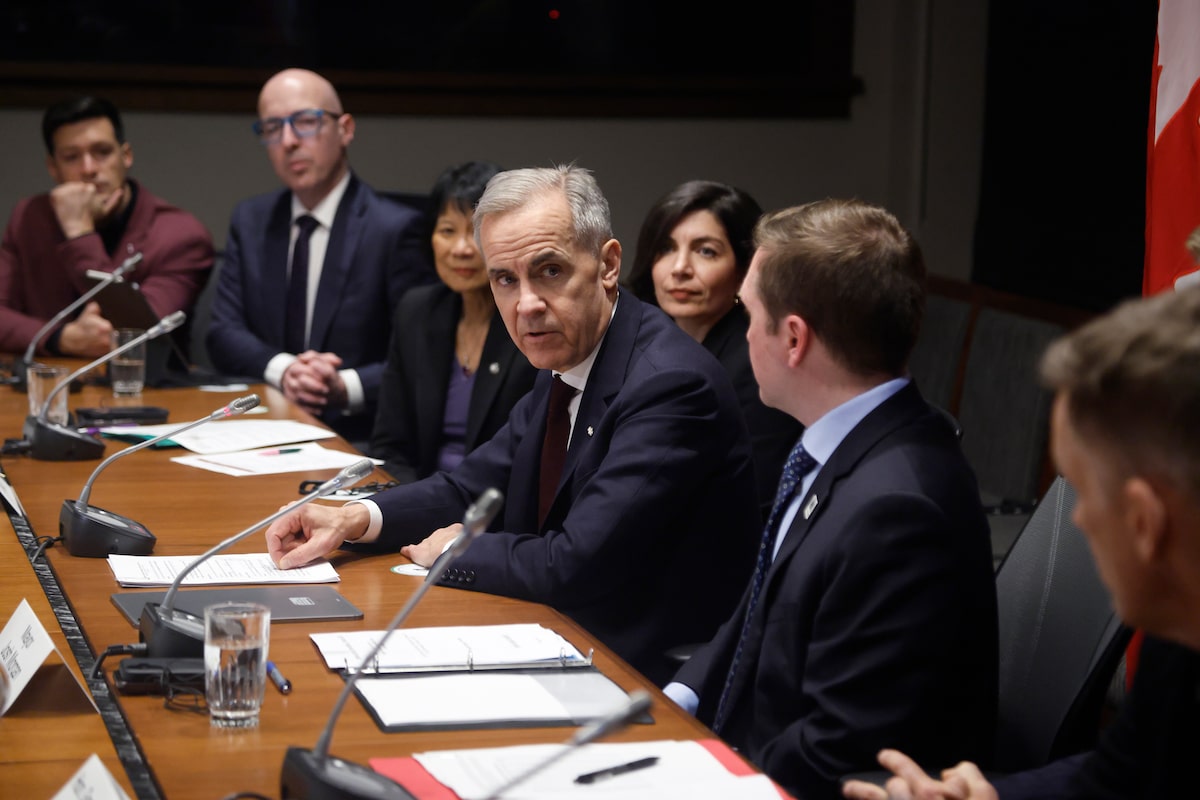
Prime Minister Mark Carney met with members of the Big City Mayors’ Caucus in Ottawa, on Wednesday.PATRICK DOYLE/The Canadian Press
The organization representing Canada’s municipal leaders says it’s been told by federal officials that a key transit program faces a $5-billion cut over the next decade and big-city mayors are urging Prime Minister Mark Carney to reverse course.
Three months after the Prime Minister released his first budget in November, the Federation of Canadian Municipalities is expressing concern about new details it learned during private meetings over the past few weeks.
The Liberal government’s Nov. 4 budget announced a new Build Communities Strong Fund, worth $51-billion over 10 years, funded largely by reprofiling and renaming several existing programs.
The government described the overall budget as a strategy to “build at a speed, scope, and scale not seen in generations.” At the same time, it also announced high-level plans to find about $60-billion in internal savings over five years.
The FCM reacted positively to the budget at the time.
Federal budget to include $50-billion local infrastructure fund
But in an interview with The Globe and Mail Wednesday, FCM president Rebecca Bligh said the changes have created new programs that have yet to be launched, while scaling back an important program that provides direct funding for transit.
The FCM says it has learned from officials that a vague reference in the budget to reallocating funds from the Canada Public Transit Fund (CPTF) will in fact mean a $5-billion cut over 10 years.
Ms. Bligh, who is also a Vancouver city councillor, and 16 big-city mayors are in Ottawa this week for meetings with Mr. Carney and several senior cabinet ministers.
Their meeting with the Prime Minister took place Wednesday evening. Before the meeting, she said they planned to ask Mr. Carney to reverse what the mayors see as a $5-billion cut.
The CPTF was first announced in 2024 and promised to deliver $3-billion per year to municipalities for transit, starting in the 2026-27 fiscal year. That program continues and was not folded into the new $51-billion Build Communities Strong Fund.
However, the FCM said it has since learned that the transit transfer program will deliver about 16 per cent less, which is nearly $5-billion over a decade.
Tony Keller: Mark Carney has turned the Titanic. He needs to keep turning
Ms. Bligh said that the design of repackaged programs forces cities, who are not directly responsible for health and postsecondary infrastructure, to compete with provinces and territories for a share of that funding.
Further, she said that many of the new programs are not up and running.
“There’s no program to administer the funding. And also, there’s no significant new funding that will actually allow municipalities to do more at the pace that the federal government has set up,” she said.
In an annex to the federal budget, most major departments provided short summaries of their contributions to the government’s overall effort to find savings.
The department of Housing, Infrastructure and Communities listed savings under the general heading of “recalibrating government programs,” worth $466.1-million in the fiscal year that begins in April before stabilizing at $776.1-million a year in 2029-30.
The department’s description of savings in the printed version of the budget was different than the electronic version.
The printed version said that there will be “a reduction in funding” to the CPTF and another fund called the Canada Housing Infrastructure Fund “to prioritize the infrastructure projects that will generate results for Canadians and recalibrate the federal government’s role in areas that fall under the jurisdiction of other levels of government.”
The wording of that paragraph in the electronic version did not mention the housing fund. It said that “a portion of uncommitted funding from the Canada Public Transit Fund will be reallocated to the Build Communities Strong Fund where transit projects will continue to be eligible.”
Neither version provided a dollar figure for CPTF reductions. Finance Department officials said the electronic version was the correct version.
Renée LeBlanc Proctor, a spokesperson for Infrastructure Minister Gregor Robertson, said that while there had been a reduction to the CPTF, public-transit projects remain eligible for both that program and the new $51-billion fund.
“The CPTF remains a standalone, permanent funding envelope for public transit, and it still has significant uncommitted funding to support transit projects,” she said.
Marco D’Angelo, president and CEO of the Canadian Urban Transit Association, which represents public-transit operators as well as private suppliers, said he and his members are also seeking clarity on what the budget means for transit funding.
“It’s great that the mayors are speaking to this,” he said, pointing out that many cities are counting on the promised funding for things such as new buses.
“That renewal needs to happen. Cities need to have certainty about that,” he said.