
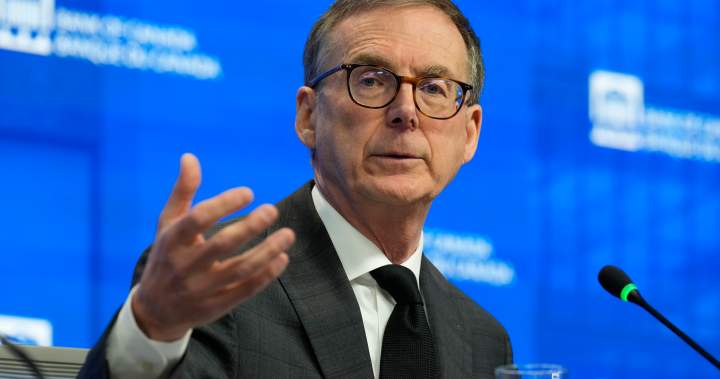
The advent of Artificial Intelligence (AI) may be reducing the number of entry-level jobs available to young people in Canada, Bank of Canada governor Tiff Macklem said Thursday.

In a talk titled ‘Structural change — Canada at a crossroads,’ Macklem addressed three structural changes that the Canadian economy will have to contend with in the near-future: the changing trade relationship with the United States, slowing population growth and the rise of AI.
“The impact of these forces on the Canadian economy will not be a temporary cyclical fluctuation,” Macklem said in Toronto.
AI was a “transformative technology,” Macklem said, adding that it has “the potential to put the economy on a higher path and raise our standard of living.”
However, he said economic observers had expressed concern about “over-investment and over-valuation as well as fears of job destruction.”
Story continues below advertisement
He said while in some cases, there may be increased demand for workers with AI skills, the “flip side is we may be seeing some early evidence that AI is reducing the number of entry-level jobs in some occupations.”

Get breaking National news
For news impacting Canada and around the world, sign up for breaking news alerts delivered directly to you when they happen.
“This may be boosting youth unemployment, although separating the effects of AI from the impact of trade and demographic changes is difficult,” he said.
There may be some “hard evidence” that it is getting more difficult to find an entry-level job in a field where the bulk of the work can be performed using AI, he said.

5:21
WEF 2026: AI dominates discussions at Davos
Trending Now

Several Toronto police officers arrested in organized crime investigation

Gavin McKenna, projected No. 1 NHL draft pick, charged with felony assault
He said Canada is also responding to another major challenge — an increasingly protectionist United States.
“As we approach the one-year mark of U.S. tariff threats, supply chains have started to shift. Goods imports from the United States have declined, while those from other countries have increased,” he said.
Story continues below advertisement
However, he added that the pivot has largely been focused on existing clients as Canadian businesses “have not found many new clients just yet” outside of the U.S.
Lower population growth, reflected in lower fertility rates as well as slashed immigration levels, have also pulled down Canada’s GDP growth forecast, he said.
“That means fewer new consumers and workers in the economy, which lowers our economic potential,” Macklem said, adding that the Bank forecasts Canada’s labour force “will hardly grow at all over the next few years.”
Over the next two years, Macklem said he expects the Canadian GDP to grow by 1.25 per cent with modestly growing household spending and business investment. However, he expects businesses to be “cautious in their hiring this year.”
“Some things are clear. The United States has rejected open trade, population growth has slowed, and AI will change the marketplace. And when the economic landscape changes, Canadian businesses need to adjust,” Macklem said.
More on Money
More videos
© 2026 Global News, a division of Corus Entertainment Inc.