
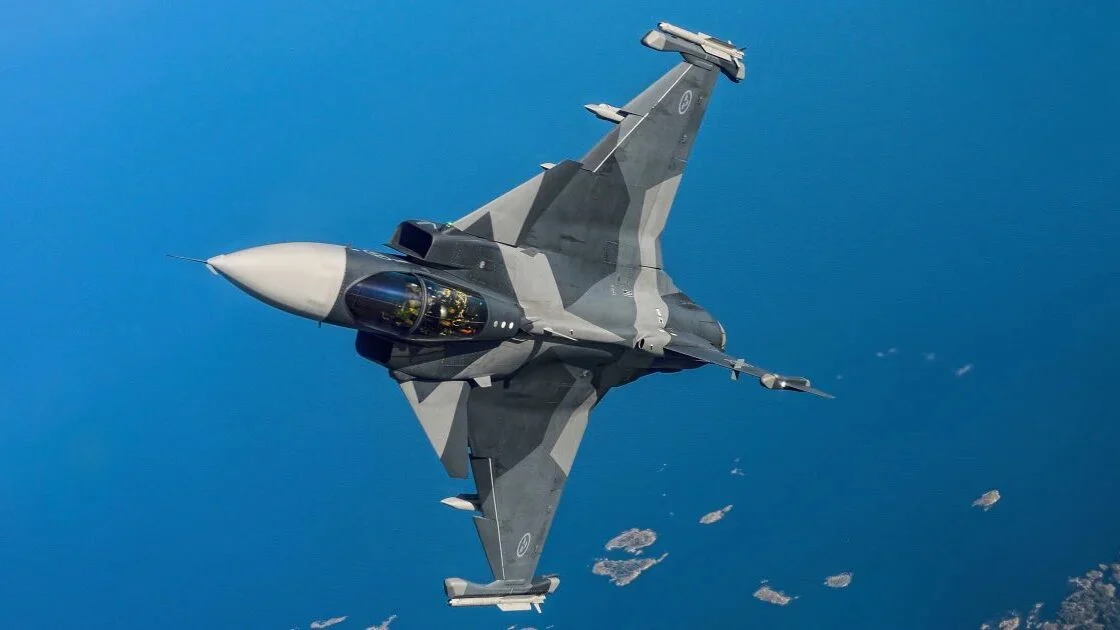
BELFAST — Sweden’s Saab appears to be capitalizing on deteriorating political relations between the US and Canada by pushing for Ottawa to fly its Gripen E/F fighter jets along with US-made F-35s, and offering domestic production to sweeten the deal.
In a call with investors today Saab CEO Micael Johansson claimed Canada was considering ways “not to be too dependent on the US by having a dual fleet, both F-35 and the Gripens.”
“We are providing all [the] detailed information that they need to understand,” he said.
Specifically, the Swedish manufacturer has shared details around speed of technology transfer and “how quickly” it could stand up a local Gripen production facility. Johansson also suggested that, should a deal be completed, the manufacturing site will play host to future Gripen export aircraft.
“How would they [Canada] be involved in the full export market perspective of a fighter business?” he said, adding that Saab is also providing that kind of information to the government.
The manufacturer currently operates two production lines for the multirole combat jet in Sweden and Brazil. In November 2025, Colombia also signed off on a €3.1 billion ($3.7 billion) contract for 17 aircraft. A much more lucrative opportunity rests with Ukraine after the war torn nation and Sweden signed a letter of intent that could see Kyiv ordering between 100 to 150 aircraft. Additionally, Thailand agreed to a 5.3 billion Swedish kroner Gripen buy, for four aircraft last year.
For weeks Sweden has pitched Gripens as an alternative to Canada, a plan that a senior Canadian official said in November was “very interesting.” The potential for Ottawa to cut its long-planned F-35 buy also prompted what appeared to be a veiled threat from US Ambassador to Canada Pete Hoekstra last month.
Pointing to “high-level political decisions” that will determine if Canada eventually acquires Gripen, Johansson said today, “I don’t know” when a contract award decision might happen. “But of course, we have intensive discussions around this,” he said.
In a note to investors, Bryon Callan of Capital Alpha Partners said this week that the potential for Canada to “truncate” its current plan for 88 F-35s “may explain” the threats from Hoekstra and President Donald Trump.
RELATED: Trump’s threats to Canadian jets raise questions about a key customer: The Pentagon
In his view, a Canadian Gripen sale could face complications because “we would expect F-35 subcontract work to be pulled from Canadian subcontractors, and the U.S. might still have leverage as the Gripen E relies on a GE Aerospace F414G engine.”
According to a Canadian Auditor General report, more than 30 local aerospace companies hold F-35 contracts, largely related to production of the stealth fighter. Callan acknowledged, however, that Canada’s move to diversify its defense supply chain “is a prudent step” on account of Trump’s threats against his neighbour’s sovereign power.
Ottawa is working off a $27.7 billion CAD ($20.3 billion ) budget for the F-35 acquisition initially announced in 2023 (to replace its Boeing CF-18 fleet) but currently under review to “ensure” that the aircraft is the “best choice,” per the Auditor General. Despite political disagreement, Canada remains committed to buying a first tranche of 16 F-35s, with eight units set for delivery to Luke Air Force Base, Ariz., between 2026 and 2027.
Though it remains to be seen if Canada will commit to a Gripen order, near term, Saab is moving forward with “many initiatives and investments” to deliver on a planned production ramp up of the plane, said Johansson. On Wednesday, another Saab executive told Aviation Week that the existing production target sits at an annual rate of 36 aircraft.
On other aviation business, Johansson said that he is awaiting a new Canadian surveillance plane acquisition to take shape, and which is expected to see Saab make a GlobalEye aircraft offer.
He is also hopeful that NATO will “come to a decision” regarding a possible contract for the airborne early warning platform, as a replacement for the alliance’s aging E-3 Sentry fleet. GlobalEye is under assessment again by NATO, after it ended interest in procurement of Boeing’s E-7A Wedgetail last year.