
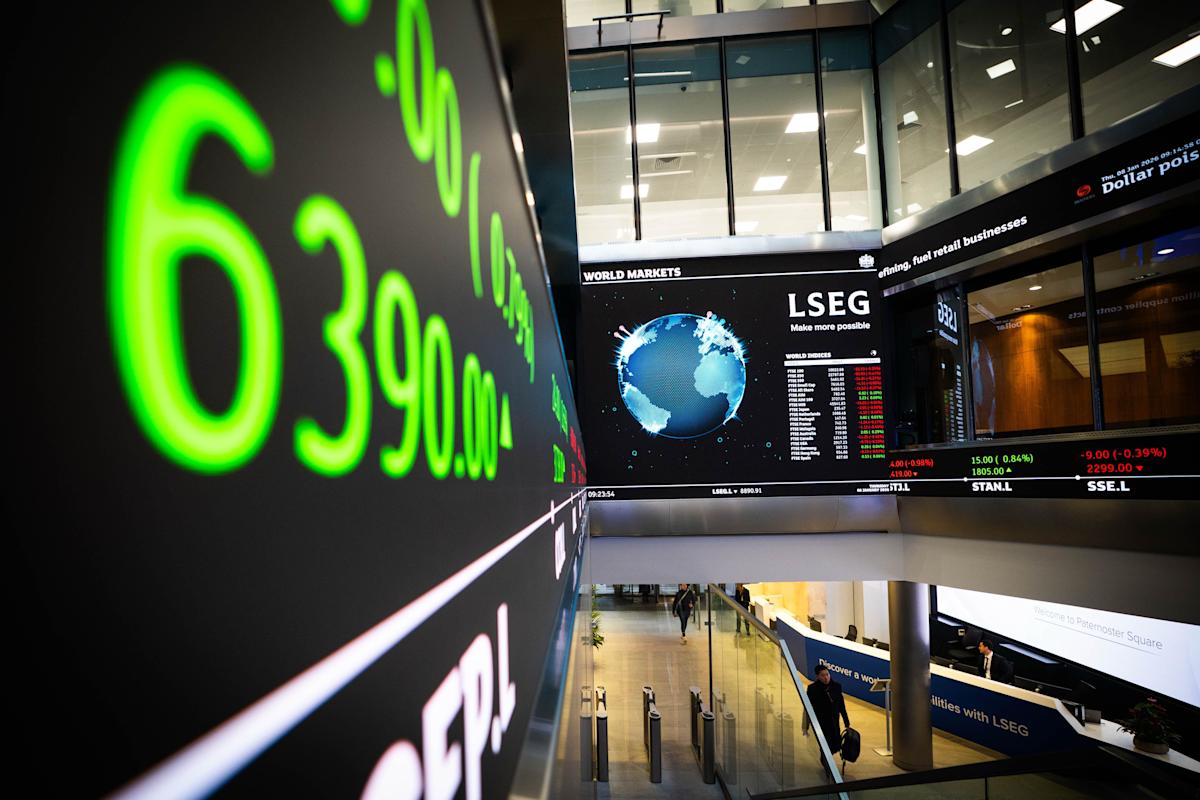
The FTSE 100 (^FTSE) and European stocks reversed their losses on Friday as a tech rout that has bruised Wall Street this week attempted to stabilise ahead of the weekend.
According to IG, around $1tn (£737m) has been wiped from the market value of the S&P 500 software index after it posted a fall of 21% from its 200-day average.
It came as Amazon (AMZN) shares plunged in after-hours trade on Thursday, down 8% pre-market, as the company projected a surge of more than 50% in capital expenditures this year.
It plans to pump $200bn into its AI efforts in 2026, joining other tech giants in a spending spree to build out artificial-intelligence infrastructure.
The news spooked investors, who are concerned about returns on the investment. Amazon, Microsoft (MSFT), Google (GOOG) and Meta (META) are expected to collectively spend more than $630bn on AI investments this year alone.
However, US stock futures turned higher early Friday, pointing cautiously to a rebound after the bell in New York.
Charu Chanana, of Saxo Markets, said: “When AI starts to replicate tasks traditionally performed by professionals – drafting, analysing, coding, reviewing – it naturally raises questions about the long-term pricing power of certain software products.
“Investors are no longer impressed simply by the presence of AI features. This is why the pressure has shown up most clearly in (software as a service): it’s where the market is first forced to debate what AI will replace, who retains pricing power and who absorbs the costs of adoption.”
Investors have seen a rotation out of expensive growth stocks into more defensive, value-oriented sectors such as consumer staples, energy and industrials, with rising short interest and falling hedge fund exposure adding to pressure.
London’s benchmark index (^FTSE) was 0.2% higher in afternoon trade
Germany’s DAX (^GDAXI) climbed 0.6% and the CAC (^FCHI) in Paris headed 0.1% into the green
The pan-European STOXX 600 (^STOXX) was up 0.4%
S&P 500 futures (ES=F) rose 0.5%, while Nasdaq 100 futures (NQ=F) added 0.7%, retracing earlier premarket losses. Contracts on the Dow Jones Industrial Average (YM=F) also switched course, moving up 0.4%, on the heels of sharp closing losses on Wall Street on Thursday
The pound was 0.4% up against the US dollar (GBPUSD=X) at 1.3593
Follow along for live updates throughout the day:
LIVE 16 updates TSB’s earnings in robust shape ahead of Santander takeover
High street banking giant TSB has reported annual profits jumping more than a fifth higher as it awaits completion of its near-£3 billion takeover by rival Santander.
The group said pre-tax profits rose 20.7% to £350.4m for 2025 as costs fell and its income rose, but loans to customers fell 0.2% to £36.3bn in a “challenging lending market”.
TSB announced late on Thursday that chief executive Marc Armengol will step down to head up its Spanish owner, Sabadell.
The move is set to coincide with TSB being bought by its bigger rival Santander, which the firms expect to happen during the first half of this year, with Mr Armengol taking on the new job after May.
Mr Armengol said 2025 was an “extraordinary year for TSB” and praised a “record financial performance”.
It is unclear if the TSB brand will remain after the takeover by Santander, with its Spanish-owner buyer yet to make up its mind.
The deal valued TSB at £2.65bn but the sale price is estimated to rise to £2.9bn once the transaction completes, which is waiting for regulatory approval.
Supermarket giant Morrisons explores £1bn property deal
Morrisons, the UK’s fifth-largest supermarket chain, is exploring a £1bn property deal amid its battle to recapture the ground it has lost to rivals including Sainsbury’s and Aldi.
Sky News said it has learnt that Morrisons, which is based in Bradford, West Yorkshire, has engaged the real estate advisory firm CBRE to evaluate options for raising finance secured against part of its large freehold store portfolio.
Sources said the process was at an early stage, but that it was unlikely to involve a conventional sale-and-leaseback transaction of the kind favoured by major grocers in recent decades.
One option expected to be considered is a medium- or long-term borrowing deal secured against a number of Morrisons’ supermarkets.
Any agreement could raise as much as £1bn, although neither the structure nor size have yet been determined.
Morrisons, which trades from approximately 500 supermarkets in the UK and employs about 95,000 people, was taken private from the stock market by Clayton Dubilier & Rice, the US-based buyout firm, in 2021 in a deal worth close to £10bn including debt.
Its performance since then has been patchy, with Aldi overtaking it last year to become the UK’s fourth-biggest grocer by sales.
Most popular stocks and funds investors bought in January
January proved to be a volatile start to the year, as heightened geopolitical tensions rattled stock markets and drove investors to gold (GC=F), as a so-called safe haven.
At the very start of the month, the US captured Venezuelan leader Nicolás Maduro, after president Donald Trump ordered the military to carry out strikes on the country.
Trump then turned his attention to Greenland, ramping up his push for the US to take over the semi-autonomous Danish territory. Stock markets sold off when Trump threatened to put new tariffs on a number of European countries over opposition to his proposed takeover of Greenland.
However, markets recovered after Trump ruled out using force to acquire Greenland, in a speech at the World Economic Forum, and later walked back on his threat of further tariffs.
Gold prices (GC=F) continued to notch new highs throughout the month, as investors sought to take shelter from volatility. Gold’s rally came to an abrupt halt at the end of the month, as the dollar strengthened after Trump announced Kevin Warsh as his pick to be the next Federal Reserve chairman.
Towards the end of the month the spotlight also shifted back onto Big Tech, as the latest earnings season got into full swing. A major focus has continued to be how much these companies are spending on AI and whether these investments are paying off.
Sentiment on Wall Street recovers slightly
US stock futures have reversed their early losses, attempting to stabilise ahead of the weekend. They are now set to open higher after the opening bell in New York today.
Daniela Hathorn, senior market analyst at Capital.com, said:
Best savings accounts as Bank of England holds interest rates
UK households are often looking for ways to make their money go further amid the cost of living crisis, and savings accounts could help you improve your finances this year.
The Bank of England‘s (BoE) decision to hold interest rates at 3.75% this week did not bring relief to mortgage holders, but was great news for savers as it influences the rates set by banks and building societies on their products.
Inflation remains well above target, with the UK’s consumer prices index (CPI) rising for the first time in five months to 3.4% in December, from 3.2% in November. But the good news is that most offers stated here offer above inflation returns.
Experts urge savers to shop around for the best deals and review their accounts regularly, as many may still be sitting on products that fail to beat inflation.
Kate Steere, personal finance expert at Finder, said:
Head of firm founded by Mandelson to quit after Epstein releases
Benjamin Wegg-Prosser, the chief executive of the lobbying firm co-founded with Peter Mandelson, has announced his resignation after information in the Jeffrey Epstein files detailed apparent links between the company and the convicted sex offender.
The BBC has the details…
Global Counsel, which the two men set up after Labour lost the 2010 general election, has advised clients including Shell and TikTok.
As first reported in the Financial Times,, external Wegg-Prosser announced his resignation on Friday, having concluded his long standing association with Lord Mandelson – and references to them both in the Epstein files – was doing the business harm and so he should go.
He has insisted he has not done anything wrong.
Wegg-Prosser’s profile page on the company’s website has already been taken down.
Lord Mandelson resigned from the board of Global Counsel in 2024, shortly before the general election.
The company employs more than 100 people and has offices in Berlin, Brussels, Singapore, Washington DC and Doha. Last year it reported a revenue of £21.6m and an annual profit of £250,000.
Wegg-Prosser has been a close associate of Lord Mandelson since the 1990s when he was one of the then-Labour politician’s key advisers.
Lord Mandelson was sacked as the UK’s ambassador to the US last year after previous information came to the light about his links to US financier and convicted sex offender Epstein.
However, following the release of thousands of emails between Epstein and Mandelson, Prime Minister Sir Keir Starmer is facing questions about why he selected in the first place and the vetting process that took place prior to the appointment.
AI is not a bubble, says Nvidia senior executive
Artificial intelligence is not a bubble, and 2026 AI-related order growth will be more than last year, Simon Lin, the chairman of Taiwanese electronics manufacturer Wistron, said on Friday.
“We believe AI really does help all industries, so I don’t think it’s a bubble; I think it will mark a new era. A new AI era is arriving,” Lin, whose company is an Nvidia supplier, told reporters in Taipei.
Wistron’s order situation is good up into 2027, and for this year growth will be “significant” compared with the prior year, he added.
The company said last year that its new US manufacturing facilities for Nvidia would be ready in 2026 and the firm was in talks with other potential customers.
Volume production there will start in the first half of this year, Lin said.
Part of the facilities will be used by Nvidia to support its plan to build AI servers worth up to $500bn in the US over the next four years.
The US firm said last April it planned to build supercomputer manufacturing plants in Texas, partnering with Foxconn in Houston and Wistron in Dallas.
FTSE risers and fallers
Here are the top FTSE risers and fallers this morning:
Bitcoin loses half its value in three months
Bitcoin’s (BTC-USD) price against the dollar slid below the $65,000 mark, selling off 9.4% compared with the previous 24 hours as crypto winter tightens its grip.
Its recent price movements bring the digital asset to 16-month lows, erasing the gains made since Donald Trump took office with a pro-crypto mandate.
On Thursday, bitcoin had tested the $60,000 mark, and is now on track to shed nearly 16% for the week.
Crypto has erased nearly $1tn in total market value in the last 30 days, according to data provider CoinMarketCap, which marked sentiment as in a state of “extreme fear”.
Investors have fled from bitcoin into less risky assets. Its fortunes have largely tracked the stock market and tech stocks in particular, which have been rocked this week by fears that the AI funding boom may not be sustainable.
Stellantis shares skid after €22bn charge
Jeep and Peugeot maker Stellantis (STLAM.MI) saw its stock crater in early trade on Friday, down more than 23% in Milan as it confirmed it has sustained a €22.2bn (£19.3bn) charge for the second half of last year as part of a strategic overhaul.
The carmaker said the shakeup was aimed at aligning its vehicle offerings with customer demand.
The charges include €6.5bn in cash payments, and mean there will be no dividend for 2026 due to the full-year net loss.
It is also scaling back its push into electric vehicles as it aligns with “the real-world preferences of its customers”.
Stellantis insists it will be at “the forefront” of electric car development, but argues that it must be “governed by demand rather than command”.
Antonio Filosa, chief executive, said:
Stellantis’ brands also include Vauxhall, Opel, Citroën, Chrysler and Fiat.
Pandora shifts from silver to platinum amid price surge
Pandora has said it will switch some of its ranges from silver to platinum to due the recent dramatic increase in silver prices (SI=F).
It comes as silver has seen its price more than double over the past year, with other precious metal prices likewise surging.
Berta de Pablos-Barbier, chief executive at the jeweller, said its aim was not to make all jewellery platinum-plated, but that silver will be reduced to around 25% of its offerings as it seeks to reduce its exposure to the precious metal, which is eating into profits.
The pivot to platinum is estimated to be completed by 2028, and the company added that platinum would “deliver improved everyday-wear performance compared to silver” and its own consumer testing showed people had “high acceptance”.
Amazon plans $200bn AI spending surge
Cloud giant Amazon (AMZN) reported its fourth quarter results after the bell on Thursday, as a miss on its Q1 operating income estimate and a massive expansion in capex for 2026 sent shares plunging.
Amazon stock fell 8% during premarket hours on Friday.
Amazon said it anticipates Q1 operating income of between $16.5bn and $21.5bn, below analysts’ expectations of $22.2bn. On top of that, the company said it will spend upward of $200bn on capex for the year, a massive jump from the $125bn Amazon was set to spend in 2025.
“With such strong demand for our existing offerings and seminal opportunities like AI, chips, robotics, and low-earth orbit satellites, we expect to invest about $200bn in capital expenditures across Amazon in 2026, and anticipate strong long-term return on invested capital,” CEO Andy Jassy said in a statement.
For the quarter, Amazon saw earnings per share (EPS) of $1.95 on revenue of $213.4bn, compared with the $1.96 and $211.5bn analysts were anticipating according to Bloomberg consensus estimates.
Amazon’s all-important AWS segment saw revenue of $35.6bn versus expectations of $34.9bn.
The company’s advertising revenue topped $21.3bn, while online store sales hit $83bn.
Read more: Live coverage of corporate earnings
Where did house prices rise and fall?
Regional differences in house price performance continue to show a widening divide between the north and the south of the UK. In the north, momentum from last year has continued, with demand and price growth remaining strong.
Northern Ireland recorded the biggest annual growth, with prices up 5.9% to £217,206. Scotland followed with a 5.4% rise, taking the average price to £221,711. In Wales, prices rose 0.5% over the year to £228,415.
Within England, the strongest growth was concentrated in the north. Prices in the North West increased 2.1% to £244,329, while the North East saw annual growth of 1.2%, bringing the typical price to £181,198.
By contrast, prices softened across much of southern England. The South East, South West, London and eastern England all recorded annual declines of more than 1%.
As the most expensive parts of the country, these markets tend to be more sensitive to higher borrowing costs and taxes, which can weigh on affordability and confidence.
Amanda Bryden, head of mortgages at Halifax, said:
Average UK house price exceeds £300,000 for first time
Average UK house prices have risen above £300,000 for the first time, according to figures from lender Halifax.
The average price of a UK home increased 0.7% in January, reversing a 0.5% fall in December. The rise pushed the typical property value to £300,077, while annual house price growth accelerated to 1% from 0.4% the previous month.
Amanda Bryden, head of mortgages at Halifax, said:
Asia and US overnight
Stocks in Asia were mostly lower overnight with the Hang Seng (^HSI) falling 1.2% in Hong Kong and the Shanghai Composite (000001.SS) 0.25% down by the end of the session.
In South Korea, the Kospi (^KS11) lost 1.4% on the day.
However, the Nikkei (^N225) bucked the trend, rising 0.8% on the day in Japan ahead of the country’s general election this Sunday, where PM Sanae Takaichi is seeking her own mandate after becoming PM last October.
Across the pond on Wall Street, concerns around AI and a weak batch of US data led to growing questions about the near-term outlook. The S&P 500 (^GSPC) slipped 1.2%, declining for a third session running, and the tech-heavy Nasdaq (^IXIC) was 1.6% lower. The Dow Jones (^DJI) also lost 1.2%.
Once again, software led the sell-off, with the S&P 500’s software component (-5.01%) posting a seventh consecutive fall.
The sell-off really also helped by the latest batch of US data, which helped to feed the more negative market narrative.
The weekly initial jobless claims spiked up to an eight-week high of 231,00 in the week ending 31 January (compared to 212,000 expected). Additionally, the JOLTS report showed that US job openings fell to just 6.542m in December (versus 7.25m expected), which is their lowest level since 2020, coming in below every economist’s estimate on Bloomberg.
Coming up
Good morning and welcome back to our markets live blog. As usual we will take a deep dive into what’s moving markets and happening across the global economy.
Looking at the day ahead, data releases include German industrial production for December, and in the US there’s the University of Michigan’s preliminary consumer sentiment index for February.
Otherwise, central bank speakers include Fed vice chair Jefferson, the ECB’s Cipollone and Kocher, and the BoE’s Pill.
Here’s a snapshot of what’s on the agenda today:
7am: Trading updates: AirtelAfrica
7am: Halifax house prices index
7am: German industrial production for December
1.30pm: Canadian non-farm payroll report for December
3pm: University of Michigan’s consumer confidence report
Download the Yahoo Finance app, available for Apple and Android.