
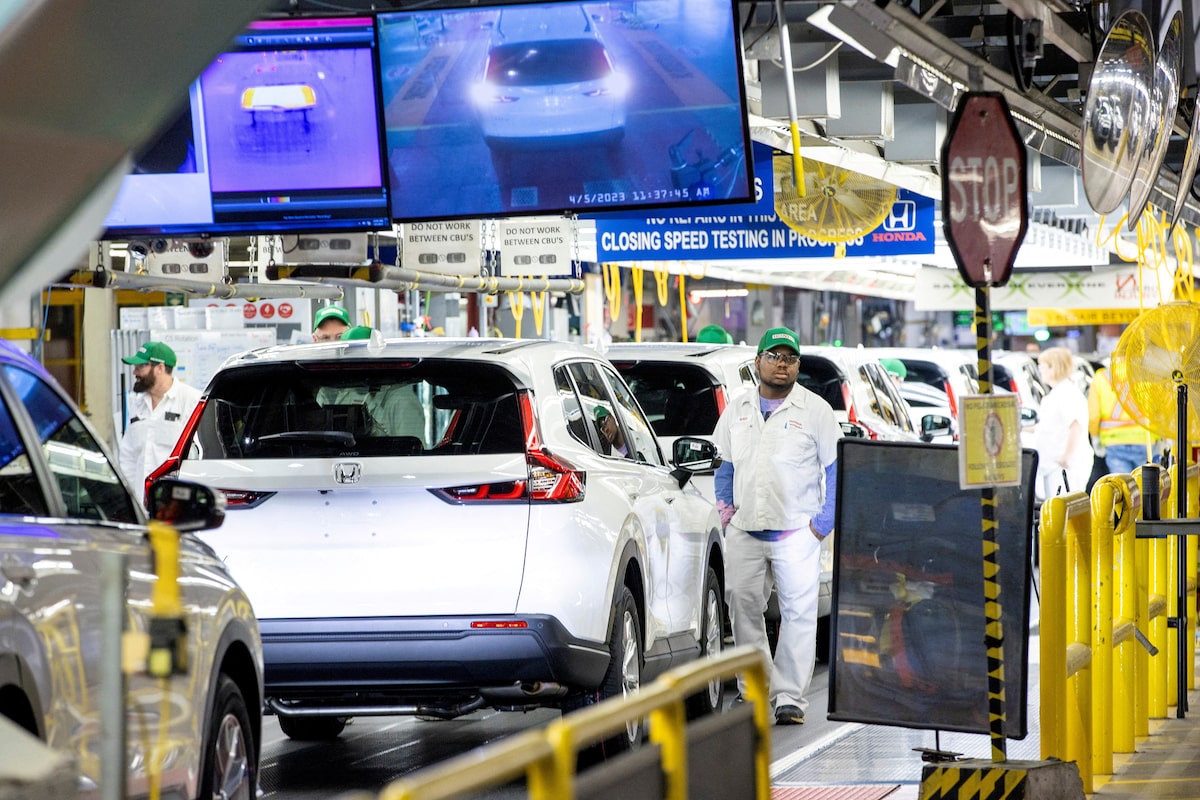
Honda’s auto manufacturing plant in Alliston, Ont. The last time Canada went this route it helped land the Toyota and Honda plants that now account for the bulk of Canadian vehicle assembly.CARLOS OSORIO/Reuters
Prime Minister Mark Carney is counting on access to Canada’s automotive market being so appealing that he can leverage it to get foreign automakers to invest in manufacturing here – a tactic last used by this country in the 1980s.
That may not be the most obvious take-away from the new national automotive strategy released on Thursday, which is at once fairly comprehensive in its scope and somewhat half-cooked in its specific policy measures.
The biggest headline-grabber is the scrapping of electric-vehicle sales requirements put in place under Justin Trudeau, in favour of going back to tailpipe emissions standards, which industry generally prefers because they’re more flexible. Alongside the return of EV purchase rebates and promised new funds to improve charging infrastructure, it means more carrots and fewer sticks in the transition from gas-fuelled cars.
The strategy also reiterates Ottawa’s willingness to provide capital subsidies for vehicle assembly plants and parts manufacturers, which it has long done, with a promise of up to $3.1-billion.
But in terms of industrial policy, the strategy’s biggest swing comes with a pair of attempts to directly tie domestic sales to domestic production: leveraging how tariffs on imported vehicles are applied, and making the EV purchase rebates more widely available for Canadian-made cars.
The starting premise underlying these new plans is hard to deny.
Opinion: How Canada’s auto sector can survive its terrible, no-good, very bad year
For decades, one of the draws for automakers to be in Canada has been access to the giant U.S. market, where the vast majority of cars assembled here have been sent. With that access now imperilled by President Donald Trump’s punitive trade measures, Mr. Carney wants to make the Canadian market a bigger reason to be here.
But it’s been a long time since anyone tested whether that market – usually around the eighth-largest among all countries for sales of new vehicles – is big enough to itself be a draw for manufacturing. And there are lots of questions, coming out of the announcement, about how aggressively the government will now attempt that sort of leverage, and how willing it will be to risk escalating trade tensions in the process.
Of the two new build-where-you-sell policies, the rebate provision is the more straightforward.
As under a previous program, which expired last year, Ottawa will cover up to $5,000 of an EV purchase, and in this case half that much for a plug-in hybrid.
The big wrinkle this time is that the rebate will only be available for vehicles with a sticker price of less than $50,000 – which, as of now, would rule out a lot of EV models – unless those cars are made in Canada. (The new version also explicitly rules out the rebates going to any models produced in a country with which Canada doesn’t have a free-trade agreement, but that mostly seems aimed at not subsidizing 49,000 EVs that Ottawa has agreed to allow from China.)
It’s not clear how “made in Canada” will be defined, exactly – whether it will apply just to assembly, or also to components.
Whatever the specifics, it’s unlikely that a discount of less than 10 per cent of purchase prices will alone be enough to attract a wave of high-end EV manufacturing, which doesn’t really exist here at the moment. That’s especially the case because, per the announcement, the rebates will decline over a five-year period, to just a maximum of $2,000 by 2030.
But that policy could theoretically work in tandem with the tariff-related policy, known as duty remissions – which is where things get really ambitious, and really complicated.
The basic idea is that tariffs are placed on cars made by automakers in other countries, but those tariffs are reduced in direct correlation with investments by those companies in making cars here.
The last time Canada went this route, with Japan four decades ago, it helped land the Toyota and Honda plants that now account for the bulk of Canadian vehicle assembly.
Now, it will seemingly be geared mostly toward exporters from the U.S., who are subject to the countertariffs imposed by Canada because of Mr. Trump’s actions.
Carney reinstates EV buyer incentives, scraps sales mandate
Those countertariffs already involve a modest version of duty remissions, in which companies that maintain their existing manufacturing operations in Ontario get corresponding exemptions. The new plan is to scale them up, to try to get new manufacturing investments here as well.
Whether the mechanism will also be used in relation to overseas automakers wasn’t made explicit on Thursday. Conceivably, Ottawa could deploy it with China, to try to get investments here in return for further opening up to Chinese exports, or even other automaking countries such as South Korea. (That seems more unlikely since it would first require new tariffs on a relatively friendly country, and Korean companies might be affected anyway by currently having a large manufacturing footprint in the U.S. but not Canada.)
Regardless of how widely the scheme is aimed, the government has set itself up with some serious design challenges – and not just relatively basic ones, such as how much to factor in Canadian-made components, as opposed to just assembly.
Part of the plan is to provide extra incentive by allowing automakers that robustly invest in Canadian production to sell credits to companies that haven’t done so, but still want to import here.
That sort of system can take years to figure out. But the government doesn’t have years, if this is meant to help counterbalance Mr. Trump’s toll on the industry. And the last thing the Canadian sector needs, right now, is even more lingering policy uncertainty atop Mr. Trump’s chaos.
That’s also a danger with some of the other measures in the new strategy.
The plan to begin imposing the new tailpipe rules in 2027 is one example. Previously, Canada simply adopted U.S. pollution limits. Because Mr. Trump is gutting those, Mr. Carney is now promising that Ottawa will develop its own. It will now be under the gun to do so in a matter of months.
But on that front, at least, there are recent models to draw from – ambitious U.S. regulations put in place under Joe Biden, and European versions – and recent evidence of how they play.
Drawing a direct line between building and selling in Canada is a different undertaking, which Ottawa wouldn’t even have considered re-embracing a few years ago.
“In a strong domestic market – and we have a strong domestic market – we can buy what we build,” Mr. Carney said Thursday.
He has a lot of work to do before putting his (or at least Canadians’) money on that bet – and finding out whether foreign capital follows.