
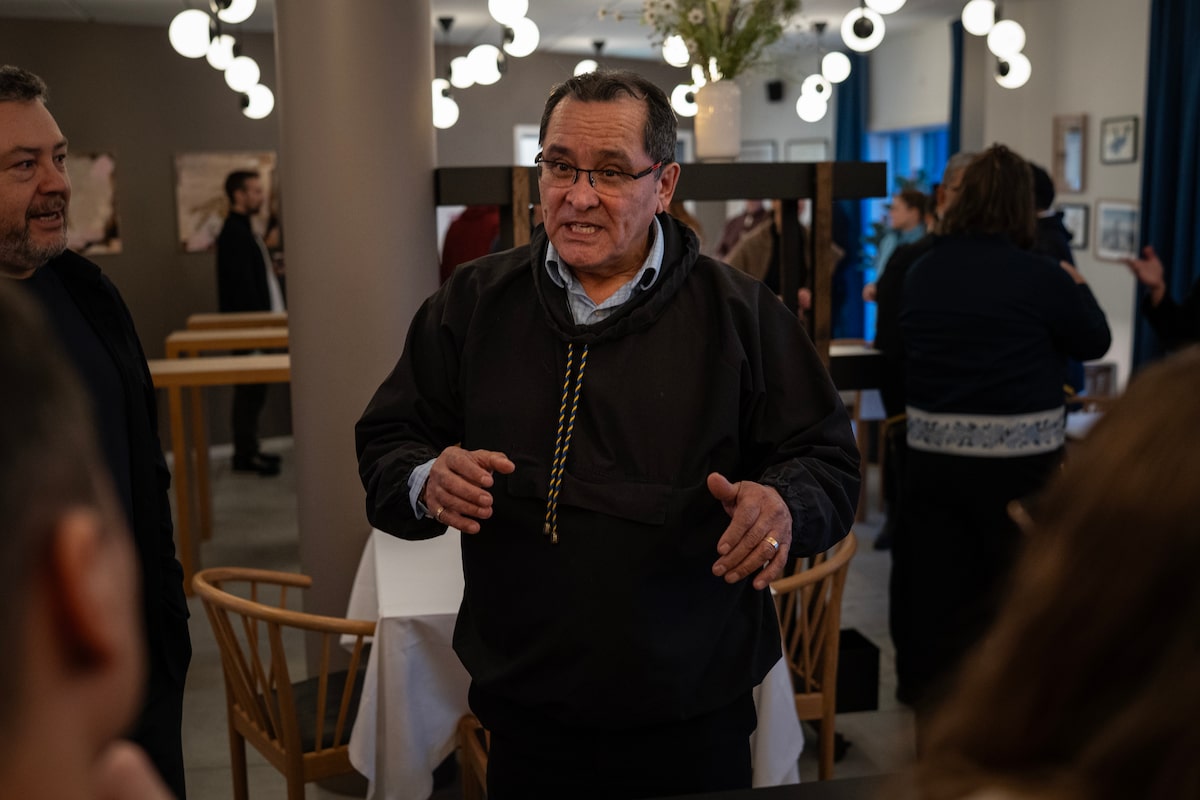
Pita Atami talks to a delegation of Canadian and Greenlandic Inuit leaders in Nuuk on Thursday.Siegfried Modola/The Globe and Mail
More than 70 Inuit leaders from across Canada have arrived in Nuuk to show their solidarity with Greenlanders in their battle with U.S. President Donald Trump and join Governor-General Mary Simon in opening a Canadian consulate.
The trip was organized in a matter of days by Pita Aatami, president of Makivvik, a political organization that represents the Inuit of Nunavik in northern Quebec. He came up with the idea after chatting with friends about Greenland and the pressure coming from the U.S. President.
“We’re trying to tell the world that we are one people, that this is our home, and will always be our home,” said Mr. Aatami, who arrived in Nuuk Thursday dressed in a seal-skin parka he bought in Greenland 26 years ago. “We’ve been living here for thousands of years as Inuit, and people can’t just take over our country.”
He called Inuit groups from Labrador to the Western Arctic to gauge who was interested in flying with him to Nuuk. The response was overwhelming and 72 people signed up, covering all of the costs themselves. Even more wanted to come, Mr. Aatami said, but they didn’t have passports.
The group chartered a plane from Air Inuit, which is owned by Makivvik, and timed the trip to coincide with the opening of the Canadian consulate on Friday. Foreign Affairs Minister Anita Anand will also be on hand for the ceremony.
Who owns Greenland? All of us, and none of us, Inuit say
Natan Obed, president of Inuit Tapiriit Kanatami, an advocacy organization that represents Canadian Inuit, said it was critical to demonstrate to Mr. Trump that Inuit people from around the world stand with Greenland.
“Inuit society is one society across from Greenland, Canada, Alaska to the Chukotka region of Russia,” said Mr. Obed, who is among those who travelled to Nuuk. “This isn’t just a frozen wasteland. These are our homes.”
He’s hoping the consulate will help to further ties between Greenland and Canada. That could include greater economic co-operation and regular flights between Nuuk and Iqaluit.
The support from the Canadian Inuit has struck a chord with Greenlanders and Mr. Aatami’s delegation received a warm welcome.
“It’s just so extremely touching and moving that they have decided to come over,” said Sara Olsvig, an Inuit leader in Greenland who is also chair of the Inuit Circumpolar Council, which represents Inuit in Canada, Greenland, Alaska and Russia. “And I think it’s typical Inuit. You know, we show up for each other, and we can act quickly, adapt quickly and organize quickly.”
A large traditional Inuit mural on an apartment block in Nuuk, Greenland.Siegfried Modola/The Globe and Mail
Ms. Olsvig added that the new consulate and the visit from the Governor-General, who is an Inuk from Nunavik, were significant signals. “It’s just extremely important that Inuit strengthen and keep maintaining our unity and we stand in solidarity with each other.”
Mr. Trump has backed away from talk of invading Greenland, but he has said the U.S. is negotiating a deal that could give it sovereignty over sections of Greenland and open the door for American companies to exploit the island’s resources. The Prime Ministers of Denmark and Greenland have said that while they were open to closer ties with the U.S., especially on security matters, sovereignty was not up for discussion.
Naaja Nathanielsen, Greenland’s Minister of Trade, Natural Resources, Justice, Energy and Gender Equality, said the threat from Mr. Trump had not gone away and that Greenlanders remained anxious.
“The world order has changed,” she said in an interview Thursday. “As Indigenous communities, we’re sort of used to adapting to changing conditions and shifts in politics that affects us, and this is one of these times.”
She added that she felt “really humbled” that Mr. Aatami’s group had made the effort to come to Greenland. “It’s just amazing and it adds so much to the opening of the consulate.”
Several European and NATO leaders have also expressed strong support for Greenland and Denmark.
This week, the French government opened a consulate in Nuuk even though there are only six French citizens on the island. French Foreign Minister Jean-Noël Poirier said the diplomatic post was an important political statement “to demonstrate our commitment to strengthening our presence”.
Activist Najannguaq Hegelund runs a non-profit organization called Sila 360, which works with Inuit women who have been forced to give up their children.Siegfried Modola/The Globe and Mail
Najannguaq Hegelund, an Inuit rights activist in Nuuk, said the show of support from Canada was especially meaningful because many Greenlandic people look to Canadian Inuit for leadership on topics related to decolonization.
Canadian First Nations have raised issues such as residential schools and discrimination for years while Denmark has only recently begun to address its dark history of colonization in Greenland, which included forced contraception of teenage girls, marginalization of Inuit culture and the removal of Inuit children from their families.
“We have looked a lot towards Canada and see how they have been dealing with things, and that has helped us to put into words how this systemic discrimination and racism works,” said Ms. Hegelund, who runs an organization for Greenland Inuit legal rights called Sila 360.
“One of the things that I’ve taken from [Canadian Inuit] is that we are good enough, that we are not wrong. We shouldn’t just be content with how things are, that we are able to change things and demand justice and equality and equity.”