
Unlock the White House Watch newsletter for free
Your guide to what Trump’s second term means for Washington, business and the world
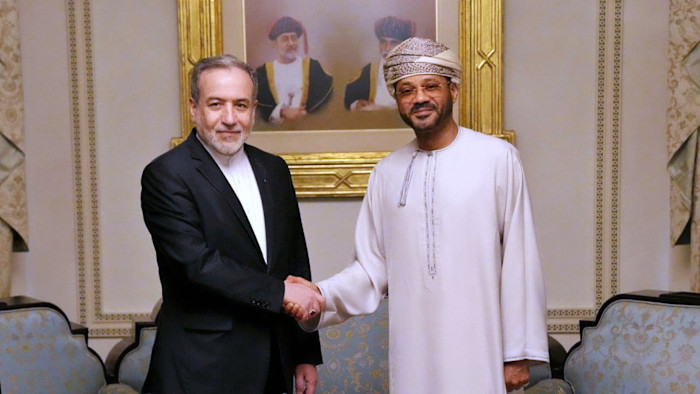
Iran’s top diplomat said negotiations with the US got off to a “good start” after concluding an initial round of indirect talks in Oman, as part of a diplomatic push to avert a new war between the arch enemies.
Iranian foreign minister Abbas Araghchi said the two delegations would consult their respective capitals before holding another round of the indirect discussions at a future date.
“It was a good start, and it can continue depending on the other party and the decisions made in Tehran,” Araghchi told Iranian state television after the discussions in Muscat on Friday. He added that the timing and format of the next round had yet to be determined.
Oman’s foreign minister Badr bin Hamad al-Busaidi, who facilitated the talks between Araghchi and US envoys Steve Witkoff and Jared Kushner, described the discussions as “very serious”.
“It was useful to clarify both Iranian and American thinking and identify areas for possible progress,” Busaidi said in a post on X. “We aim to reconvene in due course.”
There was no immediate readout from the US delegation.
The talks come as US President Donald Trump weighs military options against Iran. He has deployed an aircraft carrier strike group, fighter jets and air defences to the region after the Islamic regime brutally cracked down on nationwide protests.
The talks are the first since the two sides held multiple rounds of negotiations in Oman last year over the Islamic republic’s nuclear programme. Those ended after the US briefly joined Israel’s 12-day war — launched 48 hours before a sixth round of talks was due — against Iran in June last year to bomb its main nuclear facilities.
Analysts say the diplomatic effort faces huge challenges if it is to secure a deal between two adversaries with immense distrust for each other and diverging views on what should be discussed.
The Trump administration has insisted that Tehran agree to permanently halt its uranium enrichment programme, accept curbs on its ballistic missile arsenal and end support for regional militant groups such as Hizbollah in Lebanon and Houthi rebels in Yemen.
But Iran is adamant that the talks focus solely on the nuclear issue, while saying that it would not accept an end to its enrichment programme. It argues it has a right to enrich uranium as a signatory to the non-proliferation treaty.
It has also said its missile programme is not up for negotiation.
The challenges were apparent this week, when Iran sought to move the talks to Oman from Turkey, which had been set to host the negotiations. It also pushed back against the involvement of regional states, which had previously been expected to attend as observers.
Tehran is at its most vulnerable point in years as it faces an unprecedented confluence of intensifying domestic and international pressures.
Israel severely depleted its air defences and assassinated military commanders and nuclear scientists during its June war. Trump said Iran’s nuclear programme was “obliterated” by the US’s strikes, but this week claimed the Islamic republic was “thinking about starting a new site in a different part of the country”.
“We found out about it. I said, ‘You do that, we’re going to do . . . very bad things to you’,” he said.
Recommended

Iran is also reeling from the most violent and deadliest civil unrest since the 1979 Islamic revolution after demonstrations over soaring prices erupted in December and then morphed into mass anti-regime protests.
Tehran said more than 3,000 people were killed, including hundreds of members of the security forces. The US-based Human Rights Activists News Agency puts the confirmed toll at almost 7,000, while opposition groups abroad claim the number runs into the tens of thousands.
But Iran, which insists its nuclear programme is for civilian purposes, has sought to project defiance. Its officials have said that while Tehran is willing to seek a diplomatic end to the crisis, it is also prepared for war.
“The deep mistrust formed during eight turbulent months after the 12-day war, compounding earlier mistrust, poses a major challenge to the talks,” Araghchi told Iranian state television. “We must first overcome this.”