
Another political earthquake rocked New Jersey politics Thursday night — one with national implications.
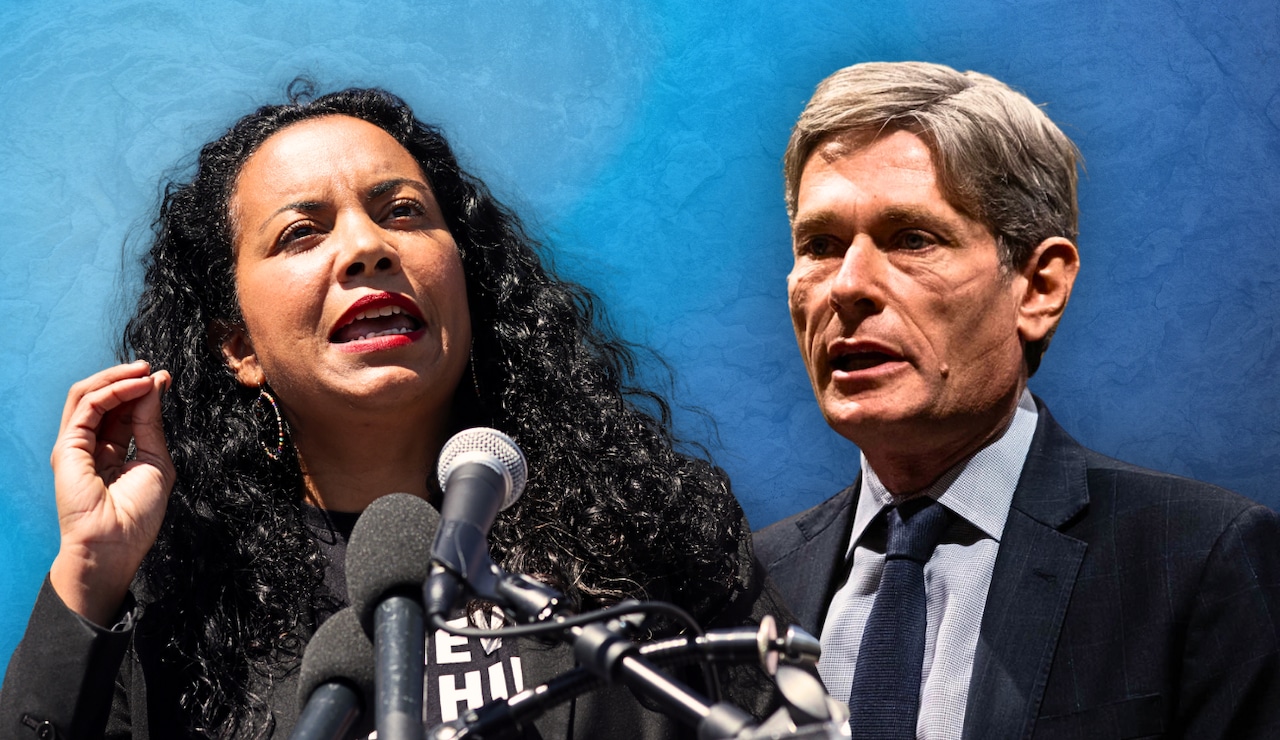
The already crowded and wild special Democratic primary election to fill Gov. Mikie Sherrill’s old U.S. House seat turned into a stunning nail-biter. As of Friday morning, the race remained too close to call, with progressive advocate Analilia Mejia leading U.S. Rep. Tom Malinowski by only a few hundred votes.
The election was widely seen as unpredictable, though many considered Malinowski to be the favorite among the 11 candidates tangling for the Democratic nomination in North Jersey’s 11th District. The relatively mainstream Democrat is seeking to return to Congress after being ousted four years ago in a different district.
And two other candidates — former Lt. Gov. Tahesha Way and Essex County Commissioner Brendan Gill — had big money and party support behind them. Way was former Gov. Phil Murphy’s second-in-command, and Gill had Murphy’s endorsement. Yet both were far behind Malinowski and Mejia with 93% of the votes counted.
Mejia, a grassroots organizer who helped run Bernie Sanders’ 2020 presidential bid in the state, was expected to be among the four top contenders. But with less funding and name ID and a more left-leaning platform, Mejia winning would be a major upset in the largely suburban district. The 11th is spread across parts of Essex, Morris and Passaic counties — a once-red area that’s gotten progressively bluer in recent years.
“The insiders got smoked,” said Matt Hale, a political science professor at Seton Hall University in South Orange, which is part of the district. “Tom Malinowski is an outsider to the district and Analilia Mejia is on the outside left wing of the party. The insiders, Tanesha Way and Brendan Gill, just seemed to fall flat.
“It was a tough day for establishment Democrats.”
Several media outlets and political prognosticators even called the race for Malinowski about an hour after polls closed after he jumped out to a healthy lead in early voting. Then, in a rarity, they retracted their calls a few hours later.
The Associated Press had still not called the race as of 5 p.m. Friday., with Mejia leading by just under 700 votes.
Mejia appeared to declare herself the winner just before 1 a.m. Friday, saying in a video on social media that she was “excited to say we have delivered people-power victory.”
“I do think that we have emerged victorious,” Mejia said during media availability Friday morning in Montclair.
“Here’s the bottom line: Every vote has to be counted,” she also said. “Here’s the other truth: We left everything on the ground.”
Malinowski has yet to concede. Campaign manager Kaylie Haberstroh told NJ Advance Media on Friday morning that he did not declare victory “because we knew a significant number” of ballots remained.
“Every vote deserves to be counted,” Haberstroh said.
The winner will face off in April’s general election against Randolph Mayor Joe Hathaway, who ran unopposed for the Republican nod. Conventional wisdom says the Dem nominee is the favorite because of the district’s blue tilt.
The prospect of a Mejia victory is garnering national attention. It raises the question of whether this is the latest Mamdani-sized example of how the Democratic Party’s progressive wing is surging in the age of Donald Trump pushback. The nail-biter has added even more intrigue to an election cycle in which Democrats will try to win back control of Congress in Trump’s midterms.
“What Analilia has done is historic,” said Antoinette Miles, the state director of the New Jersey Working Families Party, where Mejia once worked. “This is sending a message not only in New Jersey, but throughout the country, that the electorate wants something different.”
The race is also another sign of major cracks in Jersey’s famously machine-oriented politics, propelled for decades by a now-defunct primary ballot system that helped keep incumbents and party leaders in power.
Steve Kornacki, the NBC political analyst and former New Jersey political reporter, wrote on X: “What is happening in NJ-11 tonight feels momentous.”
“The state has long been dominated by a throwback political culture, particularly on the Democratic side, but there has been upheaval in the last few years as the party’s increasingly activist/professional class base has been in revolt,” he continued.
The first big blow to establishment Democrats in New Jersey came two years ago when then-Congressman Andy Kim launched an insurgent bid to replace indicted Democratic U.S. Sen. Robert Menendez.
The Democratic primary pitted Kim against then-First Lady Tammy Murphy. The governor’s wife had the backing of many top Democrats, the power of her husband’s office and the benefit of the “county line” — a unique and controversial system in Jersey politics in which party-endorsed candidates received choice primary ballot placement.
But Kim became a progressive darling who railed against a system he said built and protected Menendez. He successfully sued to take down the “line” ballot design. Shortly before the decision, Tammy Murphy dropped out of the race, and Kim not only won the Senate seat but solidified himself as a rising blue star.
A similar movement happened across the Hudson River last year as Zohran Mamdani, a self-described democratic socialist, surprisingly became New York City’s mayor over former Gov. Andrew Cuomo.
There were also party-divided undertones to last year’s New Jersey gubernatorial race, as Newark Mayor Ras Baraka finished a surprising second to Sherrill, a more moderate Dem, in the primary.
In Thursday’s race, Malinowski had the endorsement of the county party in Morris, Way had the same in Passaic, and Gill in Essex. Mejia had with no county support, though she was endorsed by Sanders and other progressive members of Congress, including U.S. Rep. Alexandria Ocasio-Cortez and U.S. Sen. Elizabeth Warren.
Gill said Friday he called Mejia to “congratulate her on her victory” and announce he “proudly” endorses her.
“Analilia ran a powerful, people-driven campaign that energized voters and built a movement rooted in opportunity, fairness, and community,” he said.
The shocking result isn’t as simple as liberals against the establishment since Malinowski also has progressive credentials — including Kim’s endorsement — and has sometimes clashed with party leaders. This was also a special election in one congressional district on a frigid day in February when Jersey had the political world largely to itself.
After all, Sherrill — praised for a strong bio and appeal to a broad array of voters — did easily win the Democratic nomination for governor last year over Baraka.
A statewide race would’ve been a tougher electorate for progressives, according to Micah Rasmussen, director of the Rebovich Institute for New Jersey Politics at Rider University and a former press secretary to former Democratic Gov. Jim McGreevey.
Even so, “the machine is in a pickle,” Rasmussen said.
“It has lost the ability to screen and narrow down a field of 11 candidates, and when that happens, you can get surprising, unpredictable results,” he added.
The county line’s demise means “voters who actually show up get to decide now,” Rasmussen said. “Voters will respond to the moment in front of them, not necessarily the long view of maintaining a party’s majority status.”
Hale, the Seton Hall professor, noted the robust turnout. Mejia said her team made tens of thousands of phone calls and door-knocks.
“More Democrats voted in this short, weird, weather-influenced Thursday primary than in the 2024 primary,” he said. “That means Democrats are pretty engaged.”
Mejia may have gobbled up support from left-leaning voters while more moderate candidates split the vote.
“That did present a fracture that typically is not typical in New Jersey politics, right?” Miles said. “Because the progressives were united in this race, and moved all of our manpower into the field, that was a key part of really pushing this forward.”
Patrick Murray, a veteran pollster who runs StimSight Research, said there was “an underestimation of Mejia, driven largely by the misunderstanding of the Democratic primary electorate in the special” election.
”There’s the sense that Dems who live in Republican areas are more moderate, when it’s actually the opposite,” he added. “They tend to be more progressives, because they live in Republican areas.”
And he stressed that Democratic voters may have seen Mejia as more of a “Trump fighter.”
“It’s not about liberal and moderate,” Murray said. “It’s about authentically taking on Trump. That’s what won the day here.”
The rise in attention over ICE was also a “huge, motivating” factor, Rasmussen said. People in the district saw ICE raids taking place in their own backyard, like in Morristown, according to Miles.
Then there’s the effect of the American Israel Public Affairs Committee, which poured about $2 million into the race to attack Malinowski through its super PAC, United Democracy Project. Although it appears AIPAC was trying to boost Way, it may have unintentionally lifted Mejia, arguably more liberal than Malinowski.
“The outcome in NJ-11 was an anticipated possibility, and our focus remains on who will serve the next full term in Congress,” a spokesperson for the group said Friday morning. “UDP will be closely monitoring dozens of primary races, including the June NJ-11 primary, to help ensure pro-Israel candidates are elected to Congress.”
AIPAC’s effect has drawn the ire of centrist Democrats. And Mejia on Friday accused the group of “frankly disgusting tactics” in terms of “misinformation and flooding the zone“ to attack Malinowski.
Regardless of whether Mejia or Malinowski beats Hathaway in April, the winner will serve only the final months of Sherrill’s unexpired term. There will be another primary in June and general election in November for a full two-year term in the House. And the question is whether June’s Democratic battle will be another hotly contested one — especially if AIPAC gets involved again.
One party insider summed up Thursday this way: “Analilia outmuscled and outflanked everyone, drove a stake through the establishment.
“I don’t know what it means for the general, but the Democratic establishment was just put on notice. They delivered a clear message that the party wants change.”