
On the Metro to the stadium, it starts again. Every Six Nations is a captivating tale because you never know how it will unfold, because every one tells a different story every time.
This one begins on the commute. What does a Six Nations Thursday night feel like? Well, it feels like that, like a commute. There is a post-work quiet, no one sings, no one, apparently, has had a long lunch or a conveniently short day, and that vast horde of travelling Irish? They have apparently decided that two days off work was too much for this one. But for tell-tale blue under heavy winter coats, you might have been on the wrong train.
It’s less “Allez les Bleus”, more “Où sont les Bleus?” The answer: they’re here all right. Oh yes, they can’t get out of the blocks fast enough.
We’re barely three minutes in and Yoram Moefana has gone through two Irishmen, given the offload and Louis Bielle-Biarrey has done his extraordinary fine balancing-act thing, tip-toeing at sprinter’s speed down the touchline, finishing with a delicate chip ahead that Charles Ollivon should have scored from but can’t quite hold.

Bielle-Biarrey scored twice as France dismantled Ireland, but the home side did not need to be clinical in their endeavours, which is a worry for Farrell
ASHLEY WESTERN/COLORSPORT/SHUTTERSTOCK
That’s just your intro, just your glimpse, and though it revealed that this was to be a one-sided contest for athleticism and technique, it also showed that France weren’t ruthless. That wasn’t the only five points they couldn’t quite finish.
They had the Irish down on the canvas in the 28th minute, already 12-0 behind and struggling to keep a grip on tackles and self-belief, but rather than apply a killer-blow kick to the corner, they took the three. This is Ireland, at least that was the French thinking — there might still be remnants of a world No1 side in there.
And all this was without France plundering the expected area of Irish weakness, the scrum. Oh, and it was a wet night. For that remnant of a world No1 side, it could have been worse.
What happened to that side? The British & Irish Lions tour is one thing that happened, an event that we are still rereading, re-interpreting and second-guessing five months on.
The Lions squad picked for Australia was so heavily Irish it had appeared as if set up as a dry run for the World Cup there two years later, to give it crucial experience, to have players return emboldened, to have its coaches — for the coaching team were largely green too — smarter and their ideas fresher. That’s not to say this was the intention (God forfend), but it had seemed a likely outcome.
The Stade de France on a Thursday night was further evidence that, weirdly, it has gone the other way. Did it harm Ireland to be without Andy Farrell, the head coach, for so long? And if it’s a largely familiar Irish coaching team with the Lions, where are the learning opportunities? Maybe the learning opportunities are for the few non-Irish recruits to sponge from them.
From every Lions tour, there are players who step forward, who announce themselves as among the world’s elite. In Australia, no one made this point more clearly than Ellis Genge. Will Stuart too. Of the Irishmen, Josh van der Flier didn’t get a sniff of the Test team; we saw that we were in the dying embers of Bundee Aki’s international career; James Lowe’s may even now have been ended.

Farrell’s Lions squad was full of Irish players, including Aki, with 16 of his regular charges picked for the tour
DAVID ROGERS/GETTY IMAGES
If you rub up alongside other international players for so long, whether consciously or not, you return home having reappraised. No doubt you return with new friendships, maybe renewed respect, but, from that tour, not a sense that the Irish were anything other than their equals.
Meanwhile, England were in Argentina, starting new international careers and burnishing the reputations of others who might, under different selectors, have been Lions instead.
It is in places like the Stade de France, when the French are so rampant that they are asking really demanding questions, not just of ability but your belief and fortitude, that some of all of this is stripped bare.
There was a period towards the end of the first half — a catalogue of backfiring Irish uncertainty — that seemed to reveal all. Joe McCarthy cannot hold a pass; Jacob Stockdale is wrapped up by his opposite man; Sam Prendergast, searching for answers, knocks through a delicate chip with the intention of relieving the pressure. But the French recycle Prendergast’s kick and are then off en route to try No3.
All of this is an Ireland reacting and not reacting well, but feeling a French power and intensity that seems insurmountable. Of course in here is the fact that Ireland have had a number of injuries, but where are the remnants of that No1 side, the innate confidence and self-belief that says: we can deal with this?
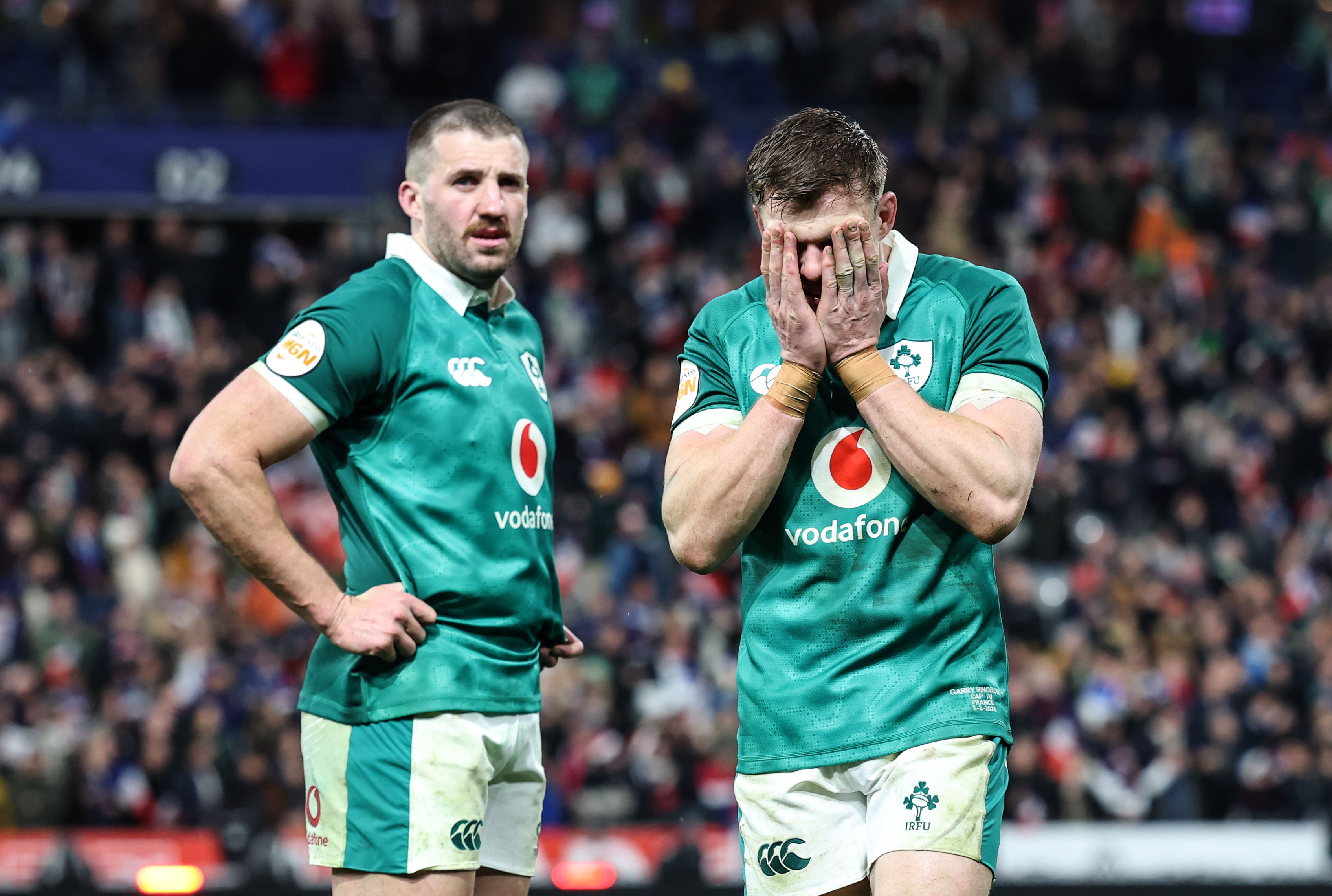
Stuart McCloskey, Garry Ringrose and their Ireland team-mates looked shellshocked after the drubbing
INPHO
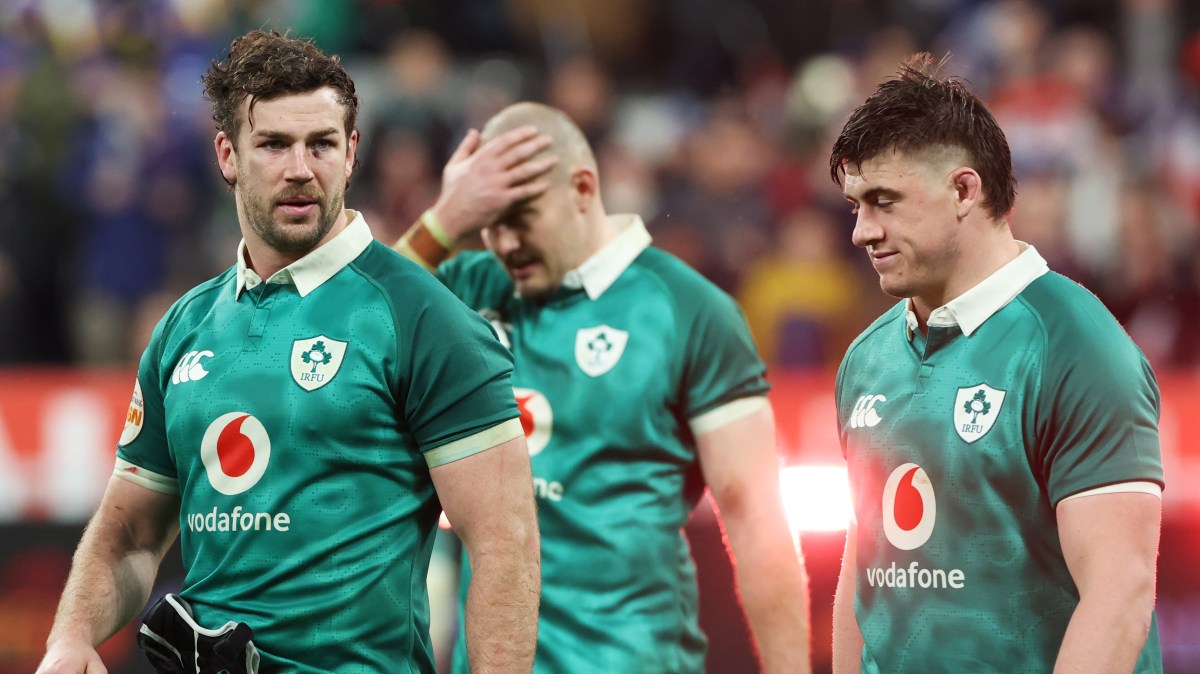
Rarely, if ever, do you see Farrell as downbeat and shaken as he was after this. His disappointment afterwards centred on the “lack of intent” and he said that that’s “something I never thought we’d be saying about this Irish team”.
Indeed, it’s something we never thought we’d be saying about an Andy Farrell team. Yet there are limitations to what even Farrell can do. Intent can be stoked by rousing leadership and an upliftingly motivational environment, but it’s skin deep if not rooted in self-belief.
This is now Farrell’s challenge. It appears that he has mistimed the regeneration of his Ireland team, that he has moved too late to replenish. He now has to rebuild the faith of players who are on the wrong side of their best; they have either gone past it or they are yet to get there. And it is far easier to replenish a team that is top of the world than one that is wondering how fast it is slipping.
Of course, Ireland’s misfortune was to have France ramming this message home. Yet you come away from the French performance mesmerised not only by the shuddering excellence that they held together for 50 minutes but also their potential.
Read more from France v Ireland
What happens if they hold it together for more than 50 minutes? Where does Antoine Dupont’s partnership with Matthieu Jalibert go now, because this was just a taster and Jalibert only slowly came to understand how he could impose his deliciously gifted game on the outcome?
And what fury can the young lock/back-row forward Mickaël Guillard unleash now that he has in his muscle memory the experience and confidence of laying waste to Ireland?
It is hardly as if France needed another huge, fast, powerful ball-playing forward. For 50 minutes, Guillard and his confrères forced Ireland to look deep into their souls and understand the limitations of what they found there. It’s a tough championship when you’ve been dismantled on day one.
The Ruck Podcast: LiveDon’t miss tough tacklers Courtney Lawes and Serge Betsen on March 9 as they compare notes on France v England and the biggest moments of this year’s Six Nations at Twickenham Stoop. Book tickets here