
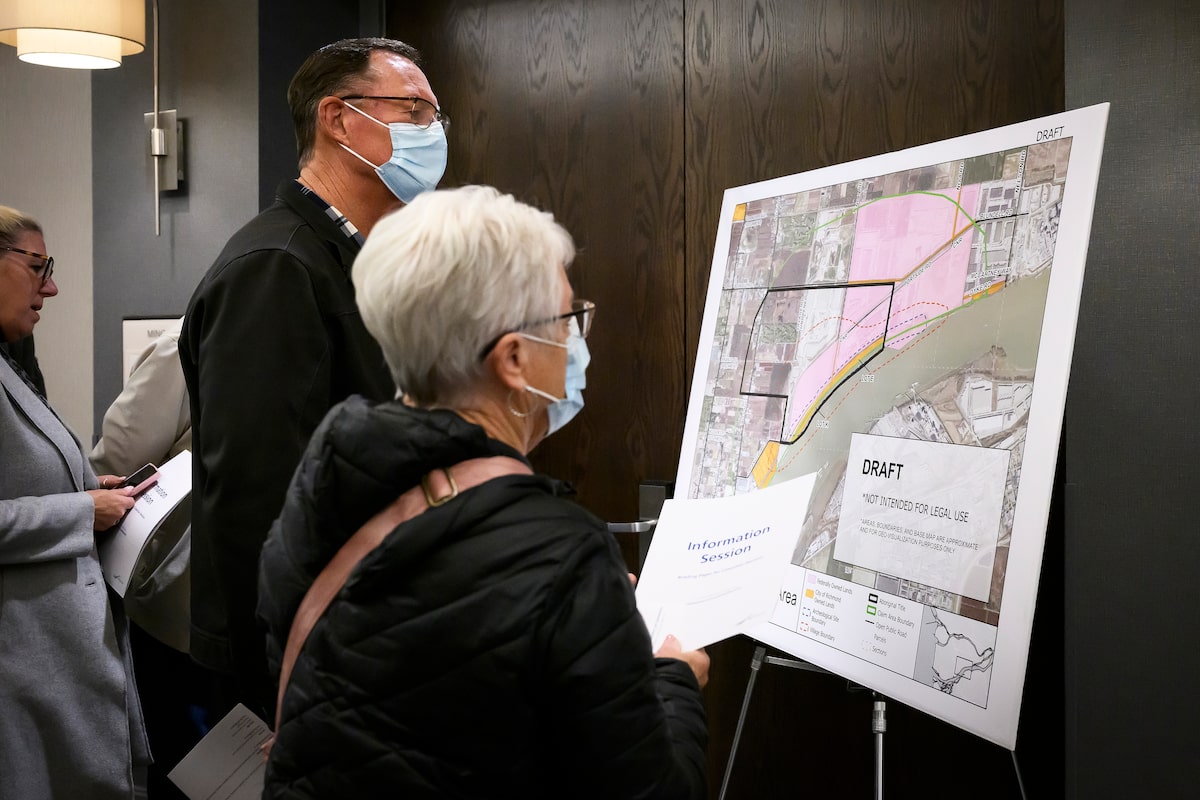
City of Richmond residents look at a map of the Cowichan land title area provided by the city of during an information session in October, 2025.Jennifer Gauthier/The Globe and Mail
An Indigenous group on British Columbia’s central coast is claiming ownership of private lands in a case that relies on a groundbreaking court decision from last summer that opened the door to Aboriginal claims on private property.
The Dzawada’enuxw First Nation is seeking a court declaration that almost 650 hectares of fee simple lands around Kingcome Inlet are rather “Indian settlement lands” that should never have been pre-empted by settlers more than a century ago. (Fee simple lands have long been known in Canadian law as the highest form of private land ownership.)
Most of the land is in the hands of two owners: Major lumber producer Interfor Corp., and the non-profit Nature Trust of British Columbia.
Until last summer, Indigenous land claim settlements and court actions steered clear of privately owned property. But in a 863-page ruling made on Aug. 7, B.C. Supreme Court Justice Barbara Young recognized “Indian settlements lands” granted prior to Confederation, and declared that Aboriginal title is a senior interest in land above fee simple titles, which derive from Crown grants.
“In the wake of the Cowichan decision, the legal landscape has changed,” said Owen Stewart, a lawyer for the Dzawada’enuxw First Nation, also referred to as the DFN.
In their statement of claim, the Dzawada’enuxw say they were promised settlement lands at Kingcome Inlet in 1879 by the Indian Reservation Commissioner of the day, Gilbert Sproat. He was replaced a year later, and when the reserve lands were mapped out, the DFN found themselves with a much smaller portion.
Village settlements, prized orchards, gravesites and access to an estuary that provided valuable food supplies were taken by settlers, with the Indian Agent responsible for the nation’s well-being helping to secure lands for his brother and his brother-in-law.
Today those lands are uninhabited, save for roughly 100 members of the DFN who live on a reserve more than three kilometres from the mouth of the inlet.
B.C. plans $150-million in loan guarantees for private landowners in Cowichan title area
Interfor owns three lots in the claim area; the two larger ones are forested, while the third is an inactive log sort area. Meanwhile, the Nature Trust started assembling land to protect habitat in the Kingcome estuary in 1980. Its conservation area spans 484 hectares, which are home to migratory birds, five species of Pacific salmon, eulachon (a type of smelt) and mammals such as grizzly bears.
In their civil suit filed Jan. 26 in B.C. Supreme Court, the DFN say those lands were wrongly sold off through Crown land grants, and they are seeking a court declaration that would recognize the properties as their Indian settlement lands.
Officials for both Interfor and the Nature Trust say they are working with the Dzawada’enuxw to resolve the claim, and there is no active logging.
“Under federal and provincial law, NTBC holds these properties in trust and is legally required to conserve them in perpetuity,” Nature Trust’s chief executive officer Jasper Lament said in a written statement. “We will continue to engage with DFN to identify opportunities where we can work together to protect these lands.”
The Dzawada’enuxw’s fight for these lands spans generations.
In 1914, a royal commission heard the grievances of many First Nations in B.C., who argued that the Crown had not honoured commitments to protect them and the lands they occupied.
Country Meadows Golf Course, which falls within the boundaries of a Cowichan Nation Aboriginal title claim, in Richmond last August.DARRYL DYCK/The Canadian Press
Hereditary Chief Cesaholis testified on behalf of his people in Kingcome Inlet, describing how white settlers began building fences and driving his people off the lands where they had long harvested their primary food resources. Loggers came next, setting up camp beside a graveyard where the Indigenous community followed the Coast Salish tradition of tree burials, placing their deceased on high limbs.
“They commenced to clear that land by cutting those trees down where the dead were, and those trees fell on the ground, and many of them fell into the river, and the bodies of the dead on these trees were just floating about … some of them not a year old,” Chief Cesaholis told the commission.
B.C. Attorney-General Niki Sharma declined comment, saying the DFN case is before the courts. But before the Dzawada’enuxw case was filed, Premier David Eby warned that the precedents set by the Cowichan decision could undermine private property ownership in Canada.
“There are many examples across the province, and across the country, where Indigenous people were displaced from land illegally, wrongly, unjustly, where there are now fee simple property owners that operate businesses or live in homes,” Mr. Eby said last November. His government is appealing the Cowichan decision, saying private property rights must be protected.
His government is also supporting a bid by Montrose Properties, a private company, to reopen the Cowichan case.
Montrose Properties is arguing that its interests were not represented at trial. In its notice of application, Montrose points out that lawyers representing the government of Canada had asked the court to issue formal notice to private property owners that their interests could be affected by the case – but the court dismissed that pretrial application.
Now, the Montrose statement says, the court has saddled the company with co-ownership of its lands without a definition of what that means. Justice Young is set to hear arguments on Feb. 13.
The B.C. government is also seeking to overturn another court judgement, looking to curb the courts’ ability to move ahead of the legislature in implementing Indigenous rights. On Friday, the province filed an appeal to the Supreme Court of Canada on the Gitxaala ruling from the B.C. Court of Appeal – a ruling on mining policy with wide-reaching implications.
The court’s judgment establishes a new benchmark for the implementation of the UN Declaration on the Rights of Indigenous Peoples, which the province has enshrined in legislation. The court ruled that, with immediate effect, the province’s mineral claims regime is “inconsistent” with the requirements of that law.
The province argues that the judgement undermines the role of democratically elected legislatures “to retain authority over whether and to what extent UNDRIP is implemented into domestic law” and must be clarified.
“The declaration presents a gauntlet for the province,” the appeal states. “Given its ambiguity, the declaration is unlikely to produce a meeting of the minds on what the province must to do comply, while at the same time, the potential future consequences of alleged non-compliance are unknown.”
The province is also working in consultation with First Nations on amendments to its UNDRIP law, to be introduced in the spring legislative session that begins Feb. 12.