
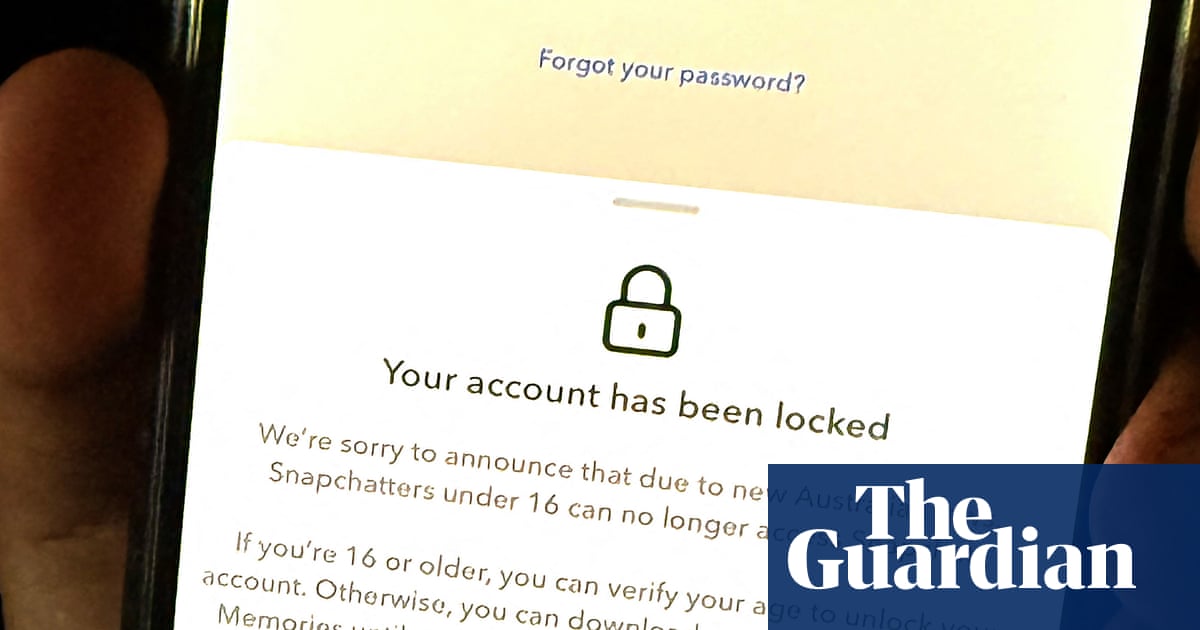
Before Australia’s age restriction rules for social media use came into effect, one of Indy’s hobbies was making fan videos of her favourite television shows and games to post on Instagram or TikTok.
The 14-year-old, who asked that her surname not be used, is autistic. While some young people were exposed to harmful content and bullying online, for Indy, social media was always a safe space. If she ever came across anything that felt unsafe, she says, she would ask her parents or sisters about it.
“I have autism and mental health things, it’s hard making friends in real life for me,” she says. “My online friends were easier because I can communicate in my own time and think about what I want to say. My social media was my main way of socialising and without it I feel like I’ve lost my friends.”
The timing of the new laws – which came into force on 10 December, right before the long summer school holidays – made things even more difficult, she says.
Sign up: AU Breaking News email
“I didn’t have all my friends’ phone numbers because we mostly talked on Snapchat and Instagram. When I lost everything I all of a sudden couldn’t talk to them at all, that’s made me feel very lonely and not connected,” she says.
“Being banned feels unfair because it takes away something that helped me cope, where I could be myself and feel like I had friends who liked me for being myself.”
The world-first laws requiring social media companies to ban the accounts of anyone under the age of 16 were introduced by the Albanese government following a sustained campaign by parents, psychologists, and child safety experts warning of the mental health impacts of those apps on children.
But despite the ban’s aim to protect young people, some advocates have warned that young people in marginalised communities or living with disabilities, like Indy, could lose vital support networks and be left feeling more isolated and vulnerable.
Advocacy group Children and Young People with Disability Australia (CYDA) says social media and the internet is “often a lifeline for young people with disability, providing one of the few truly accessible ways to build connections and find community”.
In a submission to the Senate inquiry around the laws, CYDA said social media was: “a place where young people can choose how they want to represent themselves and their disability and learn from others going through similar things”.
“It provides an avenue to experiment and find new opportunities and can help lessen the sting of loneliness,” the submission said. “Cutting off that access ignores the lived reality of thousands and risks isolating disabled youth from their peer networks and broader society.”
Isabella Choate , CEO of WA’s Youth Disability Network (YDAN), says they are concerned that young people with disability have been disproportionately affected by losing access to online communities. “Young people with disability are already isolated from community often do not have capacity to find alternative pathways to connection,” Choate says.
“Losing access to community with no practical plan for supporting young people has in fact not reduced the online risk of harm and has simultaneously increased risk for young people’s wellbeing.”
Ezra Sholl is a 15-year-old Victorian teenager and disability advocate. His accounts have not yet been shut down, but says if they were it would mean “losing access to a key part” of his social life.
Ezra Sholl, 15, and his mother, Natasha, interact with Ezra’s Instagram page. Ezra is a quadriplegic and relies on social media for connectivity and connection. Photograph: Christopher Hopkins/The Guardian
“As a teenager with a severe disability, social media gives me an avenue to connect with my friends and have access to communities with similar interests,” Ezra says.
“Having a severe disability can be isolating, social media makes me feel less alone.”
But he adds that many of his friends have also evaded the ban, either because their original account was not picked up in age verification sweeps or because they started a new one.
“Those that were asked to prove their age just did facial ID and passed, others weren’t asked at all and weren’t kicked off,” Ezra says.
‘We are trying to change the social norm’
Father of five Dany Elachi is the founder of the Heads Up Alliance, one of the parent-led groups which advocated for the ban. He says his primary aim over the five-year-long campaign was to educate parents about the harm that social media could cause their children.
“So the fact that this was a debate that was front and centre for over a year means that the message got through to every parent in the country, and from that perspective alone I count it as a win,” Elachi says. “What happens further from that is a bonus, we are trying to change the social norm and that takes years.”
Ideally, he says, a child’s exposure to online worlds should be moderated by their parents, just as parents moderate exposure to other potential harms.
“Ultimately we don’t want to have platforms policing what is going on, we just want parents themselves to say ‘this is not good for you’ to their twelve or thirteen year old children, and saying the new standard is that we don’t get on social media until we’re 16 – just like we don’t think twice about not giving cigarettes to kids any more or about not giving them alcohol to drink in early teens.”
In Australia, support is available at Beyond Blue on 1300 22 4636, Lifeline on 13 11 14, and at MensLine on 1300 789 978. In the UK, the charity Mind is available on 0300 123 3393 and Childline on 0800 1111. In the US, call or text Mental Health America at 988 or chat 988lifeline.org.