
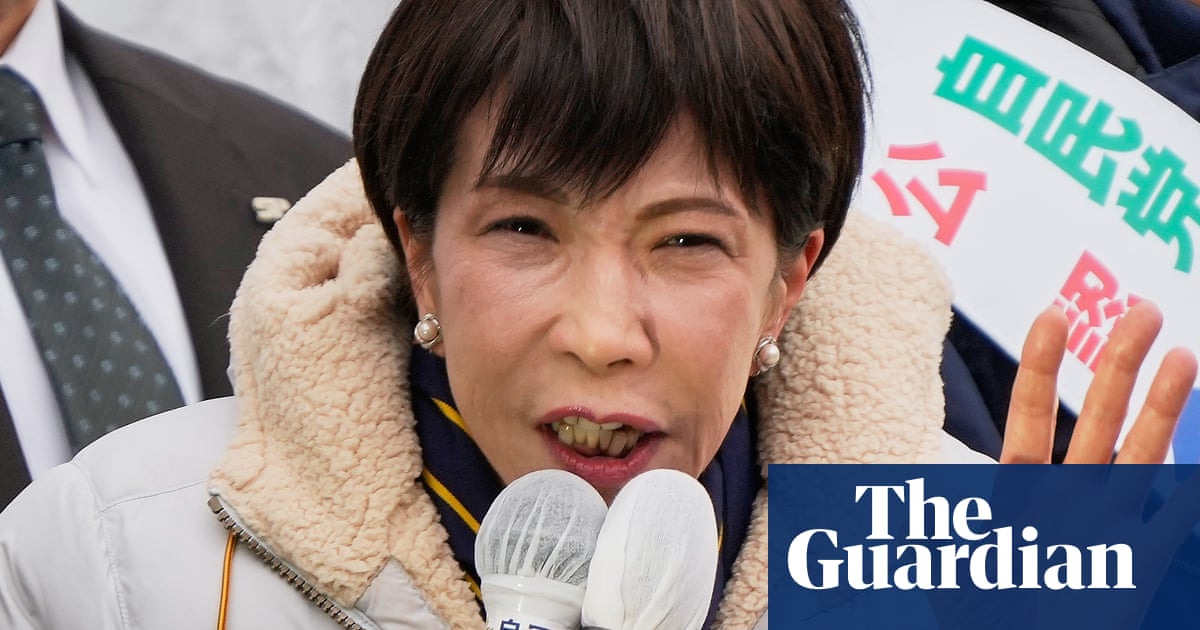
Japan’s conservative governing party is on course to dramatically strengthen its grip on power after exit polls predicted a landslide victory in Sunday’s lower house elections.
The Liberal Democratic party (LDP) was projected to win between 274 and 328 seats out of a total of 465, according to an exit poll by the public broadcaster NHK, well above the 233 it needed to regain the majority it lost in 2024. Combined with seats secured by its junior coalition partner, the Japan Innovation party, the parties could win between 302 and 366 seats, NHK added.
The elections for the lower house of Japan’s parliament, held on a freezing day when many parts of the country were again hit by heavy snow, will be seen as an early public endorsement of the new prime minister, Sanae Takaichi.
People queue up at a polling station in Kawasaki, Kanagawa prefecture. T Photograph: Yuichi Yamazaki/AFP/Getty Images
Takaichi, who called the snap election soon after becoming Japan’s first female prime minister last autumn, had vowed to resign if her coalition failed to secure a simple majority.
She will not have long to savour her party’s victory, however. There are concerns over her management of Japan’s public finances and her ability to defuse a bitter row with China over the future of Taiwan.
Takaichi sought to appeal to voters with a $135bn stimulus package aimed at easing the cost-of-living crisis, later promising to suspend the 8% consumption (sales) tax on food for two years – a ¥5tn ($30bn) hit to annual revenue.
Her spending plans have rattled financial markets and caused currency volatility, prompting some commentators to question her approach given that Japan’s debt is more than twice the size of its GDP – the heaviest debt burden of any advanced economy.
A voter at a polling station in Uonuma, Niigata prefecture. The elections took place on a freezing day when many parts of the country were hit by heavy snow. Photograph: Manami Yamada/Reuters
After a whirlwind introduction to diplomacy – including meetings with Donald Trump and Xi Jinping late last year – Takaichi sparked a row with Beijing in November when she suggested that Japan could become involved militarily in the event of a Chinese attempt to invade Taiwan.
China urged tourists not to visit Japan – advice they have heeded – and young people not to study there, citing “safety concerns”. The dispute has disrupted cultural exchanges, and even brought an end to decades of “panda diplomacy”.
Takaichi’s refusal to withdraw her remarks may have angered Beijing, but it has played well with many voters.
A woman walks past a panel of candidates near a polling station in Tokyo on Sunday Photograph: Yoshio Tsunoda/AFLO/Shutterstock
Margarita Estévez-Abe, an associate professor of political science at Syracuse University, said Sunday’s election victory could give Takaichi room to repair the damage to Sino-Japanese ties.
“Now she doesn’t have to worry about any elections until 2028, when the next upper house elections will take place,” Estévez-Abe said. “So the best scenario for Japan is that Takaichi kind of takes a deep breath and focuses on amending the relationship with China.”
But if she follows through with the consumption tax cut, the market reaction could be swift and hostile, according to some analysts.
If Takaichi won big, she would have more political room to follow through on key commitments, including on consumption-tax cuts,” said Seiji Inada, the managing director at the consultancy FGS Global. “Markets could react in the following days, and the yen could come under renewed pressure.”
A voter exits a polling station in Tokyo. The cold weather, which caused widespread disruption, is expected to contribute to a low turnout. Photograph: Franck Robichon/EPA
Blizzard conditions in some regions made visiting a polling station in Sunday’s election, the first held in mid-winter for 35 years, a test of endurance for many voters.
Kazushige Cho, a 54-year-old teacher, said he had been determined to vote for the LDP despite the atrocious weather. “She has shown strong leadership and pushes various policies forward,” Cho said outside a polling station in a small town in Niigata prefecture where the snow had reached a depth of more than 2 metres. “I think things could turn out quite well.”
The weather, which is expected to contribute to a low turnout, caused widespread disruption on Sunday, halting services on dozens of train lines and forcing the cancellation of 230 domestic flights, according to the transport ministry.
Turnout stood at 21.6% with four hours left before polls closed – 2.65 percentage points lower than at the same time in the 2024 lower house election, the Nikkei business newspaper said, citing the internal affairs ministry.
Takaichi’s personal popularity – particularly with younger voters – has transformed the LDP’s fortunes since winning the race to succeed Shigeru Ishiba as the party’s president in October.
Under Ishiba, the LDP and its then coalition partner Komeito lost their majorities in both houses of parliament amid public anger over a slush fund scandal and the rising cost of food and other basics.
The party, which has governed Japan for most of the past 70 years, was helped, as in previous elections, by a fractured and uninspiring opposition.
The main opposition Centrist Reform Alliance – formed weeks before by two existing parties – was expected to suffer heavy losses on Sunday, leaving questions hanging over its future.
The final count will not be known until late on Sunday. If the Takaichi-led coalition achieves an absolute majority of 261 seats, it will control parliamentary committees, making it easier to pass budget and other legislation.
A super-majority of 310 seats would allow the coalition to override the upper house, where the LDP-led alliance lost its majority in July last year.